Artwork
The German Painter Marcus Johann Heaselich
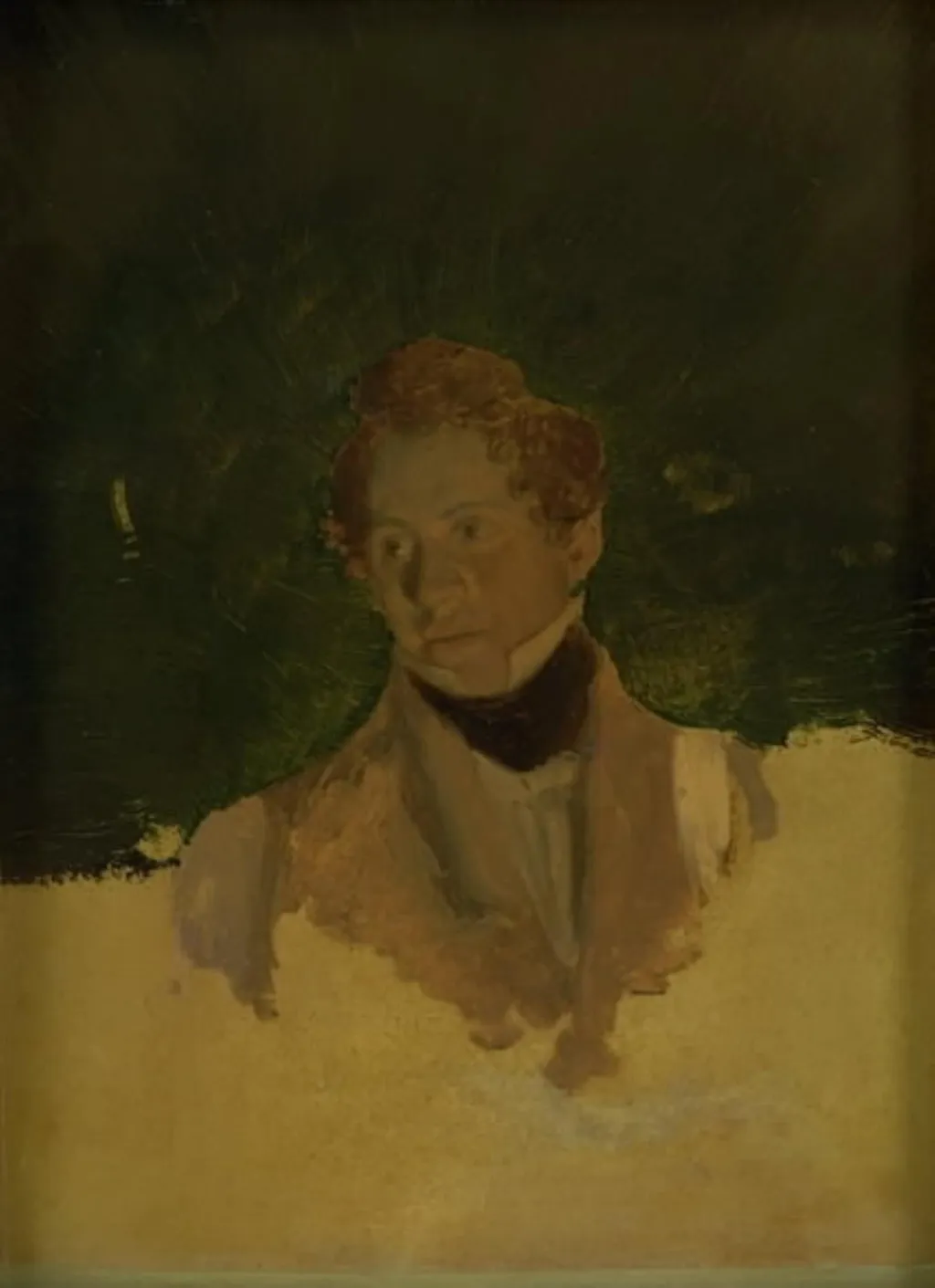
The German Painter Marcus Johann Heaselich is a photography by Unknown. It dates from 1831 and is held in the collection of the Statens Museum for Kunst. This image, dated around 1831, depicts Marcus Johann Heaselich, a German painter, seated outdoors in a candid moment.
About this work
Overview
The work is held by the Museum of Ethnography, where it functions as a record of an individual rather than a formal artistic commission.
This image, dated around 1831, depicts Marcus Johann Heaselich, a German painter, seated outdoors in a candid moment. Though labeled as a photograph, its soft focus, nuanced lighting, and tonal gradations resemble painted portraiture. The work is held by the Museum of Ethnography, where it functions as a record of an individual rather than a formal artistic commission. Its quiet atmosphere suggests an informal session, possibly taken during a break from studio work.
Subject & Meaning
Marcus Johann Heaselich is portrayed with a restrained expression, his slight frown and direct gaze conveying introspection rather than grandeur. Dressed in a dark coat and light trousers, he appears unadorned, emphasizing his identity as a working artist rather than a figure of social status. The setting, partially obscured by blurred greenery and a dim sky, removes context, focusing attention on his presence and demeanor as a private individual.
Technique & Style
The image employs subtle chiaroscuro, with gentle transitions between light and shadow that soften contours and lend depth without harsh contrast. The blurred background and diffused lighting reduce sharp detail, creating a painterly effect uncommon in early photography. This aesthetic choice aligns the work with contemporary painting traditions, suggesting the photographer sought to emulate the mood of portraiture rather than document with clinical precision.
History & Provenance
The work was created circa 1831, placing it among the earliest photographic experiments in Germany. It entered the collection of the Museum of Ethnography, where it is preserved as a cultural artifact rather than a fine art object. Its attribution to an unnamed photographer reflects the anonymity common in early photographic practice. The image’s survival suggests it was valued for its personal or documentary significance from an early date.
Context
In the early 1830s, photography was emerging as a new medium, often used to capture likenesses before the widespread availability of painted portraits. Heaselich’s image reflects this transitional moment: it is neither fully a painting nor a modern photograph. The informal setting and subdued tone mirror the domestic, introspective ideals of the period, contrasting with the public, ceremonial portraits typical of the era.
Legacy
The image stands as an early example of how photography began to absorb the visual language of painting, particularly in portraiture. Its preservation in an ethnographic museum highlights its role as a record of individual identity within a broader cultural shift. Though not widely known, it contributes to understanding how early photographers negotiated artistic tradition and technical novelty in capturing human presence.
Artist & collection

 Domestic Scene
 Giacomo and Cardinal Marco, investing Andrea, Abbot of San Zeno, with his Benefice
 The Nymph of Fontainebleau
 Portrait of a Woman
 Madonna and Child with Saints in the Enclosed Garden
 Venus and Minerva
 Family Group of Four on Sofa
 Wall painting from Room H of the Villa of P. Fannius Synistor at Boscoreale
 Portrait of a gentleman, aged 34
 Unknown Young Gentleman
 Unknown Young Gentleman
 Portrait of a gentleman holding a book
 Portrait of a Gentleman
 William Thomas (1825-1862)
 Self-portrait
 William Henry Vining
 Portrait of a Gentleman
 Frederik Adrian (1804-74), graaf van Limburg Stirum of Thomas Henry (1804-42), graaf van Limburg Stirum