Artwork
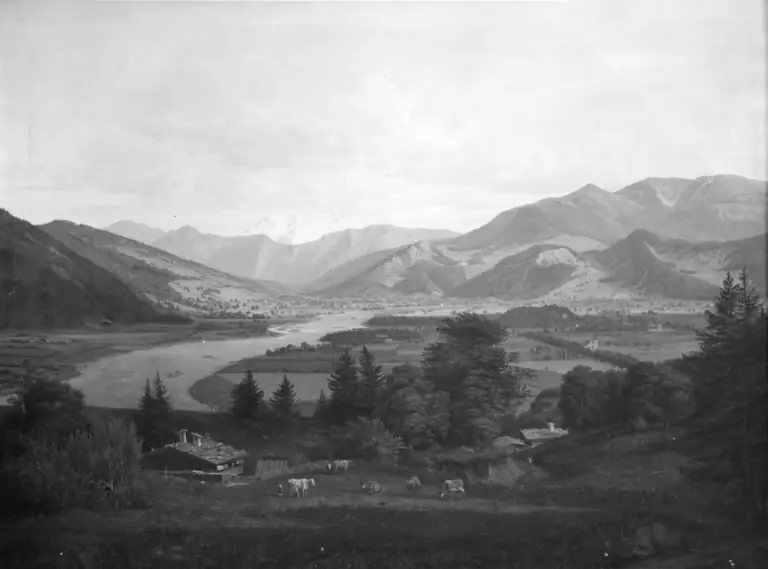
Parti af egnen ved Salzburg
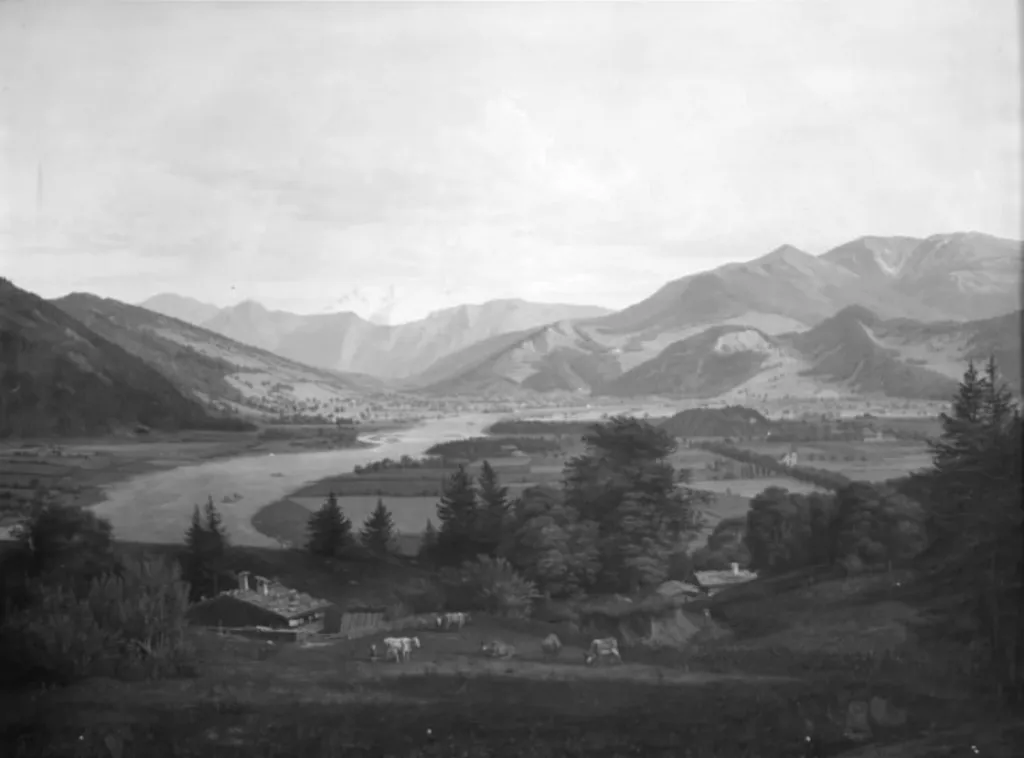
Parti af egnen ved Salzburg is a photography by the Romanticist artist Unknown. It dates from 1834 and is held in the collection of the Statens Museum for Kunst. Created in 1834, this black-and-white photograph captures a tranquil valley near Salzburg.
About this work
Artists at the time often painted similar scenes, but this is one of the earliest photos of the same kind.
This black-and-white photo shows a quiet valley nestled between tall mountains. A winding river cuts through the scene, with fields and trees dotting the landscape. In the foreground, a small farmhouse sits beside a few horses grazing near a dirt path.
The image was made in 1834, when photography was brand-new. Artists at the time often painted similar scenes, but this is one of the earliest photos of the same kind.
Next, look up Romanticism to see how artists and photographers used nature to inspire their work.
Overview
Created in 1834, this black-and-white photograph captures a tranquil valley near Salzburg. Among the earliest photographic records of a landscape, it reflects the nascent potential of the medium to document natural scenery with precision. The work is held in the collection of the Museum of Ethnography, where it stands as a rare early example of photographic observation rather than artistic interpretation.
Subject & Meaning
The scene depicts a quiet rural valley framed by steep mountains, with a winding river, scattered trees, and cultivated fields. A modest farmhouse and grazing horses anchor the foreground, suggesting human presence within an expansive natural setting. The composition avoids drama, instead conveying stillness and harmony, aligning with broader 19th-century ideals of nature as a quiet, enduring force.
Technique & Style
Rendered in monochrome, the photograph employs long exposure to capture subtle tonal gradations in light and shadow. The sharp detail of the landscape, unusual for the time, reflects early photographic processes like the daguerreotype or calotype. The framing is unembellished, prioritizing factual representation over compositional flourish, distinguishing it from contemporary painted landscapes.
History & Provenance
Made in 1834, shortly after the public announcement of photography, the image is among the first to record a European landscape with camera precision. Its survival and placement in the Museum of Ethnography suggest early institutional interest in photography as a documentary tool. The photographer’s identity remains unconfirmed, though the work aligns with regional efforts to record topography during this period.
Context
In the 1830s, painters of the Romantic movement idealized nature as sublime or emotionally charged. This photograph, by contrast, offers a restrained, observational approach. Its existence marks a shift from artistic interpretation to mechanical recording, reflecting broader cultural changes as science and technology began to reshape how people perceived and documented the natural world.
Legacy
As one of the earliest photographic landscapes of the Austrian region, it represents a pivotal moment in visual culture. It demonstrates how photography, even in its infancy, could capture the physical reality of a place with a neutrality that painting could not. The work contributes to the historical record of how landscapes were documented before mass reproduction and travel became common.
Artist & collection

 Domestic Scene
 Giacomo and Cardinal Marco, investing Andrea, Abbot of San Zeno, with his Benefice
 The Nymph of Fontainebleau
 Portrait of a Woman
 Madonna and Child with Saints in the Enclosed Garden
 Venus and Minerva
 Family Group of Four on Sofa
 Wall painting from Room H of the Villa of P. Fannius Synistor at Boscoreale