Artwork
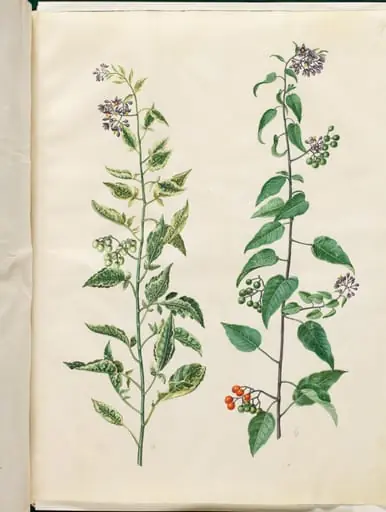
Solanum pseudocapsicum (jerusalem-koralbær)
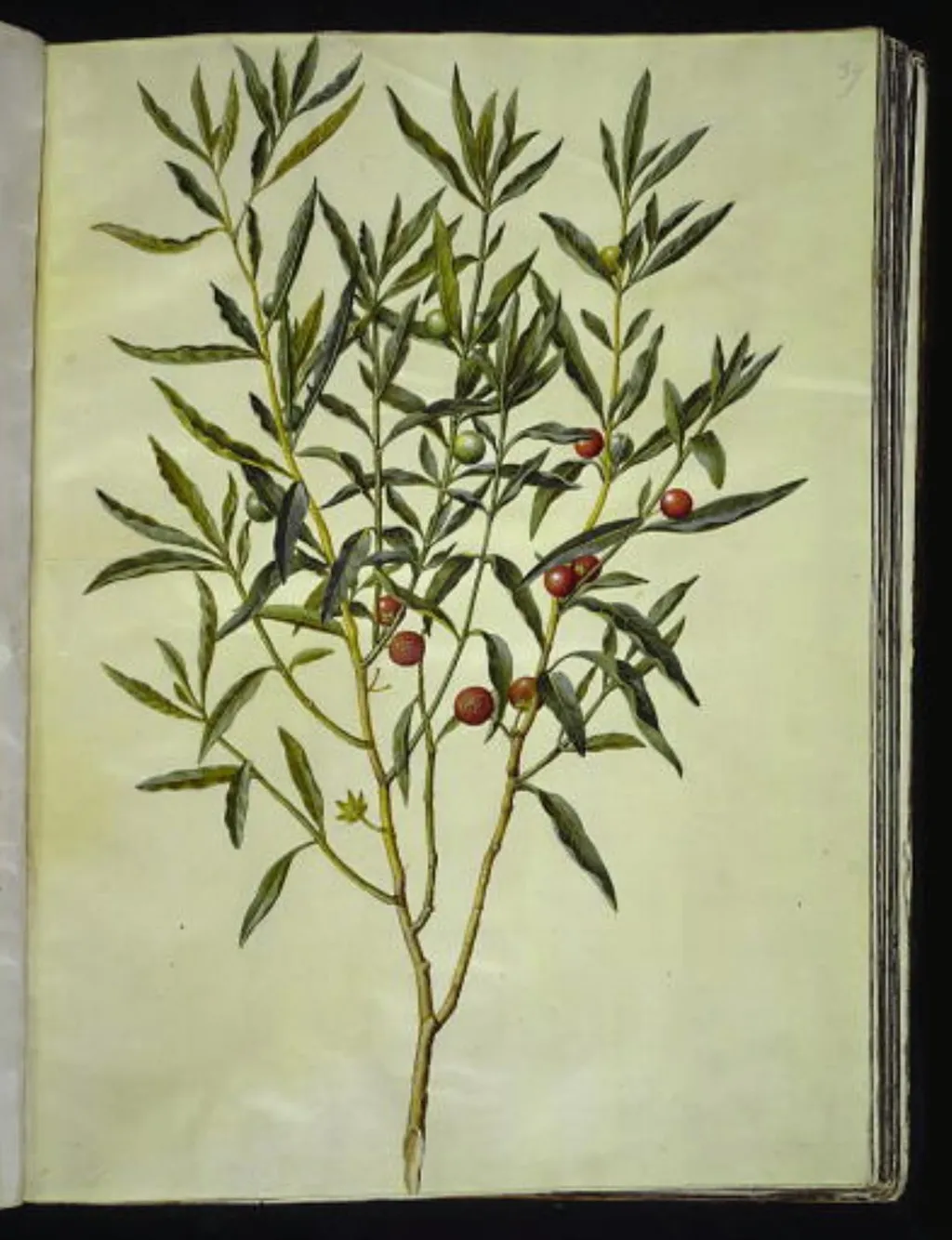
Solanum pseudocapsicum (jerusalem-koralbær) is an unspecified work on paper by Unknown. It dates from 1654 and is held in the collection of the Statens Museum for Kunst. This watercolor painting, dated around 1654, depicts Solanum pseudocapsicum, commonly known as Jerusalem cherry.
About this work
Overview
This watercolor painting, dated around 1654, depicts Solanum pseudocapsicum, commonly known as Jerusalem cherry. Created by an artist identified only as 35199_person, the work is part of the collection at the Museum of Ethnography. Rendered with delicate brushwork, the plant is isolated against a neutral background, emphasizing botanical accuracy over decorative flourish.
Subject & Meaning
The painting presents a single specimen of Solanum pseudocapsicum, a plant native to the Americas but cultivated in European gardens for its ornamental red berries. Its inclusion in a scientific or curatorial context suggests an interest in documenting exotic flora. The absence of human figures or symbolic elements points to a focus on observation rather than allegory.
Technique & Style
The artist employed layered watercolor washes to capture the subtle variations in hue across leaves and berries. Soft, controlled strokes define each leaf’s form and the delicate texture of the fruit. The muted palette—dominated by pale greens and faint yellows—enhances the plant’s naturalism. The plain background ensures visual clarity, typical of botanical illustration from this period.
History & Provenance
The work entered the Museum of Ethnography’s holdings as part of a broader collection of natural history illustrations. Its origin remains tied to the artist identified only as 35199_person, whose broader oeuvre is not well documented. The painting likely served as a reference for scholars or collectors interested in New World plants introduced to Europe in the 17th century.
Context
In mid-17th-century Europe, detailed plant studies flourished alongside expanding global trade and botanical exploration. Artists were often commissioned to record unfamiliar species for scientific and aristocratic audiences. This painting reflects that trend, aligning with the era’s emphasis on empirical observation and classification of nature.
Legacy
Though not widely known outside institutional collections, the work contributes to the historical record of early botanical documentation. Its restrained aesthetic and precise rendering exemplify the quiet rigor of pre-modern scientific illustration, offering insight into how naturalists visually encoded knowledge before the advent of photography.
Artist & collection

 Domestic Scene
 Giacomo and Cardinal Marco, investing Andrea, Abbot of San Zeno, with his Benefice
 The Nymph of Fontainebleau
 Portrait of a Woman
 Madonna and Child with Saints in the Enclosed Garden
 Venus and Minerva
 Family Group of Four on Sofa
 Wall painting from Room H of the Villa of P. Fannius Synistor at Boscoreale