Artwork
Cypresser
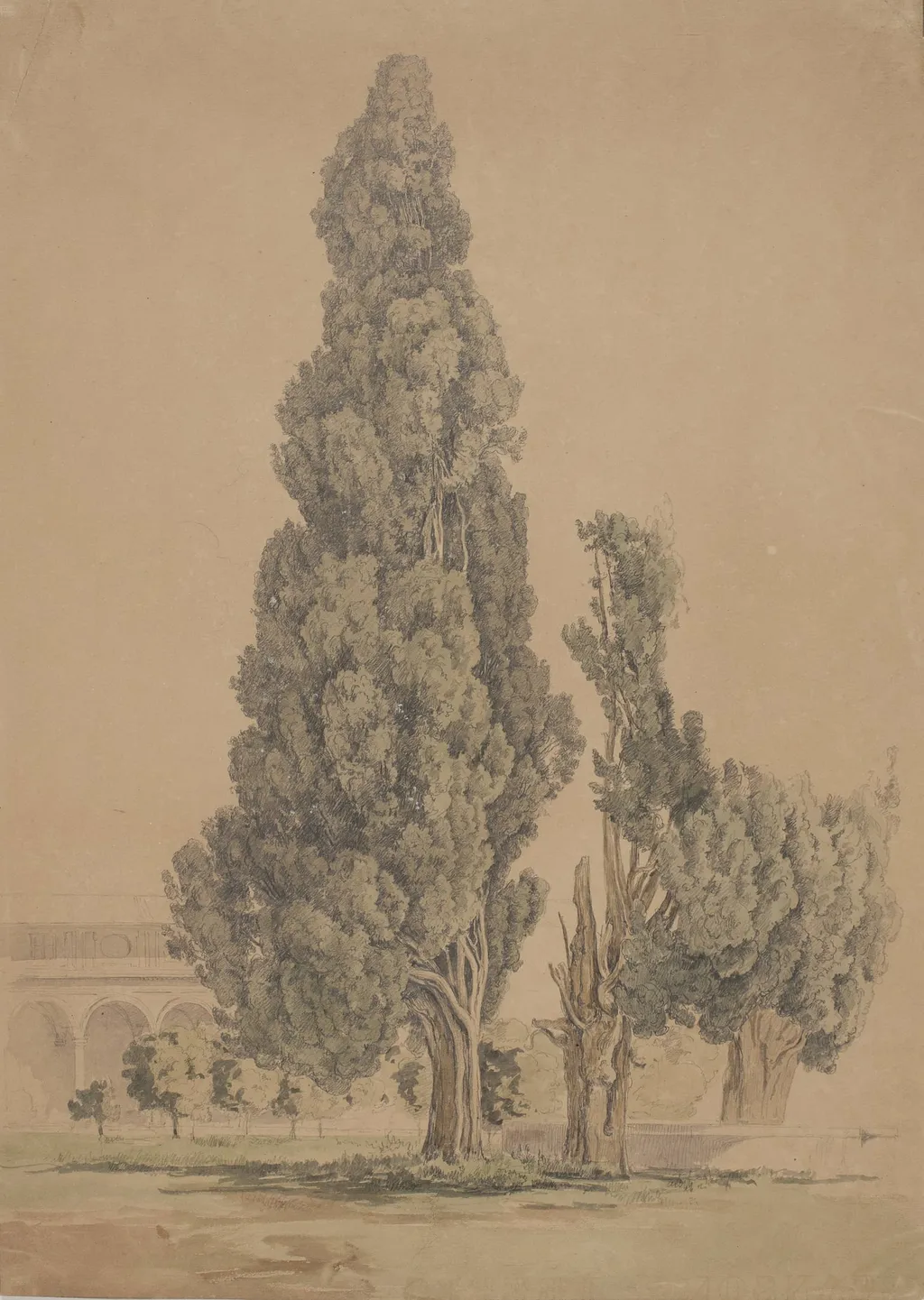
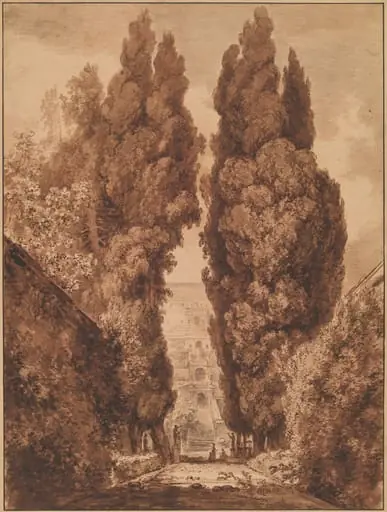
Cypresser is an unspecified painting by Unknown. It dates from 1850 and is held in the collection of the Statens Museum for Kunst. Created around 1850, this work depicts a solitary cypress tree in a quiet landscape.
About this work
Overview
The composition centers on the tree’s vertical form, framed by a low stone wall and distant architecture.
Created around 1850, this work depicts a solitary cypress tree in a quiet landscape. The artist rendered the scene with subdued tones of brown and green, emphasizing texture over color. The composition centers on the tree’s vertical form, framed by a low stone wall and distant architecture. Its placement suggests isolation, yet the soft lighting unites the elements into a contemplative whole. The piece is held in the collection of the Museum of Ethnography.
Subject & Meaning
The lone cypress, a tree often associated with endurance and mourning, stands as the focal point against a muted backdrop. Its dominance in the frame, contrasted with the leaning secondary tree and distant arches, implies a quiet tension between permanence and decay. The absence of human figures and the subdued palette invite reflection rather than narrative, suggesting a meditation on time, solitude, or natural resilience.
Technique & Style
The artist employed a restrained palette and delicate gradations of light to model the tree’s form. Bark texture is suggested through layered brushwork, while branches are rendered with dense, overlapping strokes. Light diminishes softly from the upper canopy to the base, creating a subtle chiaroscuro effect. The background elements are blurred into atmospheric haze, reinforcing the tree’s prominence through tonal contrast rather than sharp definition.
History & Provenance
The work dates to approximately 1850 and entered the Museum of Ethnography’s collection without documented prior ownership. Its origin as a standalone study or part of a larger series remains unclear. No exhibition history or artist correspondence has been preserved, leaving its intended audience and purpose speculative. The piece is cataloged under the artist’s name, though little else is known about their practice.
Context
Produced during a period when landscape studies gained traction among artists seeking naturalistic observation, this work aligns with quiet, introspective traditions in 19th-century European art. Unlike grand Romantic vistas, it favors intimacy and restraint. The inclusion of architectural elements hints at human presence without direct representation, reflecting a broader interest in the relationship between nature and built environments.
Legacy
Though not widely exhibited or reproduced, the painting contributes to a lesser-known strand of 19th-century landscape study focused on elemental forms and atmospheric tone. Its preservation in an ethnographic museum suggests an interest in cultural or regional visual traditions, though its stylistic roots remain ambiguous. It endures as a quiet example of observational painting, valued for its restraint and sensitivity to natural form.
Artist & collection

 Domestic Scene
 Giacomo and Cardinal Marco, investing Andrea, Abbot of San Zeno, with his Benefice
 The Nymph of Fontainebleau
 Portrait of a Woman
 Madonna and Child with Saints in the Enclosed Garden
 Venus and Minerva
 Family Group of Four on Sofa
 Wall painting from Room H of the Villa of P. Fannius Synistor at Boscoreale
![View through the Trees at Tivoli [recto], by Jasper Francis Cropsey](https://artifactworldgallery.com/img/jasper-francis-cropsey--view-through-the-trees-at-tivoli-recto--982b0e365e4ea403-w320.webp)