Artwork
Beggars at a Doorway
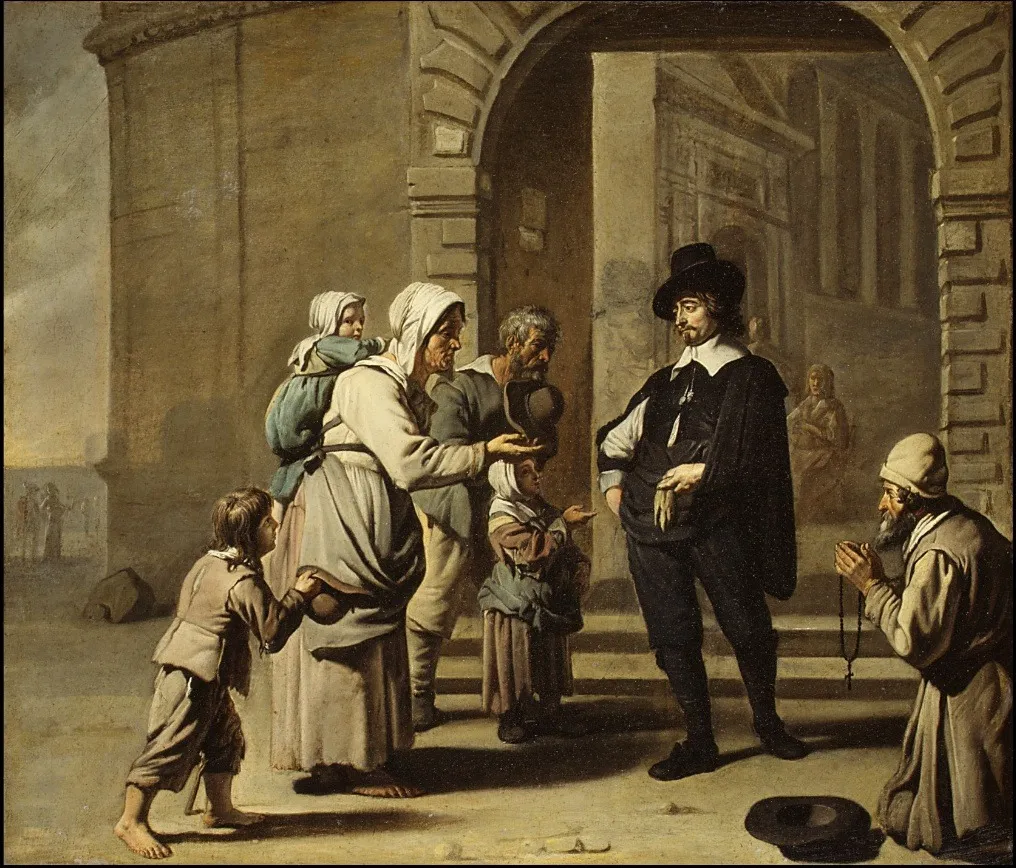
Beggars at a Doorway is an oil painting by the Dutch Golden Age artist Abraham Willemsens. It dates from 1650 and is held in the collection of the Metropolitan Museum of Art.
About this work
Overview
Created around 1650, *Beggars at a Doorway* is an oil painting by the Flemish artist Abraham Willemsens. The work portrays a small group of destitute figures gathered at an entrance, captured in a moment of quiet exchange. It is part of the collection of the Metropolitan Museum of Art in New York.
Subject & Meaning
The composition shows five individuals: a man in a dark coat offering an object to a woman with a white headscarf, her child clinging to her skirt, a barefoot boy watching, and an older man in a turban kneeling with a hat. The scene suggests a fleeting interaction among strangers, emphasizing themes of poverty, charity, and human connection in everyday life.
Technique & Style
Willemsens employs a restrained palette and careful modeling of light, allowing warm illumination to bring out the faces while the surrounding doorway recedes into shadow. The handling of oil paint reflects the influence of the Le Nain brothers, whose genre scenes similarly blend naturalistic detail with a modest, almost narrative tone.
History & Provenance
Active in the mid‑17th‑century Flemish art world, Willemsens was known for genre scenes and occasional copies after Peter Paul Rubens, indicating his engagement with contemporary masters. *Beggars at a Doorway* entered the Metropolitan Museum of Art’s collection through acquisition in the early 20th century, where it remains on view as part of the museum’s European paintings holdings.
Artist & collection
Artist
Abraham Willemsens or Abraham Willemsen (c. 1605-1610 - 1672), was a Flemish painter of history and genre paintings. His genre scenes were reminiscent of the style of the Le Nain brothers. He also produced copies after the works of Rubens.
