Artwork
Portrait of Violinist Jean Vidal (1789–1867)
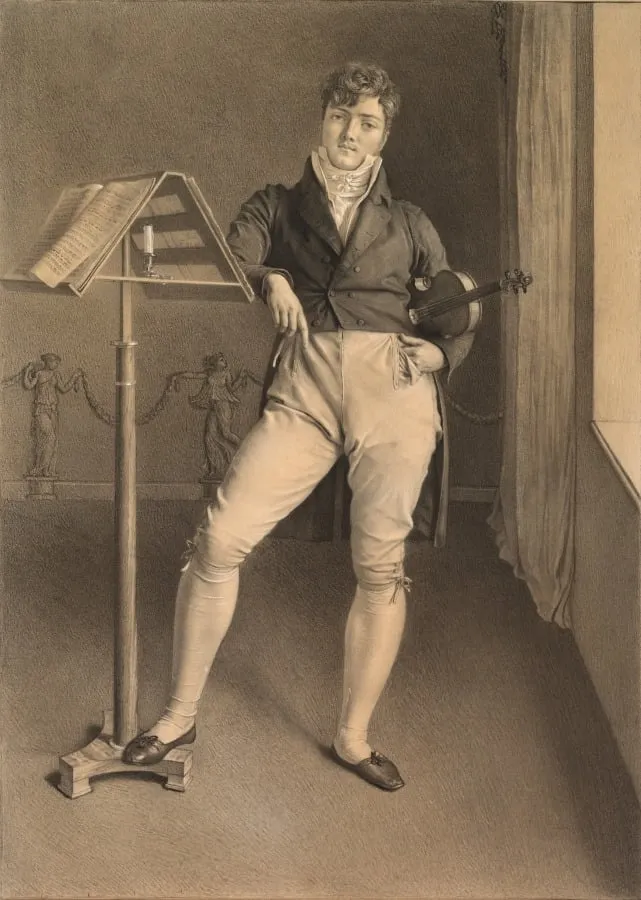
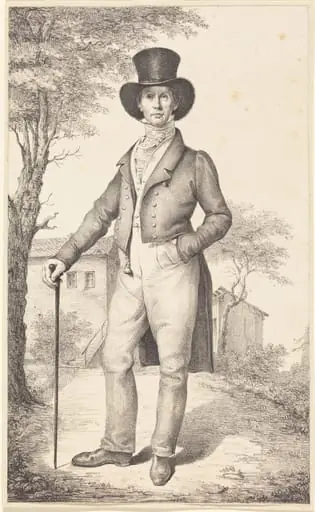
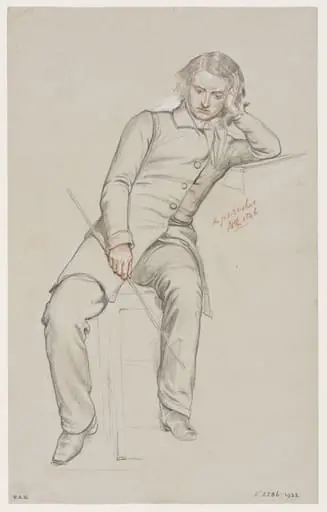
Portrait of Violinist Jean Vidal (1789–1867) is a drawing by the Romanticist artist Adrien Victor Auger. It dates from 1808 and is held in the collection of the Cleveland Museum of Art.
About this work
Overview
Instead of mythic or heroic subjects, Auger turned to contemporary Parisian life, capturing a working musician in a moment of quiet introspection.
Adrien Victor Auger’s portrait of Jean Vidal is the most completed drawing known by the artist, distinguishing itself from the grand historical narratives favored by his mentor, Jacques-Louis David. Instead of mythic or heroic subjects, Auger turned to contemporary Parisian life, capturing a working musician in a moment of quiet introspection. The work reflects a shift toward intimate, realist portraiture in early 19th-century France.
Subject & Meaning
Jean Vidal, a rising violinist in Paris, is portrayed not as an idealized figure but as a modern individual—thoughtful, dressed in contemporary attire, and absorbed in his own thoughts. His gaze, directed away from the viewer, suggests an inner emotional world rather than performative display. The choice to depict a musician in casual repose underscores a cultural shift toward valuing artistic temperament over aristocratic grandeur.
Technique & Style
Auger employed chalk on tan paper, using varied pressure and density of strokes to model form with subtle gradations. Highlights are added sparingly in white to catch the light on Vidal’s collar and cheek, while the tan paper serves as a mid-tone base. The lines are delicate and suggestive, avoiding heavy outlines, yet the face emerges with lifelike presence—emphasizing texture and quiet realism over dramatic contrast.
History & Provenance
Created around 1810, the drawing is among the few surviving works by Auger that demonstrate his departure from academic conventions. While little is documented about his career, this piece stands as a rare testament to his personal artistic direction. It remained in private hands until entering a public collection, where it now serves as a key example of non-academic portraiture from the period.
Context
In post-revolutionary Paris, artistic focus gradually shifted from state-sponsored history painting to depictions of everyday life and individual character. Auger’s choice to portray a musician—rather than a general, philosopher, or deity—aligns with broader cultural interests in the arts and the rising status of performers. His technique reflects a growing appetite for authenticity over idealization.
Legacy
Though Auger did not achieve lasting fame, this drawing influenced later artists seeking to capture psychological depth without theatricality. Its restrained realism and sensitivity to light and texture prefigure the quiet portraiture of mid-century French draftsmen. The work remains a quiet but significant marker of how art began to turn inward, toward the individual, rather than outward toward myth or power.
Artist & collection
Artist
Adrien Victor Auger (1786–1854) was a French artist, born in Saint-Valery-en-Caux.