Artwork
Paganini moderne ...
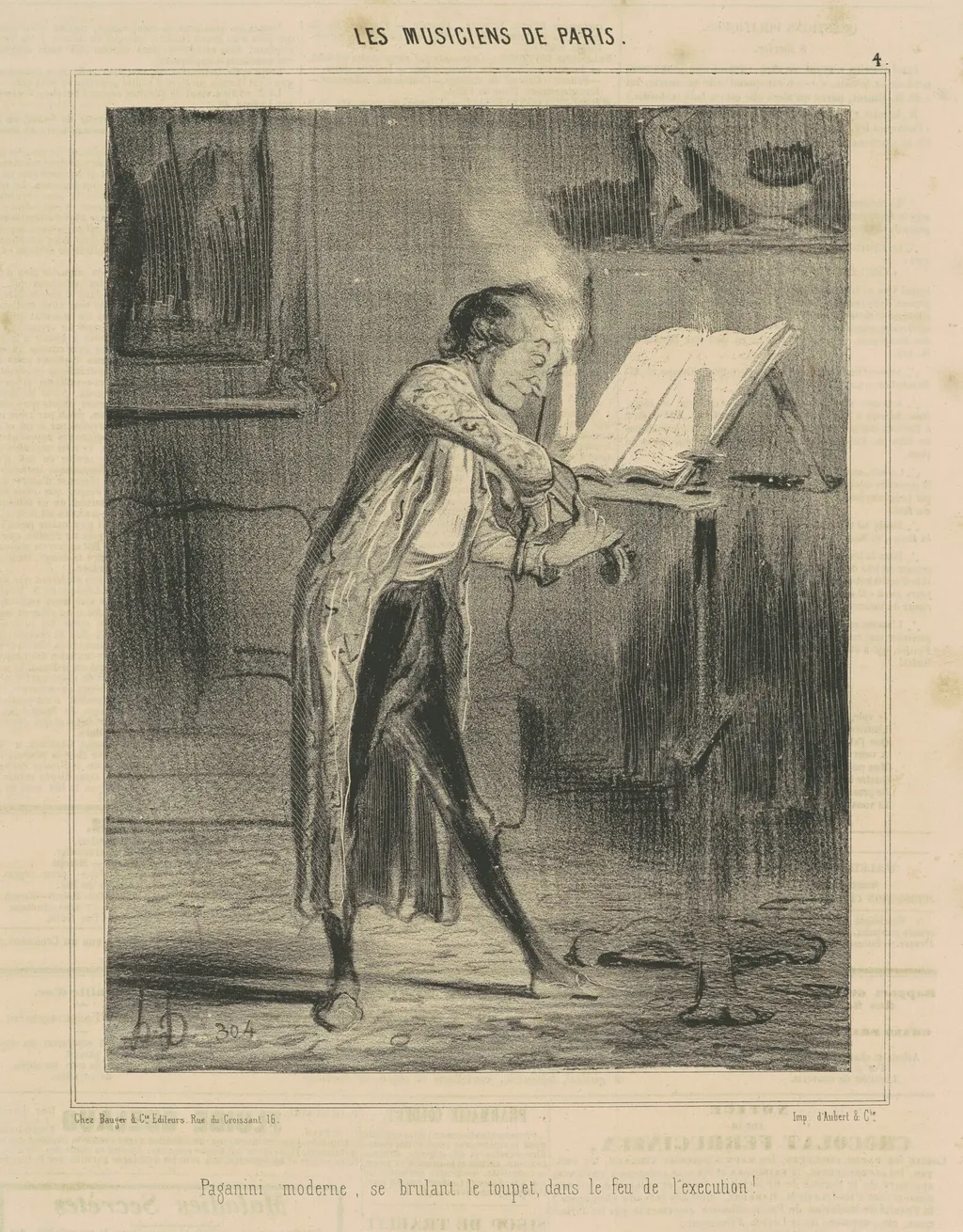
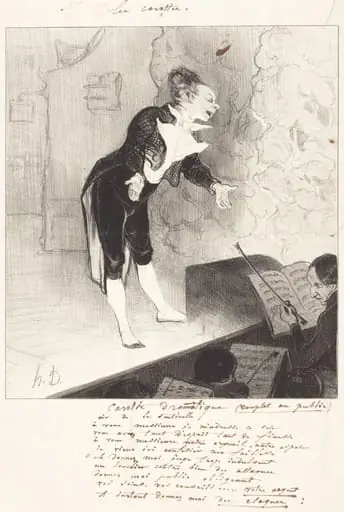
Paganini moderne ... is an ink print by the Romanticist artist Honoré Daumier. It dates from 1841 and is held in the collection of the National Gallery of Art.
About this work
Overview
The work exemplifies Daumier’s capacity to convey movement and concentration within the limited palette of black and white lithography.
Honoré Daumier’s lithograph Paganini moderne presents a solitary violinist absorbed in performance. Rendered in a single stone print, the image isolates the musician against a softened backdrop, emphasizing the act of playing rather than any surrounding narrative. The work exemplifies Daumier’s capacity to convey movement and concentration within the limited palette of black and white lithography.
Subject & Meaning
The central figure is a violinist, hunched over his instrument, his hands rendered with crisp, decisive lines that contrast with the loosely suggested clothing. The focus on the musician’s intense engagement suggests a study of artistic dedication, shifting Daumier’s usual satirical tone toward a more earnest observation of creative labor.
Technique & Style
Daumier employed the traditional lithographic process, drawing the composition on a limestone slab with greasy crayon. When the stone was moistened, ink adhered only to the crayon marks, reproducing the drawing with stark contrast. The resulting image balances vigorous, sketch‑like strokes for the coat with sharply defined details for the hands, creating depth through line rather than tone.
Context
Created during the mid‑19th century, a period when lithography was gaining popularity as a medium for both illustration and fine art, the print reflects contemporary interest in music and virtuoso performers such as Niccolò Paganini. Although Daumier is best known for caricatures of society, this work aligns with his broader exploration of everyday figures rendered with immediacy.
Legacy
Paganini moderne illustrates Daumier’s versatility beyond social satire, demonstrating his skill in capturing kinetic energy within a static medium. The lithograph continues to be cited in studies of 19th‑century printmaking for its effective use of line to convey motion and for its subtle shift toward a more respectful portrayal of artistic subjects.
Artist & collection

Artist
Honoré-Victorin Daumier was a French painter, sculptor, and printmaker, whose many works offer commentary on the social and political life in France, from the Revolution of 1830 to the fall of the Second French Empire in 1870.