Artwork
Head of a Donor
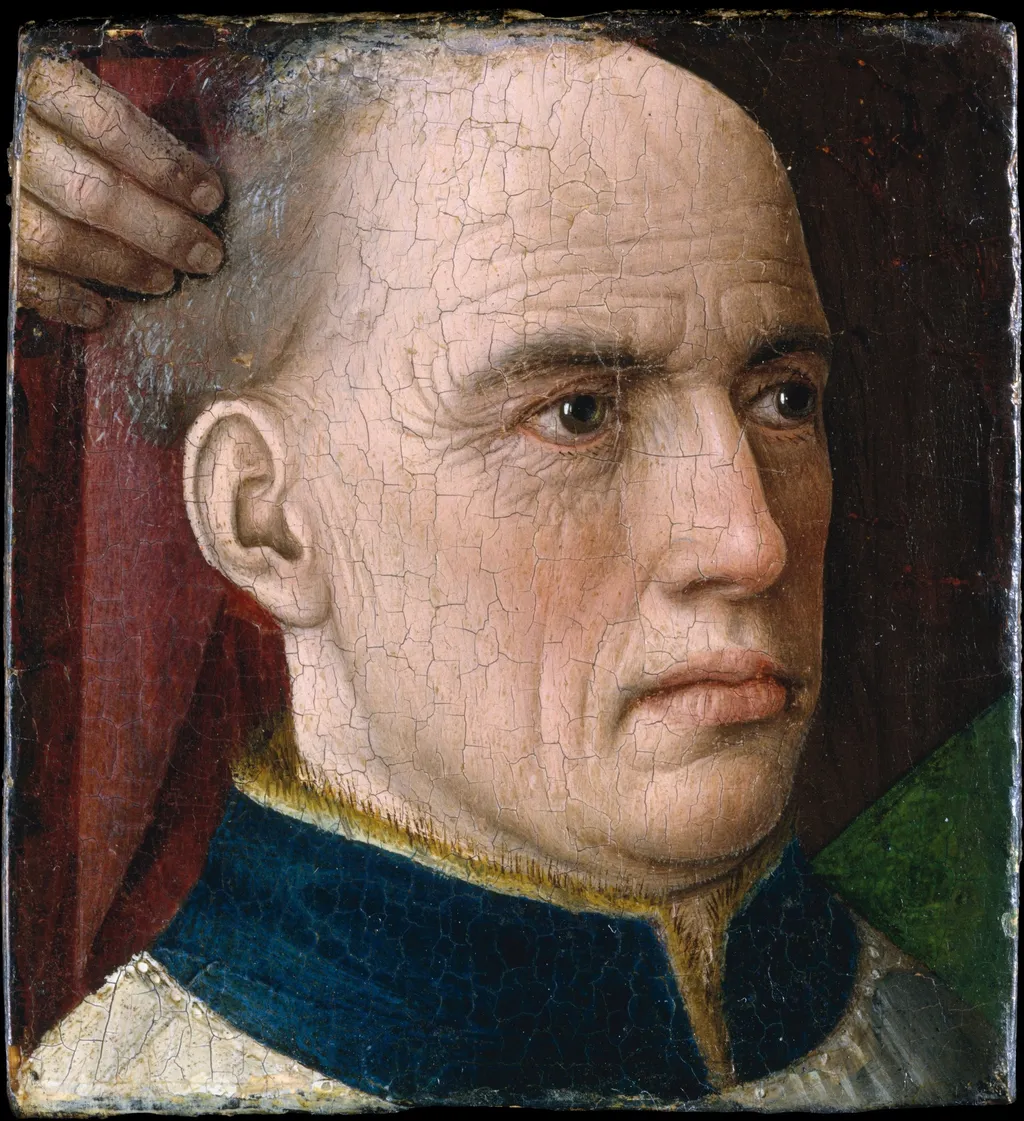
Head of a Donor is an oil painting by the Northern Renaissance artist Albert van Ouwater. It dates from 1460 and is held in the collection of the Metropolitan Museum of Art.
About this work
Overview
Created circa 1460, *Head of a Donor* is an oil painting by Albert van Ouwater, an early practitioner of the Northern Renaissance in the Netherlands. The work presents a tightly framed portrait of a male figure, rendered against a dark, unadorned background, and is presently held in the collection of The Metropolitan Museum of Art.
Subject & Meaning
The composition focuses on the sitter’s face and upper torso, showing a slightly wrinkled complexion, a short beard, and a receding hairline. He is dressed in a dark blue garment with a white collar, and his right hand rests on a red cloth. The plain backdrop directs attention to the individual’s features, suggesting a straightforward commemorative purpose typical of donor portraits.
Technique & Style
Van Ouwater employed oil medium to achieve smooth transitions in skin tone and delicate modeling of facial shadows, a hallmark of early Netherlandish realism. The contrast between the vivid red cloth and the muted background enhances spatial depth, while the fine brushwork captures subtle textures in the fabric and flesh.
History & Provenance
The painting belongs to the early phase of oil painting in the Northern Netherlands, when the medium was increasingly used for detailed portraiture. After remaining in private hands for several centuries, the work entered the Metropolitan Museum of Art’s collection, where it is displayed as part of the museum’s early Netherlandish holdings.
Artist & collection
Artist
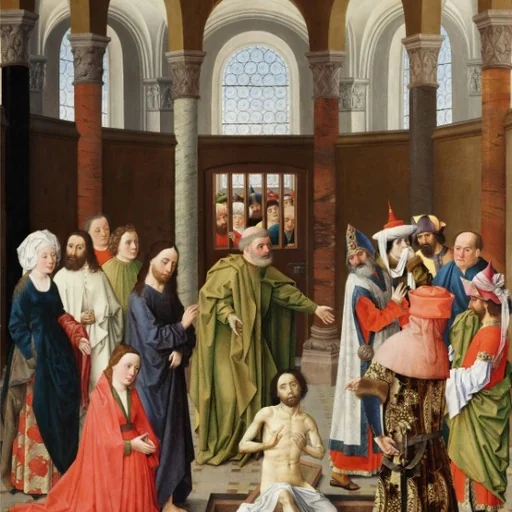
Albert van Ouwater (c. 1410/1415 – 1475) was one of the earliest artists of Early Netherlandish painting working in the Northern Netherlands, as opposed to Flanders in the South of the region.
