Artwork
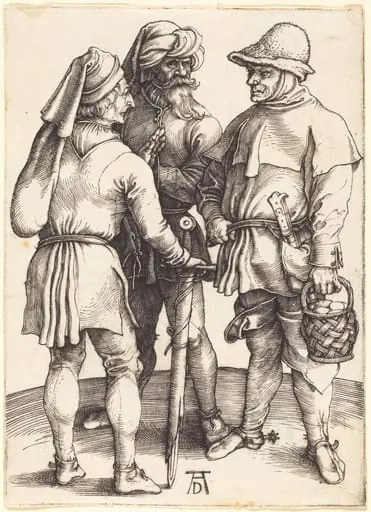
Three Peasants in Conversation
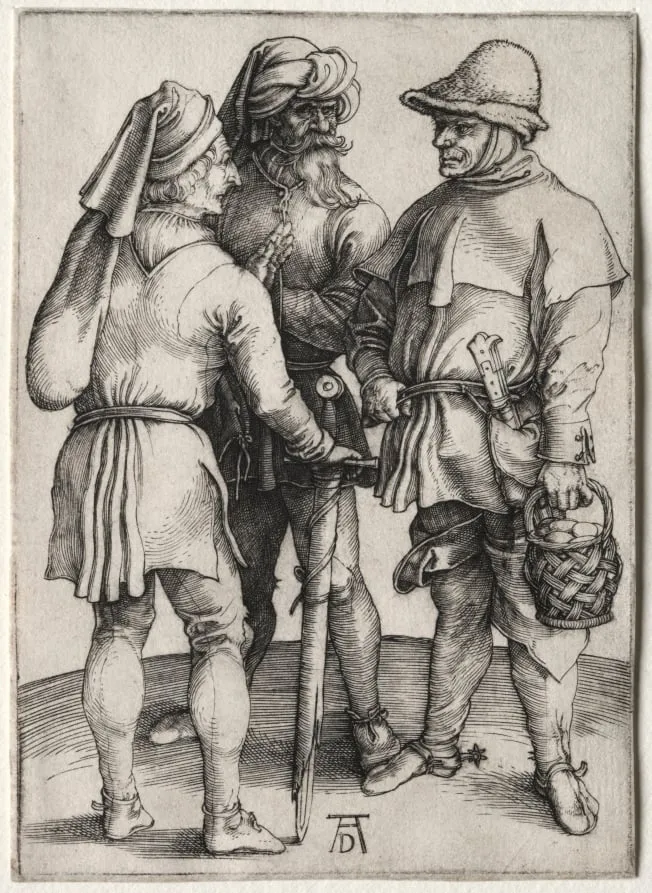
Three Peasants in Conversation is a print by the Renaissance artist Albrecht Dürer. It dates from 1497 and is held in the collection of the Cleveland Museum of Art.
About this work
Overview
Created around 1497, this drawing by Albrecht Dürer captures three rural laborers in quiet dialogue. Though best known for his woodcuts and engravings, Dürer also produced intimate studies of ordinary people, revealing his interest in human character beyond religious or mythological themes. Executed in pen and ink with wash, the work exemplifies his precision and attention to physical presence.
Subject & Meaning
Dürer avoids idealization, presenting them as individuals with observable habits and attire, grounding the scene in daily reality.
The three figures represent distinct social roles: a laborer with a cloth wrapped around his head, a bearded peasant with a pouch at his belt, and a soldier carrying a helmet and basket. Their proximity and posture suggest an informal exchange, possibly after work or during travel. Dürer avoids idealization, presenting them as individuals with observable habits and attire, grounding the scene in daily reality.
Technique & Style
Dürer employs fine, controlled lines and graded ink washes to model volume and texture. Shadows fall sharply along folds of fabric and facial contours, enhancing the three-dimensionality of the figures. The precision of his draftsmanship reflects his training in Nuremberg’s artisan traditions and his study of Italian Renaissance methods, particularly in the rendering of anatomical solidity.
History & Provenance
The drawing is part of Dürer’s extensive body of preparatory sketches and observational studies, likely made during his travels or in his Nuremberg studio. It was not intended for public sale but served as a record of human types and a practice in naturalistic representation. Its survival reflects its value to later collectors who recognized its artistic merit beyond its functional origin.
Context
In late 15th-century Germany, depictions of peasants were rare in fine art, typically reserved for marginalia or moralizing scenes. Dürer’s focus on their dignity and individuality aligns with broader humanist currents, where observation of the natural world gained intellectual weight. His engagement with such subjects paralleled his interest in anatomy, perspective, and the dignity of labor.
Legacy
This drawing contributed to a shift in Northern Renaissance art, where everyday life became a legitimate subject for serious artistic inquiry. Dürer’s technique influenced later generations of draftsmen who sought realism without embellishment. The work remains a testament to his belief that close observation of ordinary people held artistic and moral significance.
Artist & collection
Artist
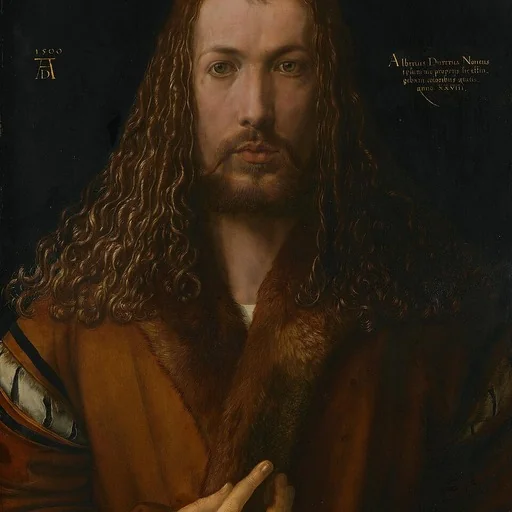
Albrecht Dürer spent his life in Nuremberg, a busy German city where artists traded prints like currency.

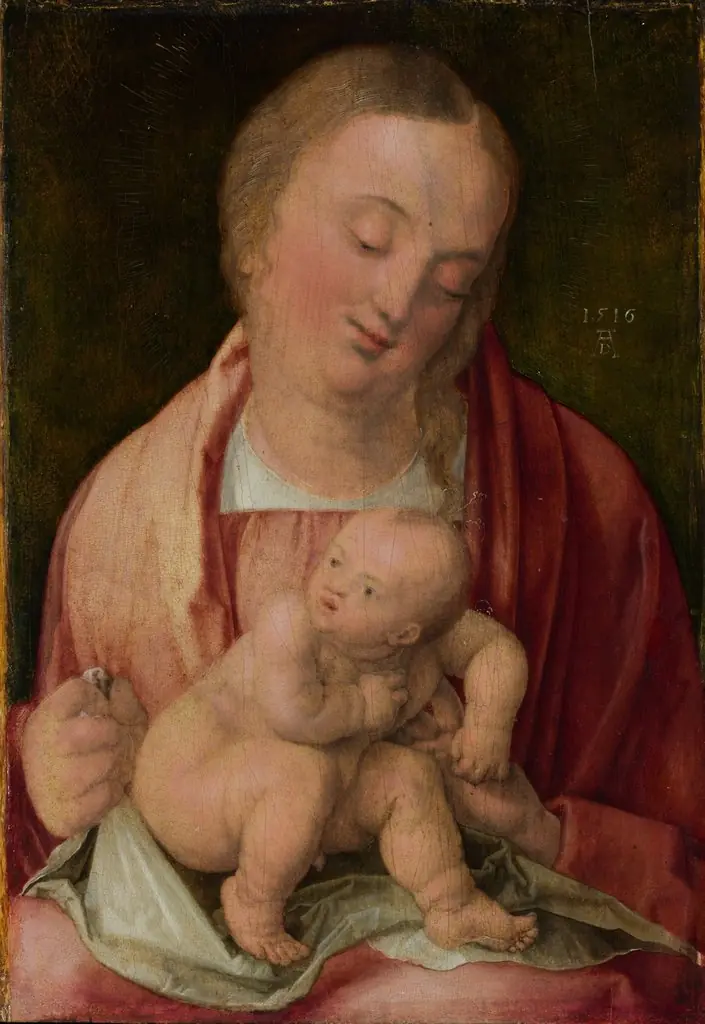
![Madonna and Child [obverse], by Albrecht Dürer](https://artifactworldgallery.com/img/albrecht-durer--madonna-and-child-obverse--d7b8ebf05d22ebe5-w320.webp)
![Lot and His Daughters [reverse], by Albrecht Dürer](https://artifactworldgallery.com/img/albrecht-durer--lot-and-his-daughters-reverse--b4ebf9b282faa17a-w320.webp)
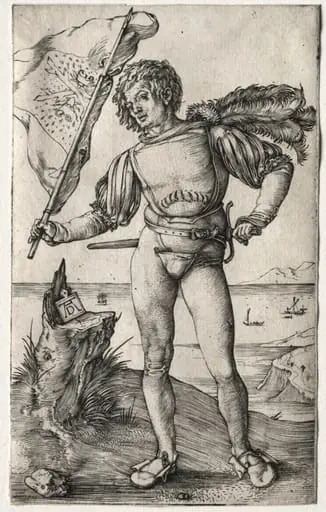 The Burgundian Standard Bearer
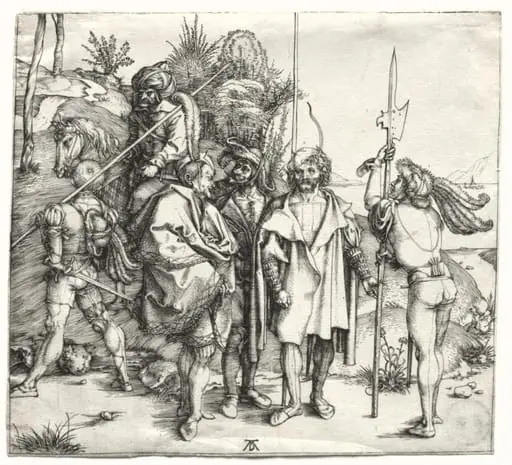 Five Soldiers and a Turk on Horseback
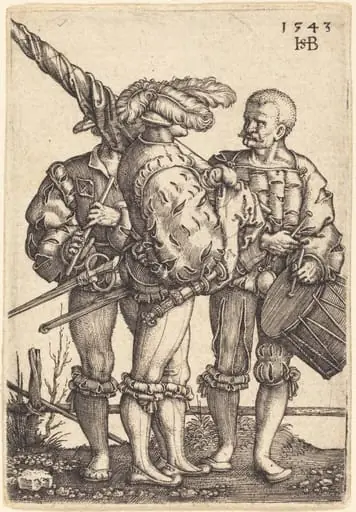 Standard Bearer, Drummer, and Piper
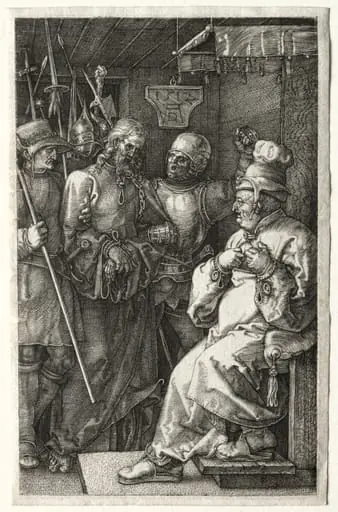 Christ before Caiaphas
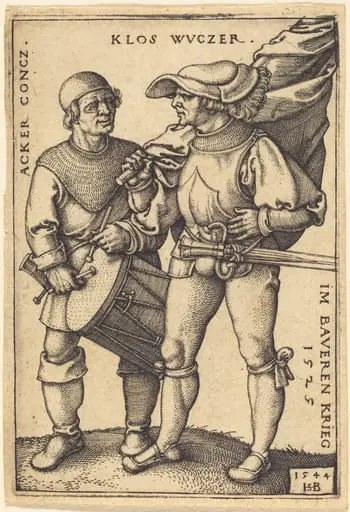 Standard Bearer and Drummer
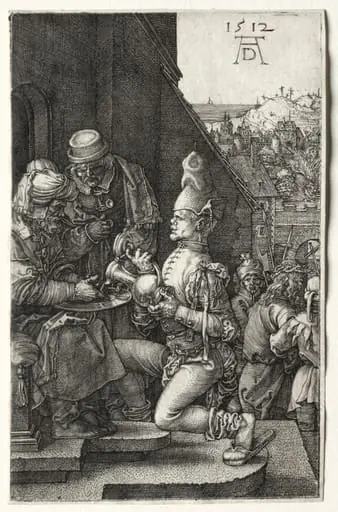 Pilate Washing His Hands
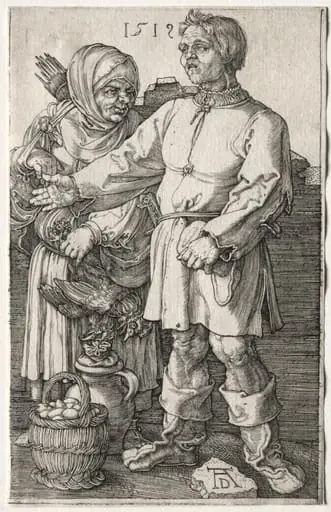 The Peasants at Market
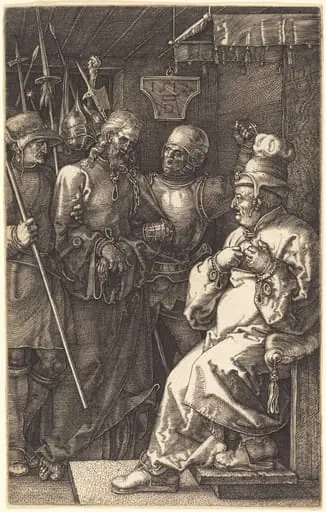 Christ before Caiaphas
 Four Soldiers and Military Band
 Charlemagne, Arthur and Godfrey
 Three Soldiers and a Dog
 Three Peasants in Conversation