Artwork
Taking of Narva
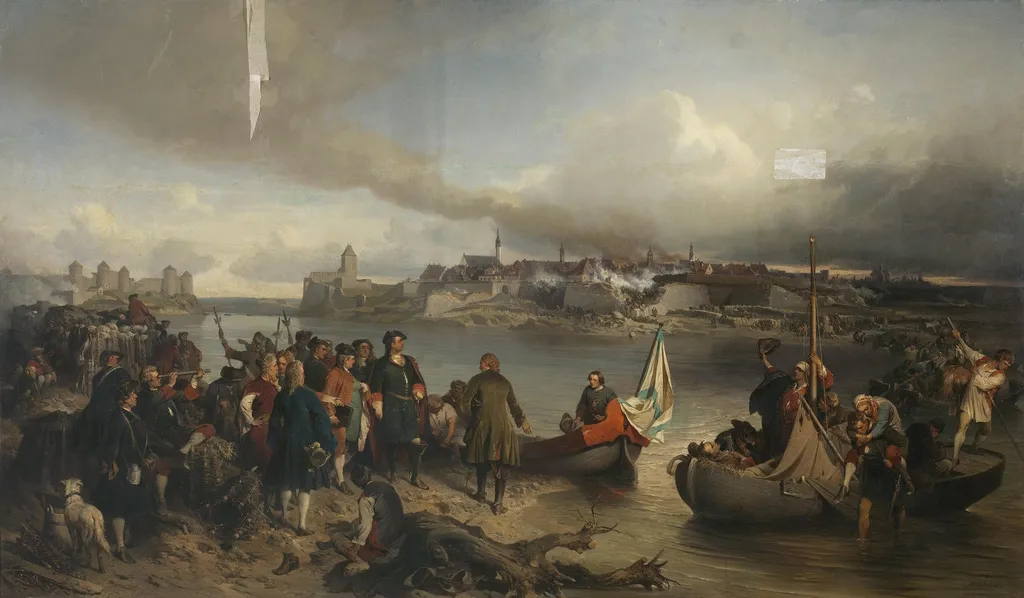
Taking of Narva is an oil painting by the Realist artist Alexander von Kotzebue. It is held in the collection of the Hermitage Museum.
About this work
Overview
Completed in 1890, *Taking of Narva* is an oil on canvas by Alexander von Kotzebue, a German painter associated with Romantic historicism. The work portrays a moment from the 1700 siege of Narva, focusing on a shoreline scene where a boat and the fortified Hermann Castle dominate the composition. It is part of the State Hermitage Museum’s collection.
Subject & Meaning
The canvas captures the tension of the siege, showing soldiers and civilians in period dress gathered on the banks, some bearing weapons and flags. A central figure in a dark coat and hat appears to command the group, suggesting leadership amid the conflict. Smoke rising from the castle underscores the chaos of battle and the urgency of the moment.
Technique & Style
Kotzebue employs a realist approach within a Romantic framework, using chiaroscuro to model forms and heighten drama. Strong contrasts of light and shadow give depth to the figures and the distant fortress, while the muted palette of earth tones conveys the somber atmosphere of a wartime landscape.
History & Provenance
After its completion, the painting entered the Russian imperial collection and eventually became part of the State Hermitage Museum’s holdings. Its presence in the Hermitage reflects the museum’s broader acquisition of 19th‑century European works that document historical battles.
Artist & collection
Artist
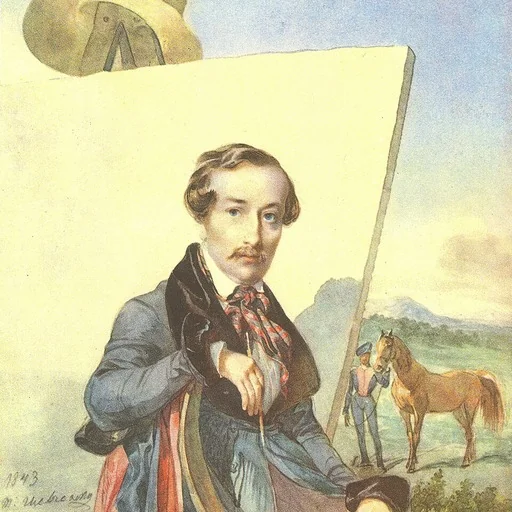
Alexander Friedrich Wilhelm Franz von Kotzebue or Alexander Yevstafiyevich Kotzebue (Russian: Александр Евстафиевич Коцебу, romanized: Aleksandr Yevstafiyevich Kotsebu; 9 June 1815 – 24 August 1889) was a German…
