Artwork
The Valley of Guiuk-Suey, Sweet Waters of Asia
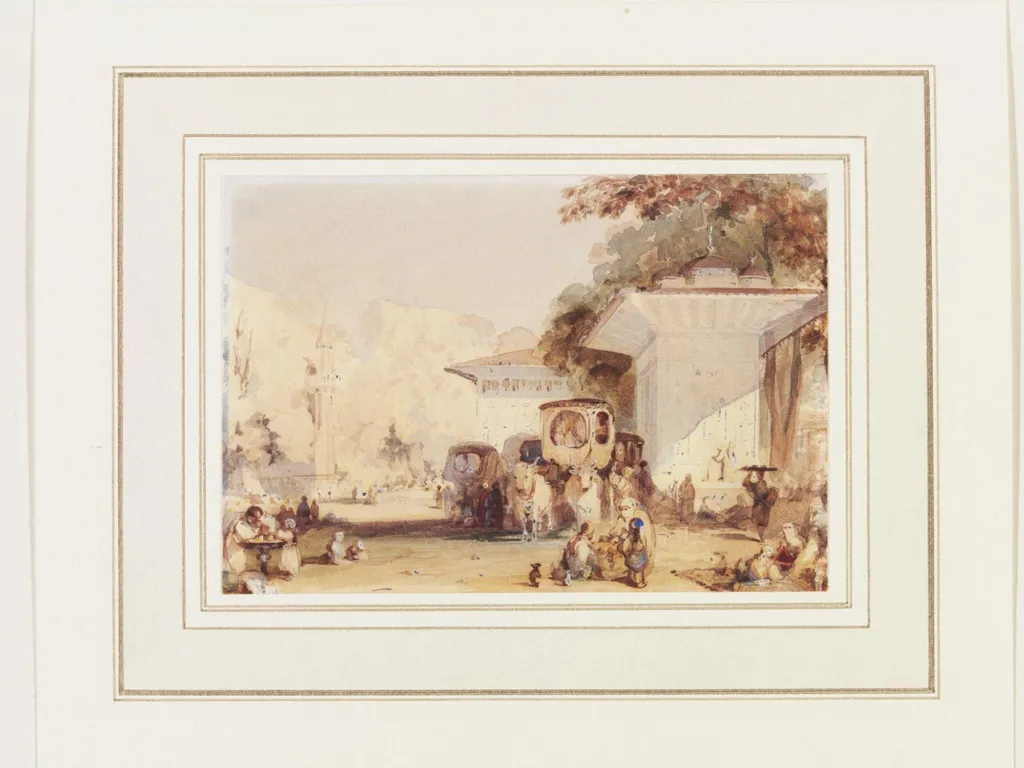
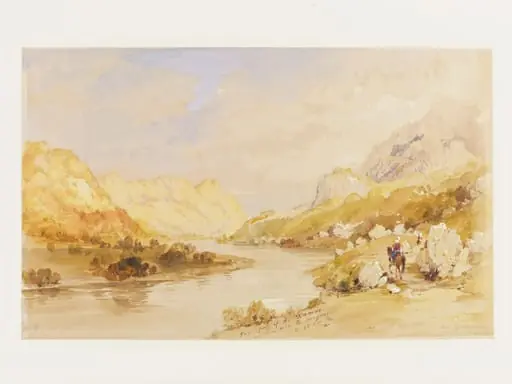
The Valley of Guiuk-Suey, Sweet Waters of Asia is a watercolor work on paper by the Romanticist artist Thomas Allom. It dates from 1838 and is held in the collection of the Victoria and Albert Museum.
About this work
Overview
The piece was reproduced as an engraving in a volume by Robert Walsh, contributing to European perceptions of the region during the early 19th century.
Thomas Allom created this watercolour in 1838 as part of an illustrated publication documenting Constantinople. The work captures the Sweet Waters of Asia, a scenic stretch along the Asian shore of the Bosphorus, known for its tranquil beauty and historical significance as a retreat for Ottoman elites. The piece was reproduced as an engraving in a volume by Robert Walsh, contributing to European perceptions of the region during the early 19th century.
Subject & Meaning
The scene portrays a quiet riverside community engaged in daily life: figures rest, stroll, or gather beneath shaded arbors, while a covered boat rests near the water’s edge. The absence of overt drama suggests a contemplative mood, reflecting the site’s reputation as a place of leisure and repose. The soft rendering of figures and architecture implies harmony between human activity and the natural landscape, reinforcing its cultural identity as a serene escape.
Technique & Style
Allom employed delicate watercolour washes to evoke atmosphere rather than detail. Hazy forms, muted tones, and blurred edges create a sense of distance and soft light, characteristic of topographical watercolours of the period. Buildings and figures are rendered with minimal definition, allowing them to merge with the landscape. The calm water and diffused foliage enhance the tranquil, almost ethereal quality of the composition.
History & Provenance
The watercolour was produced for inclusion in Robert Walsh’s 1838 publication on Constantinople, with engravings by W. Floyd based on Allom’s drawings. It was part of a broader effort to document Ottoman sites for Western audiences. The original drawing likely passed through private collections before entering institutional holdings, though its exact provenance prior to museum acquisition remains undocumented in public records.
Context
During the 1830s, European interest in the Ottoman Empire surged, fueled by travel literature and illustrated accounts. Allom’s work aligned with this trend, offering idealized views of Eastern landscapes for a Western readership. The Sweet Waters of Asia, long favored by Ottoman nobility, became a symbol of exotic tranquility. Such images helped shape romanticized notions of the East, blending observation with aesthetic convention.
Legacy
Allom’s watercolours contributed to the visual record of 19th-century Constantinople, influencing later depictions of the region. While not widely exhibited today, his illustrations remain referenced in studies of Orientalist art and topographical drawing. The piece endures as a quiet example of how travel art mediated cultural understanding, offering a gentle, unembellished glimpse into a landscape valued for its stillness rather than its grandeur.
Artist & collection

Artist
Thomas Allom (13 March 1804 – 21 October 1872) was an English architect, artist, and topographical illustrator.