Artwork
The Union Cavalry and Artillery Starting in Pursuit of the Rebels up the Yorktown Turnpike
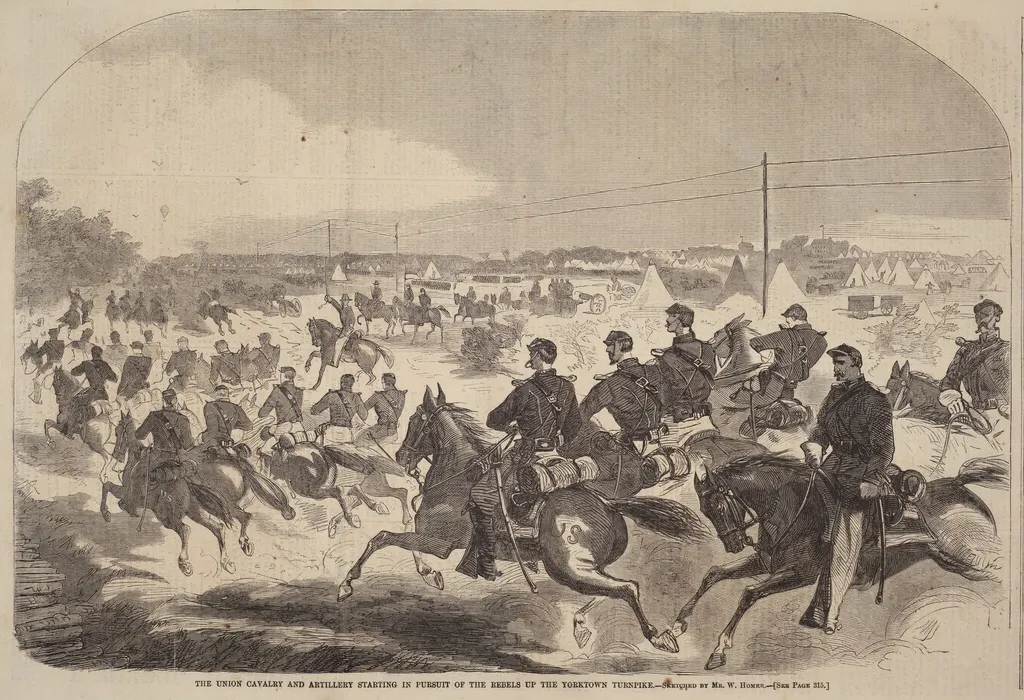
The Union Cavalry and Artillery Starting in Pursuit of the Rebels up the Yorktown Turnpike is an ink print by the Impressionist artist American 19th Century. It dates from 1862 and is held in the collection of the National Gallery of Art.
About this work
Overview
The medium’s capacity for detail allows for individualized uniforms and weaponry, grounding the scene in documentary realism rather than idealization.
This wood engraving captures a moment during the American Civil War in which Union cavalry and artillery units advance along the Yorktown Turnpike in pursuit of Confederate forces. Rendered with fine, precise lines, the composition conveys motion and urgency through overlapping figures, galloping horses, and scattered equipment. The medium’s capacity for detail allows for individualized uniforms and weaponry, grounding the scene in documentary realism rather than idealization.
Subject & Meaning
The image depicts Union forces in active pursuit, emphasizing momentum and tactical movement rather than combat. The presence of artillery wagons alongside mounted troops suggests coordinated military operations. The backdrop of tents and distant structures implies a recent encampment, reinforcing the narrative of a rapid transition from rest to pursuit. The absence of enemy figures shifts focus to the Union’s organizational drive and logistical effort.
Technique & Style
Executed as a wood engraving, the work relies on meticulously carved lines to render texture, depth, and movement. Shading is achieved through dense cross-hatching and varying line weights, giving volume to horses, uniforms, and terrain. The style prioritizes clarity and narrative immediacy, typical of illustrated journalism of the period. Fine details in harnesses, weapons, and tent flaps reflect the engraver’s technical precision and commitment to visual accuracy.
History & Provenance
Created during the Civil War, this print likely appeared in a periodical such as Harper’s Weekly, which regularly commissioned artists to document military campaigns. Its production coincided with the Peninsula Campaign of 1862, when Union forces advanced toward Richmond along the Yorktown Turnpike. As a mass-produced image, it served to inform Northern audiences and bolster morale through visual reporting of troop movements.
Context
Wood engravings like this were central to wartime media, bridging the gap between battlefield reality and public perception. With photography still limited in mobility and reproduction, engravings provided the most accessible visual record of military activity. This piece reflects the Union’s emphasis on mobility and pursuit as strategic priorities, contrasting with earlier static siege imagery and signaling a shift toward dynamic, mobile warfare.
Legacy
The engraving stands as an example of 19th-century visual journalism, preserving the look and rhythm of Union cavalry operations. While not attributed to a single artist, its craftsmanship reflects the collective skill of illustration teams working under tight deadlines. Today, it remains a primary source for understanding how contemporary audiences perceived the pace and scale of Civil War campaigns through printed media.
Artist & collection

Artist
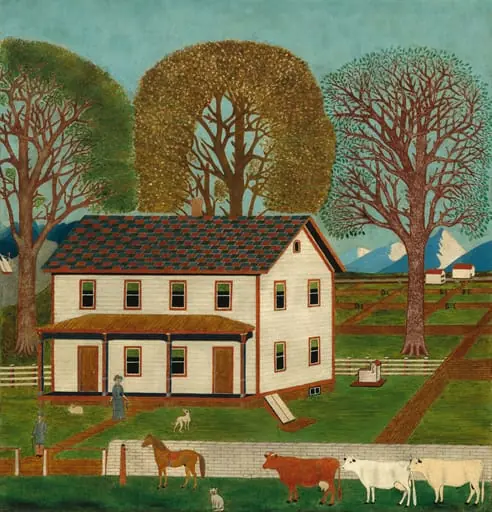
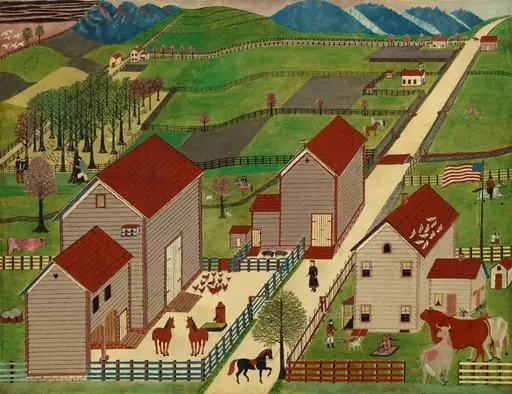
This artist painted everyday American life in the 1800s. Look at *Farmhouse in Mahantango Valley*—a quiet, sunlit scene of rural Pennsylvania. *Boy and Girl* shows two children standing close, their faces turned toward…

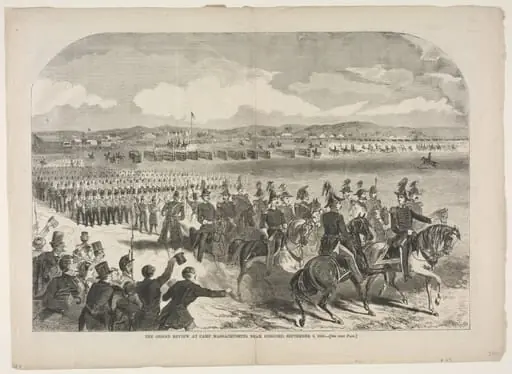 The Grand Review at Camp Massachusetts, near Concord, September 9, 1859
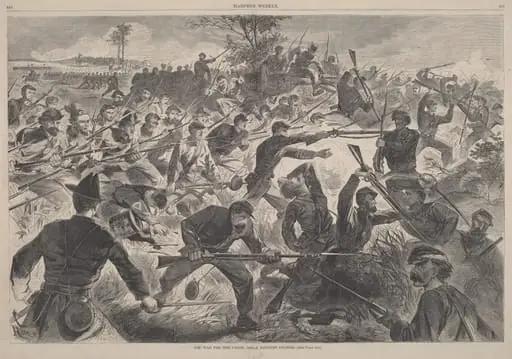 The War for the Union, 1862 - A Bayonet Charge
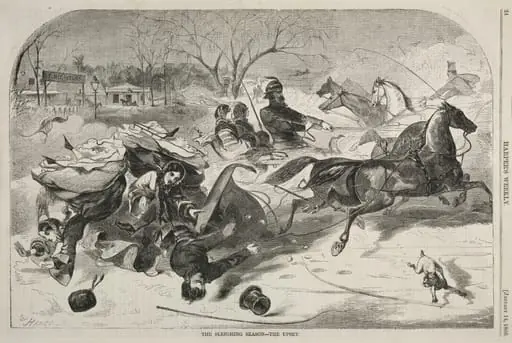 The Sleighing Season - The Upset
 The Songs of the War
 The Songs of War
 Album for 1835: Carré enfoncé...
 Υδατογραφία του ελληνικού στρατού κατά τον Ελληνοτουρκικό πόλεμο του 1897
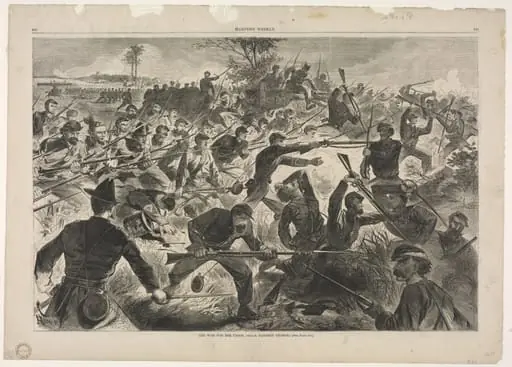 The War for the Union, 1862 - A Bayonet Charge