Artwork
Elephants in a circus
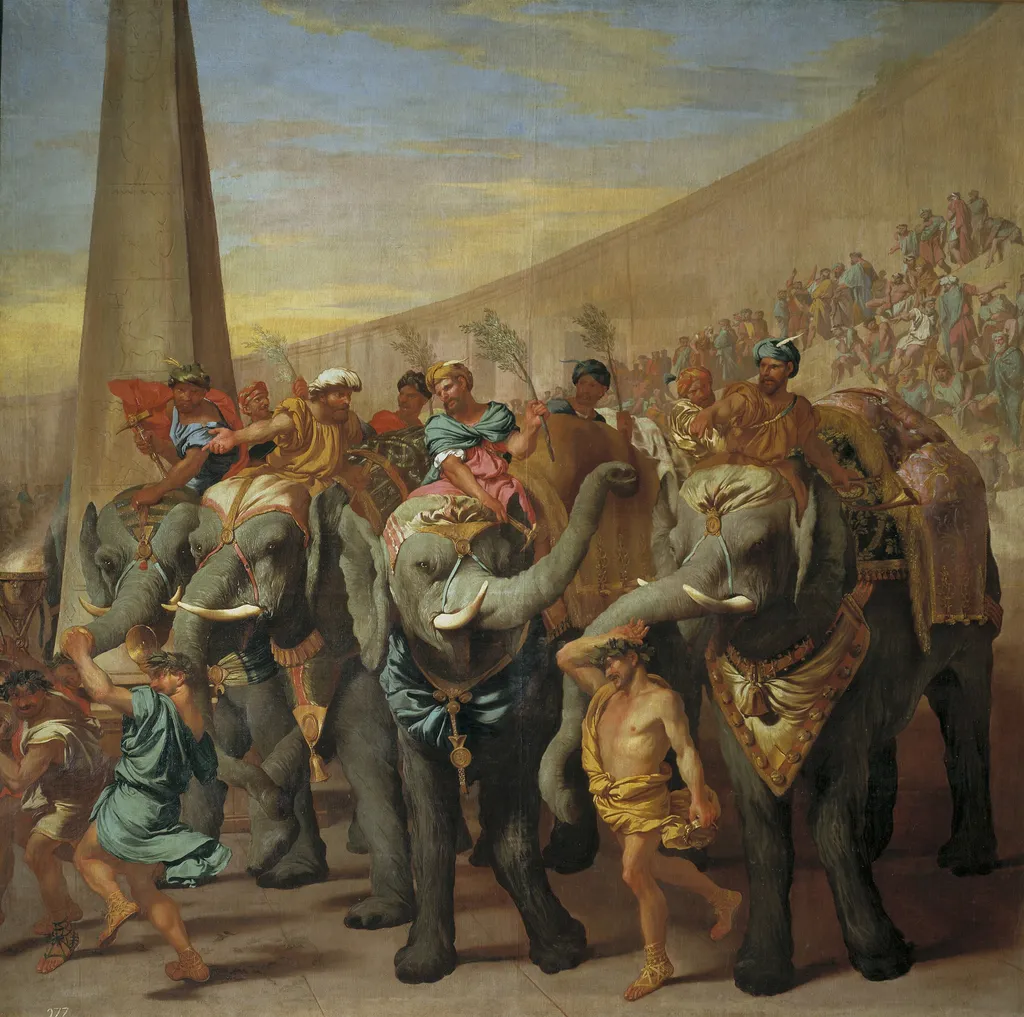
Elephants in a circus is an oil painting by the Early Baroque Italian artist Andrea di Leone. It dates from 1640 and is held in the collection of the Museo del Prado.
About this work
Overview
Created in 1640 by the Neapolitan Baroque painter Andrea di Leone, this oil on canvas presents a bustling circus tableau centered on two elaborately adorned elephants. The composition is filled with figures on horseback and on foot, each engaged with musical instruments or props, set against a warm, hazy backdrop that emphasizes the festive atmosphere.
Subject & Meaning
The work captures a moment of public spectacle, highlighting the exotic appeal of circus elephants as symbols of wonder and entertainment. The presence of a trumpet, a rattle, and a weary onlooker suggests a narrative of performance, while the crowded setting reflects the social dynamics of popular gatherings in 17th‑century Italy.
Technique & Style
Di Leone employs the Baroque penchant for movement and drama, arranging figures in a lively, diagonal flow. Rich hues of red, gold, and blue contrast with a softened background, while chiaroscuro modeling gives depth to the elephants and surrounding crowd, enhancing the sense of three‑dimensional space and kinetic energy.
History & Provenance
Since its creation, the painting has entered the collection of Madrid’s Museo del Prado, where it is displayed among other Italian Baroque works. Its acquisition reflects the museum’s broader effort to represent the diverse artistic output of early 17th‑century Europe.
Context
The piece belongs to the early Italian Baroque movement, a period marked by heightened emotional expression and theatricality. Naples, Di Leone’s native city, was a vibrant cultural hub where exotic animal exhibitions were popular, providing artists with subject matter that combined local festivity with the allure of the foreign.
Own this work as a print
Artist & collection
Artist
Andrea di Leone (8 September 1610 – 12 February 1685) was an Italian painter of the Baroque period, active in his native city of Naples.
