Artwork
Descent into Limbo
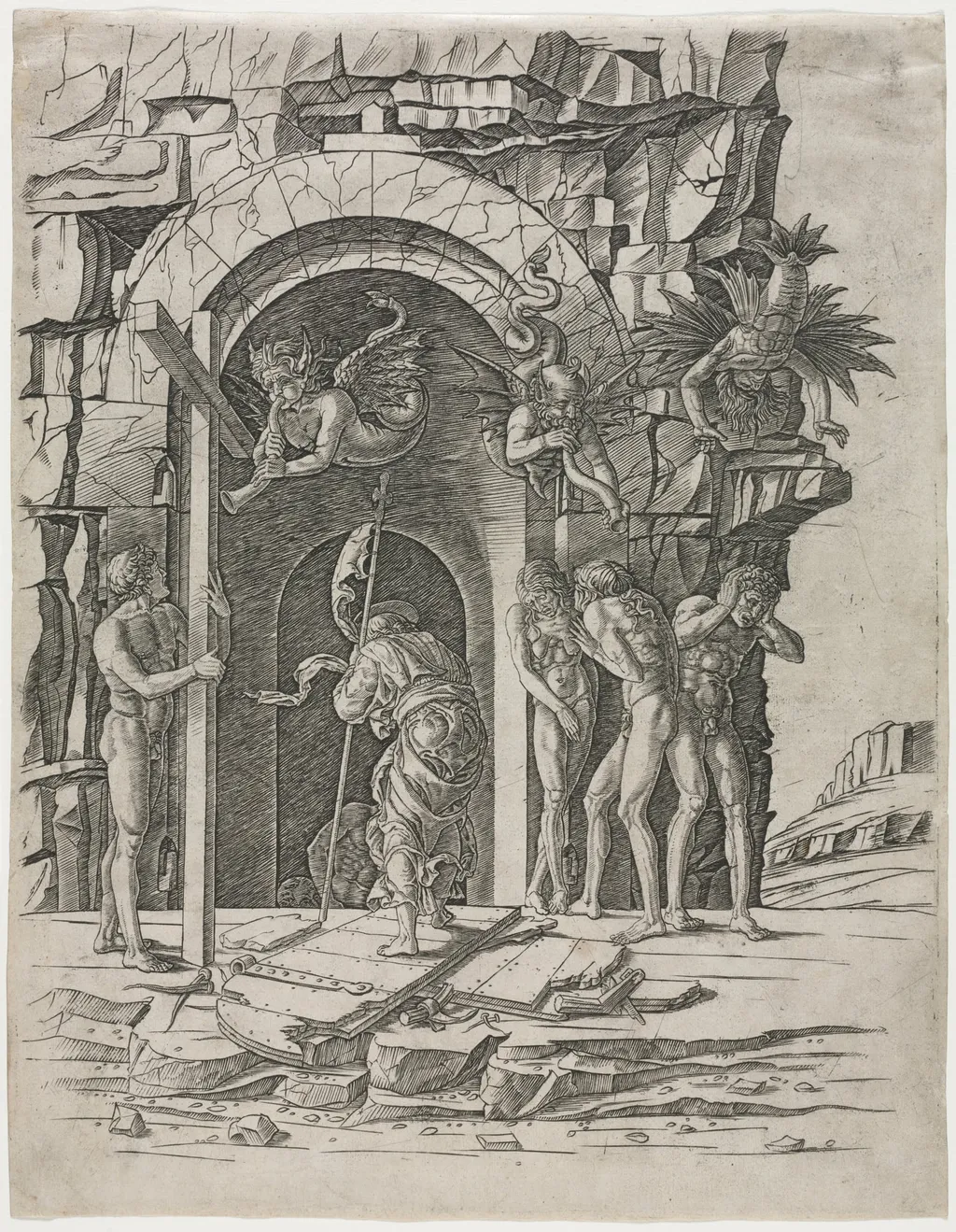
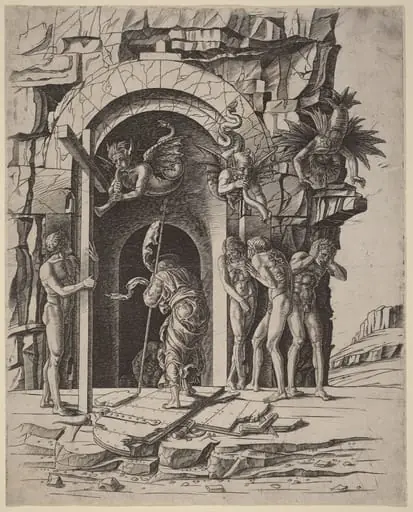
Descent into Limbo is a print by the Renaissance artist Andrea Mantegna. It dates from 1464 and is held in the collection of the Cleveland Museum of Art.
About this work
Overview
Executed as a graphic work, it reflects his broader painterly concerns: architectural precision, sculptural form, and dramatic spatial compression.
This black-and-white print depicts a scene from Christian tradition known as the Harrowing of Hell, rendered by Andrea Mantegna around 1464. Executed as a graphic work, it reflects his broader painterly concerns: architectural precision, sculptural form, and dramatic spatial compression. The image is part of the Cleveland Museum of Art’s collection and exemplifies Mantegna’s interest in classical antiquity and spatial innovation.
Subject & Meaning
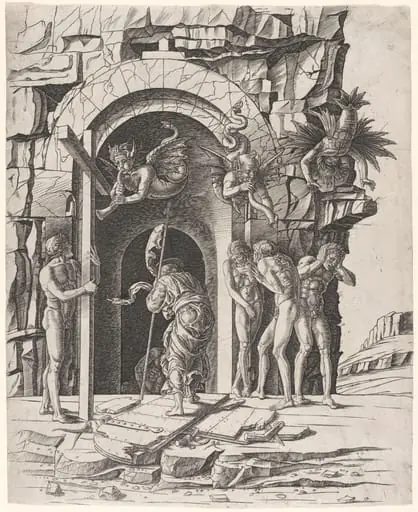
The scene illustrates Christ’s descent into Limbo to liberate the righteous souls of the Old Testament. A bearded figure, likely Christ, opens a heavy portal, while figures within—naked and ancient—react with awe. A winged entity above the arch may symbolize divine presence or a soul in transition. Palm fronds, traditional emblems of victory, suggest triumph over death, reinforcing the theological narrative of redemption.
Technique & Style
Mantegna employs sharp, incised lines and deep chiaroscuro to define forms with a metallic, stone-like texture. Figures are rendered with muscular clarity, their bodies modeled as if carved rather than painted. The compressed space, achieved through a low horizon and overlapping planes, enhances the monumentality of the scene. The contrast between solid, earthly figures and the ethereal shapes within the cave adds psychological tension.
History & Provenance
Created during Mantegna’s early career in Padua, this print likely served as a devotional image or study for a larger composition. It entered the Cleveland Museum of Art’s collection in the 20th century, where it is preserved as part of a broader group of Renaissance prints reflecting the artist’s influence on graphic arts. Its survival in black-and-white underscores its origins in a period when printmaking was gaining artistic legitimacy.
Context
Mantegna’s work emerged amid a revival of classical antiquity in northern Italy, where artists studied Roman sculpture and architecture to inform their compositions. His use of perspective and anatomical rigor aligned with humanist ideals. This print reflects broader trends in 15th-century religious imagery, where theological narratives were rendered with heightened realism and emotional gravity to engage the viewer’s devotion.
Legacy
Mantegna’s integration of sculptural form and spatial depth influenced generations of printmakers and painters. His precise line work and dramatic lighting became benchmarks for Northern Italian Renaissance graphics. Though this print is not widely reproduced, its technical discipline and symbolic density remain significant in understanding the evolution of religious imagery in early print culture.
Artist & collection
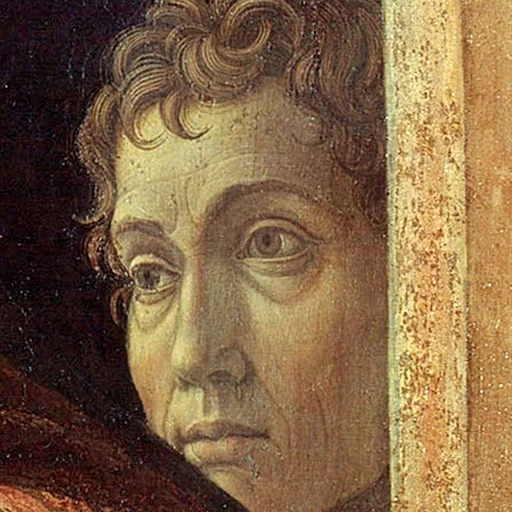
Artist
Andrea Mantegna (UK: , US: ; Italian: ; c. 1431 – September 13, 1506) was an Italian Renaissance painter, a student of Roman archaeology, and the son-in-law of Jacopo Bellini. Like other artists of the time, Mantegna…