Artwork
Aeneas Takes Leave of Dido
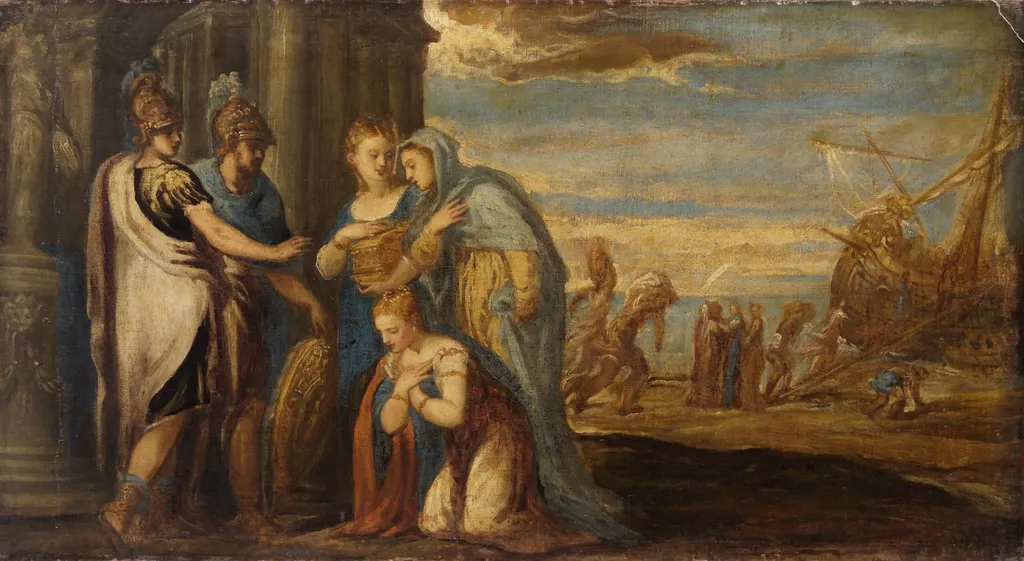
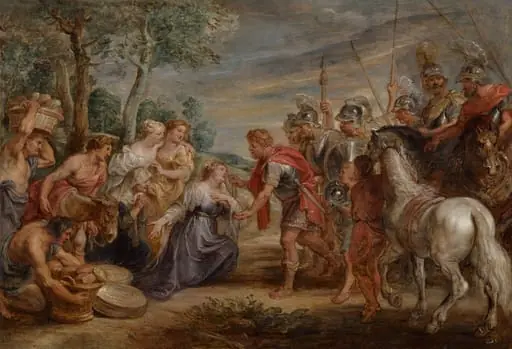
Aeneas Takes Leave of Dido is an oil painting by the Mannerist artist Andrea Schiavone. It dates from 1555 and is held in the collection of the Kunsthistorisches Museum.
About this work
Overview
Andrea Schiavone’s oil painting *Aeneas Takes Leave of Dido*, executed in 1555, portrays the dramatic farewell between the Trojan hero and the Carthaginian queen. The composition gathers several figures in classical attire before a columned façade, with a ship poised on the water in the background. The work is part of the Kunsthistorisches Museum’s collection in Vienna.
Subject & Meaning
The scene draws from Virgil’s *Aeneid*, capturing the moment Aeneas departs Carthage, leaving Dido and their unborn child. A armored Aeneas clasps Dido’s hand while a grieving woman in blue kneels with a child, clutching a golden object that may symbolize the broken pact. The arrangement emphasizes loss, duty, and the tension between personal affection and destiny.
Technique & Style
Rendered in the Mannerist idiom, the painting employs elongated figures, complex poses, and a heightened sense of drama. Schiavone’s handling of light and shadow reflects a chiaroscuro approach, modeling forms through strong contrasts. The palette and brushwork reveal the influence of Venetian masters, particularly Titian, while retaining the artist’s own idiosyncratic spatial ambiguity.
History & Provenance
Born Andrea Meldolla in Dalmatia, Schiavone spent most of his career in Venice, where he merged local painting traditions with Mannerist tendencies. *Aeneas Takes Leave of Dido* entered the Kunsthistorisches Museum’s holdings in the 19th century, though earlier ownership records are sparse. The painting has been documented in several catalogues of Venetian Mannerism.
Context
The work belongs to the broader 16th‑century fascination with classical mythology, a subject that allowed artists to explore human emotion within grand historical narratives. In Venice, the interplay between the city’s rich coloristic tradition and the emerging Mannerist style created a fertile environment for painters like Schiavone to experiment with composition and affect.
Artist & collection
Artist
Andrea Meldolla (Croatian: Andrija Medulić), also known as Andrea Schiavone or Andrea lo Schiavone, literally "Andrew the Slav", (c.