Artwork
Archduke Ferdinand and Archduchess Maria Anna of Austria
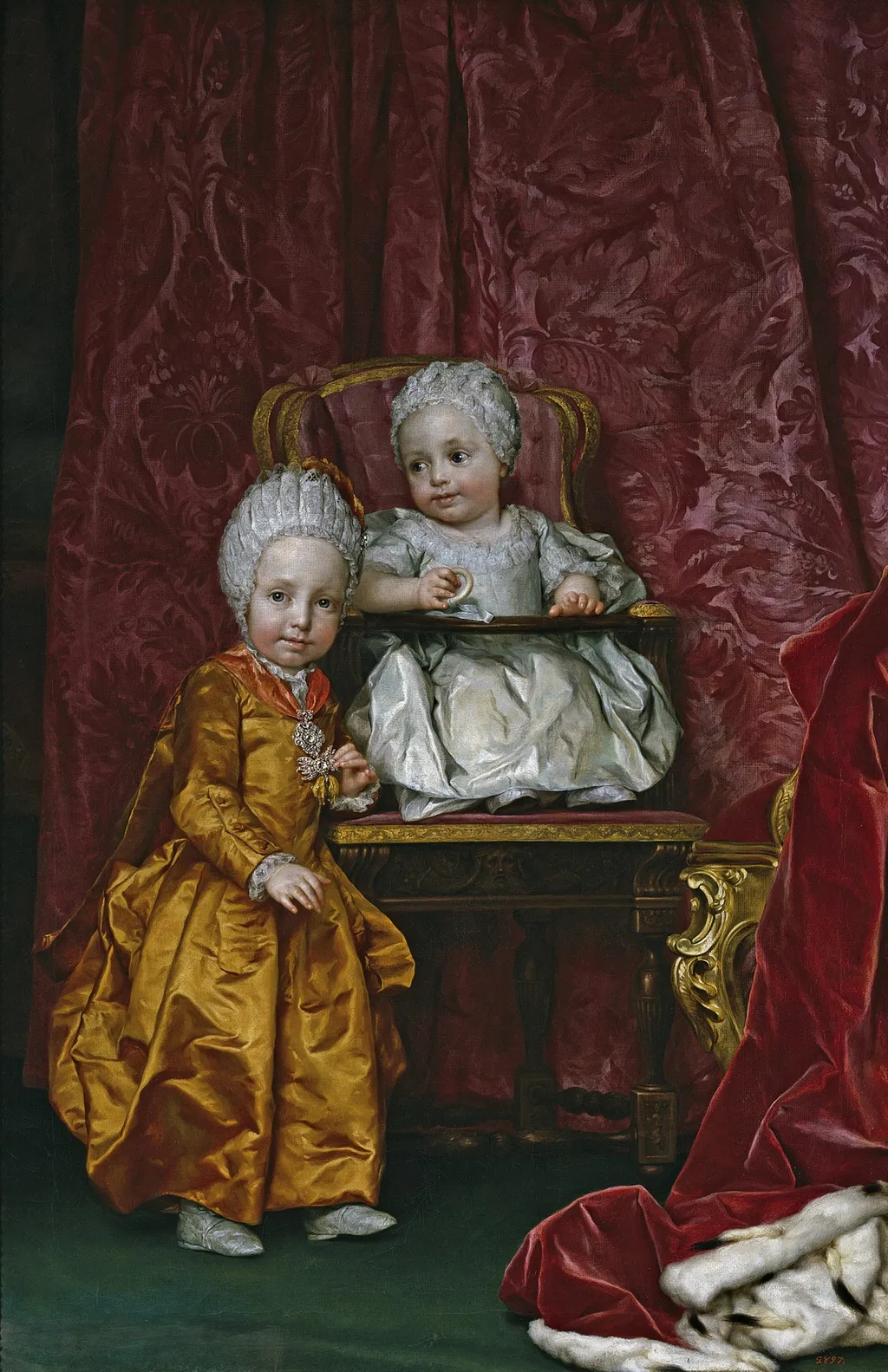
Archduke Ferdinand and Archduchess Maria Anna of Austria is an oil painting by the Rococo painting artist Anton Raphael Mengs. It dates from 1770 and is held in the collection of the Museo del Prado.
About this work
A boy in a bright yellow coat stands holding a fancy medal, while a baby in a white dress sits in a gilded chair behind him.
A boy in a bright yellow coat stands holding a fancy medal, while a baby in a white dress sits in a gilded chair behind him. Both have big white wigs and serious faces. Rich red curtains frame the scene, and a red cloth lies on the floor with a white fur trim.
The boy’s medal looks like the *Golden Fleece*, a symbol of honor. The painting was made in 1770, but the kids’ expressions feel timeless.
Next, look up the *Golden Fleece* to see why this medal mattered.
Overview
Anton Raphael Mengs painted an oil portrait in 1770 that is now part of the Museo del Prado’s collection. The work presents two young members of the Habsburg family, positioned against a richly draped backdrop of red curtains and a floor covered with a red carpet edged in white fur. The composition balances formal regalia with the children’s solemn expressions.
Subject & Meaning
The figures are Archduke Ferdinand, later Grand Duke of Tuscany, and his sister Archduchess Maria Anna. Both wear elaborate white wigs and formal attire, underscoring their noble status. The young boy holds the Golden Fleece, a prestigious chivalric order, indicating the family’s high rank and the political significance of the order within the Austrian court.
Technique & Style
Executed in oil on canvas, Mengs employs a smooth, luminous finish characteristic of late Baroque classicism. The bright yellow coat of the boy contrasts with the deep reds of the curtains, while subtle modeling of flesh and fabric creates a sense of three‑dimensionality. The precise rendering of the medal and textiles reflects Mengs’s academic training.
History & Provenance
Created in 1770, the portrait entered the Spanish royal collection before being transferred to the Prado Museum, where it remains on display. Its documentation traces a straightforward path from the Habsburg patronage of the artist to its current public setting, illustrating the movement of courtly artworks across European royal houses.
Context
The painting emerges during a period when the Habsburgs emphasized dynastic continuity through portraiture of heirs. The inclusion of the Golden Fleece links the children to the Order of the Golden Fleece, a symbol of loyalty to the Spanish and Austrian crowns, reinforcing political alliances in the late eighteenth century.
Own this work as a print
Artist & collection