Artwork
Feast of Our Lady of Herbs
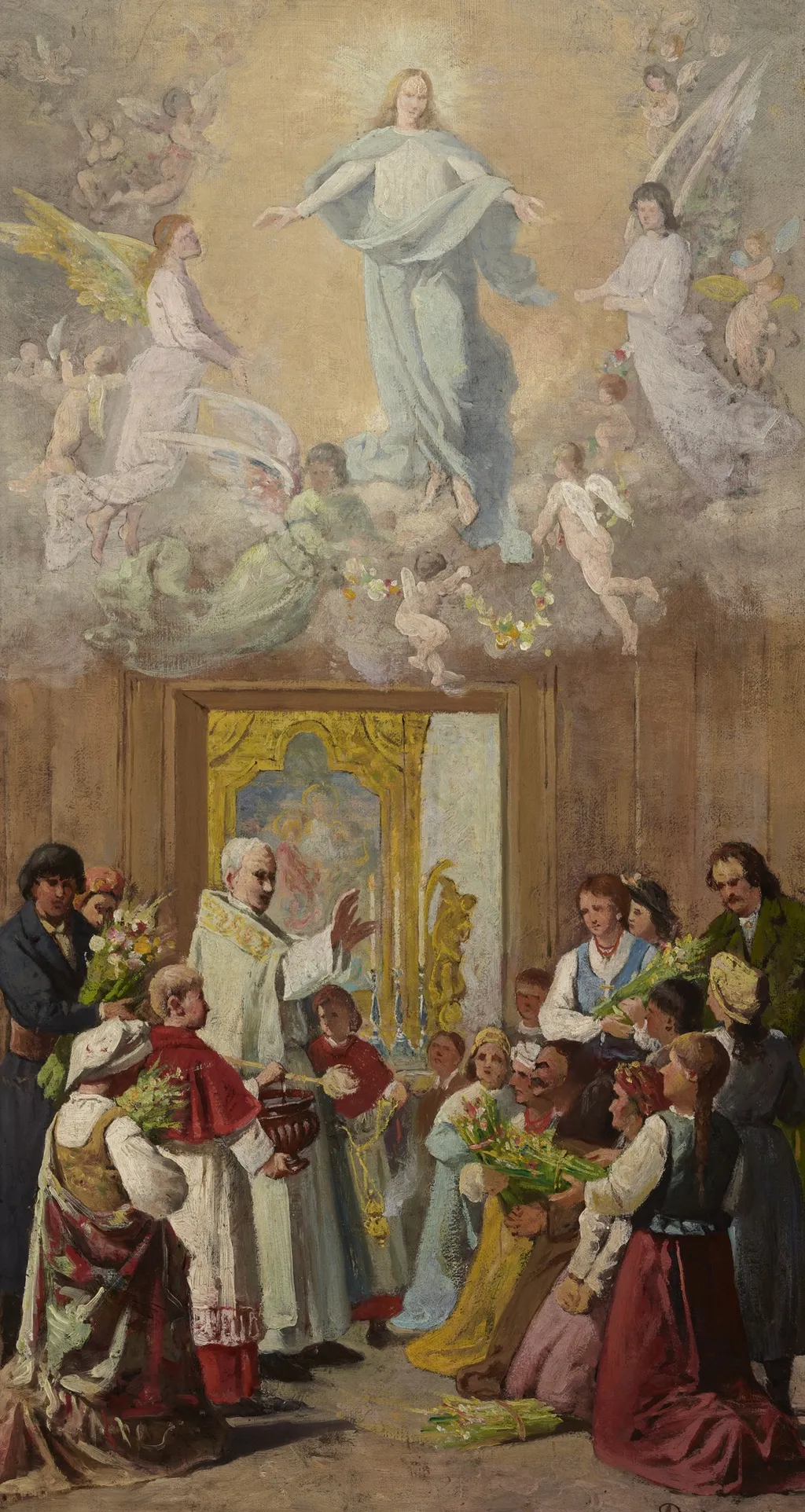
Feast of Our Lady of Herbs is an oil painting by Antoni Gramatyka. It dates from 1891 and is held in the collection of the National Museum in Kraków.
About this work
Overview
Painted around 1891 by Antoni Gramatyka, this oil work captures a religious festival centered on the veneration of herbs. It resides in the National Museum in Kraków, where it is noted for its vivid depiction of communal devotion. The composition blends earthly ritual with celestial imagery, creating a layered narrative of faith and celebration within a domestic interior.
Subject & Meaning
A priest in white stands before a doorway, offering the herbs from a large bowl, while worshippers kneel and hold blossoms.
The scene portrays a blessing of herbs, a traditional Slavic custom tied to healing and protection. A priest in white stands before a doorway, offering the herbs from a large bowl, while worshippers kneel and hold blossoms. Above, a luminous female figure—likely the Virgin Mary—hovers amid angels, suggesting divine presence. The gathering reflects both popular piety and the blending of folk tradition with Catholic ritual.
Technique & Style
Gramatyka employs soft chiaroscuro to model forms and suggest spatial depth, particularly in the figures’ drapery and the dimly lit interior. Warm earth tones in the walls contrast with the bright hues of the attendees’ clothing and the radiant white of the celestial figures. The brushwork is detailed yet restrained, emphasizing texture in fabrics and floral elements without overt theatricality.
History & Provenance
The painting was completed in the late 19th century and entered the collection of the National Museum in Kraków shortly thereafter. Its preservation reflects its significance as a regional religious work from a period of heightened national cultural identity in Polish art. No major alterations or restorations are documented in public records.
Context
Created during a time when Polish artists sought to affirm cultural identity under foreign partitions, the painting draws on local customs rather than grand historical or mythological themes. Similar devotional scenes appeared in rural churches and homes, but Gramatyka’s rendering elevates the ordinary into a sacred moment, aligning with broader European trends in religious genre painting.
Legacy
Though not widely exhibited beyond Poland, the work remains a key example of late 19th-century Polish religious painting that honors folk practice. It contributes to scholarly understanding of how regional rituals were visually codified in academic art, bridging popular devotion and institutional aesthetics without idealization.
Artist & collection

 La muerte de San Francisco
 La adoración de la Sagrada Forma
 Literary Chapel in St. John’s Cathedral in Warsaw
 The Distribution of Rosaries
 Himmelfahrt Mariae
 Village School at Wróblewice
 Institución de la Orden Trinitaria por Inocencio III en 1190
 Pope Gregory XVI Visiting the Church of San Benedetto at Subiaco
 Ferdinand VII swears the Oath as Prince of Asturias
 Confessional, Church of St. Paul, Antwerp
 Das Innere einer italienischen Kirche
 The Mass of Saint Basil