Artwork
Triptych: Bust of Christ, Saint John the Baptist and Saint Peter. Closed: Saint John the Evangelist and Saint Colombe
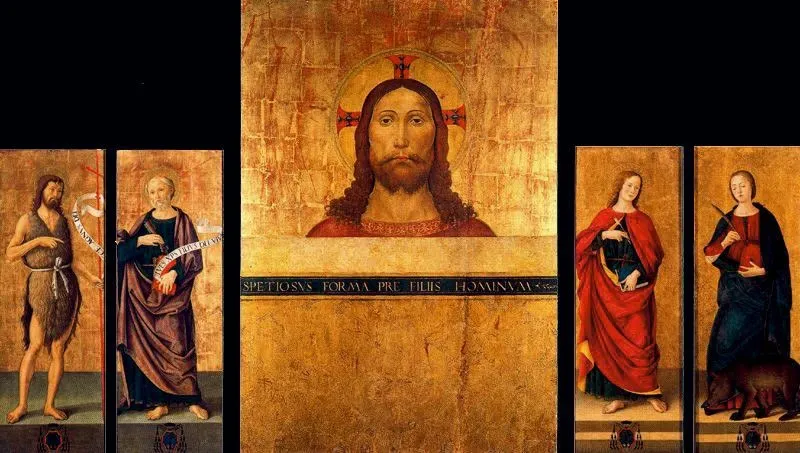
Triptych: Bust of Christ, Saint John the Baptist and Saint Peter. Closed: Saint John the Evangelist and Saint Colombe is an unspecified painting by the Early Renaissance artist Antoniazzo Romano. It dates from 1498 and is held in the collection of the Museo del Prado.
About this work
Overview
This piece is currently preserved in the Museo del Prado, showcasing Romano's characteristic blend of contemporary and traditional elements.
Antoniazzo Romano, a leading painter of the Roman school in the late 15th century, completed this triptych in 1498. The artwork, rendered in an Early Renaissance style, depicts various religious figures, including Christ, Saint John the Baptist, Saint Peter, Saint John the Evangelist, and Saint Colombe. This piece is currently preserved in the Museo del Prado, showcasing Romano's characteristic blend of contemporary and traditional elements.
Subject & Meaning
The central panel of the open triptych features a bust of Christ, with Saint John the Baptist and Saint Peter appearing on the side panels. When closed, the exterior reveals Saint John the Evangelist and Saint Colombe, a less commonly depicted saint. Below Christ, the Latin inscription "Speciosus forma prae filiis hominum" translates to "beautiful in the sight of the sons of men," emphasizing his divine presence.
Technique & Style
Executed in an Early Renaissance manner, the triptych intentionally incorporates older iconographic styles. Antoniazzo Romano was known for reviving such traditions, notably employing the gold ground technique in this work. This method contributes to the painting's archaic quality, fostering a sense of timelessness and reverence, consistent with its function as a cult image.
History & Provenance
This triptych was created in 1498 by Antoniazzo Romano, a prominent figure in the Roman art scene of the late Quattrocento. His artistic practice often involved integrating historical iconography with contemporary approaches. The painting has since become a part of the esteemed collection at the Museo del Prado, where it is exhibited today.
Artist & collection
Artist
Antonio di Benedetto Aquilo degli Aquili (c. 1430 – c. 1510), known as Antoniazzo Romano, was an Italian Early Renaissance painter, the leading figure of the Roman school during the latter part of the 15th century He…