Artwork
Views: The Market on the Molo
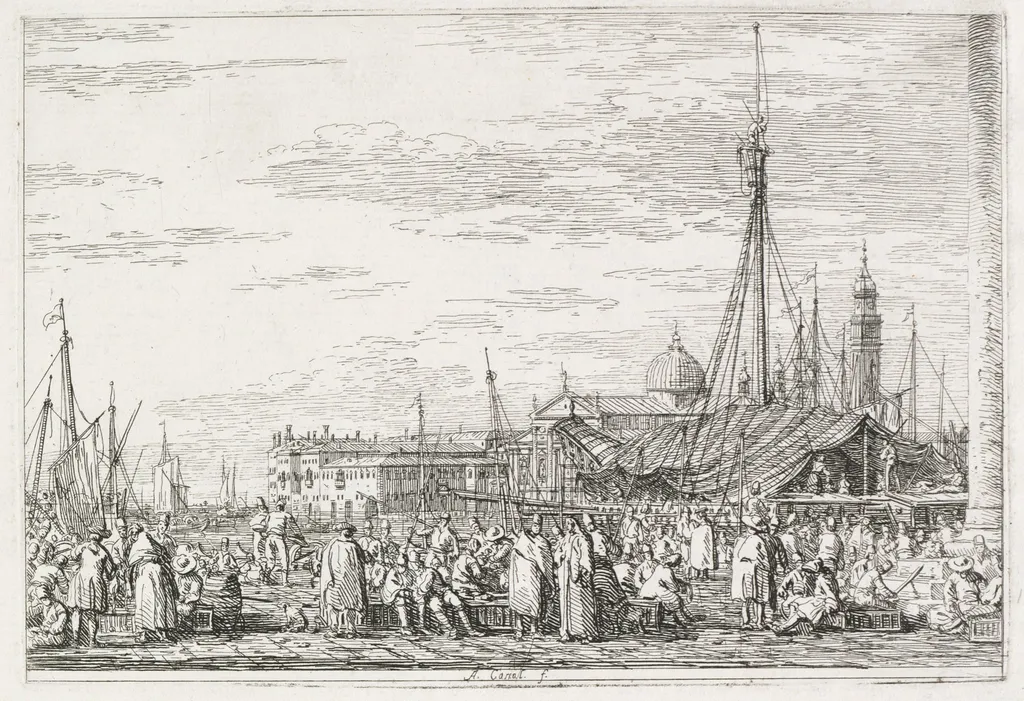
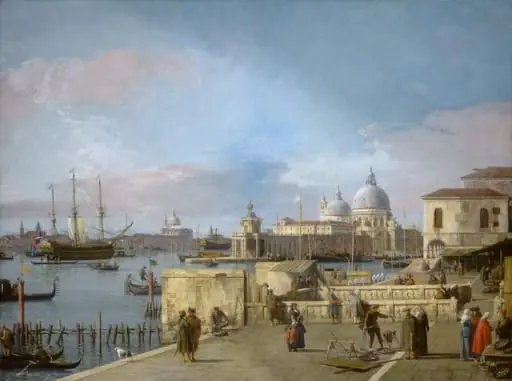
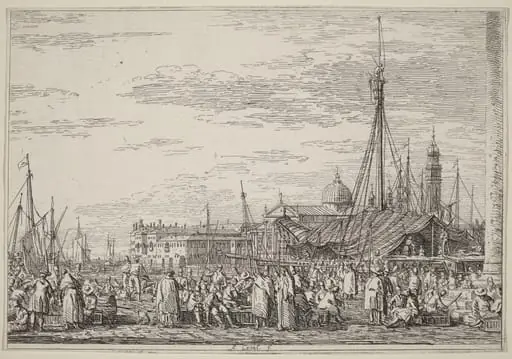
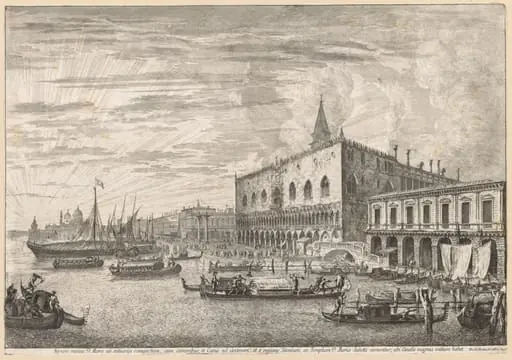
Views: The Market on the Molo is a print by the Baroque artist Canaletto. It dates from 1740 and is held in the collection of the Cleveland Museum of Art.
About this work
Overview
Created in 1740 by Giovanni Antonio Canal, known as Canaletto, this print is part of a series documenting Venice’s urban landscape.
Created in 1740 by Giovanni Antonio Canal, known as Canaletto, this print is part of a series documenting Venice’s urban landscape. Unlike his oil paintings, this work is rendered in fine linear detail, likely as a preparatory drawing or engraved print. It captures the Molo, Venice’s principal waterfront, as a hub of commercial and social activity, emphasizing architectural precision and atmospheric depth through controlled shading.
Subject & Meaning
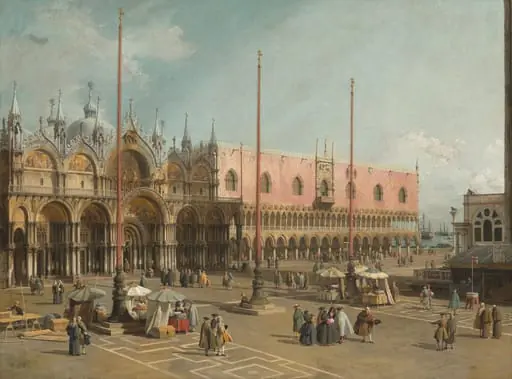
The scene portrays everyday life along Venice’s Molo, where merchants, laborers, and travelers gather near the docks. Tall ships with full sails suggest active maritime trade, while the domed buildings and spires in the background reflect the city’s religious and civic identity. The composition conveys no single narrative but instead presents a quiet testament to Venice’s function as a commercial crossroads, grounded in observation rather than symbolism.
Technique & Style
Canaletto employs precise, incised lines to define structures and figures, evoking the clarity of etching. Light and shadow are carefully modulated to suggest volume and spatial recession, despite the monochrome medium. The choppy water and layered architecture are rendered with measured accuracy, reflecting his training in stage design and his commitment to topographical fidelity over romantic embellishment.
History & Provenance
This work likely originated as a study for a larger painting or as a print intended for collectors interested in Venetian views. Though its exact early ownership is undocumented, it aligns with Canaletto’s broader practice of producing detailed urban scenes for Grand Tour travelers. Its survival as a standalone drawing underscores its value as a record of 18th-century Venetian topography and artistic process.
Context
In mid-18th century Venice, vedute—detailed cityscapes—gained popularity among foreign visitors seeking souvenirs of the city’s grandeur. Canaletto’s work responded to this demand, blending documentary precision with aesthetic order. The Molo, as the city’s primary port, was a natural subject, embodying Venice’s maritime identity amid its shifting political and economic fortunes.
Legacy
Canaletto’s approach to urban observation influenced later topographical artists and the development of architectural drawing as a disciplined practice. This print, like others in his oeuvre, remains a reference for historians studying Venice’s physical layout and daily rhythms before industrialization altered its character. His method of recording space through line and tone set a standard for visual documentation in the pre-photographic era.
Artist & collection
Artist
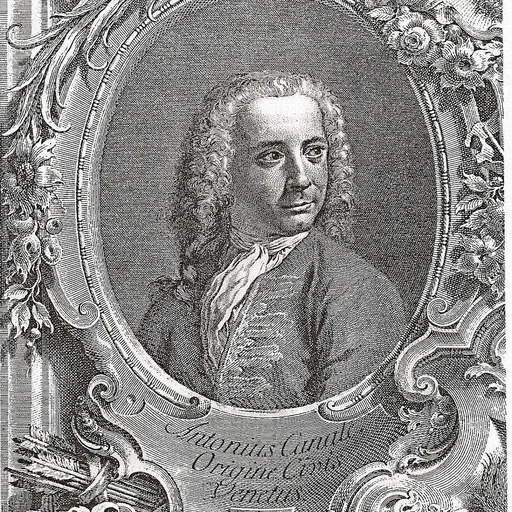
Giovanni Antonio Canal (18 October 1697 – 19 April 1768), commonly known as Canaletto (Italian: ), was an Italian painter from the Republic of Venice, considered an important member of the 18th-century Venetian school.


![The Market on the Molo [upper left], by Canaletto](https://artifactworldgallery.com/img/canaletto--the-market-on-the-molo-upper-left--85c85bc3adc3874e-w320.webp)
![The Market at Dolo [lower left], by Canaletto](https://artifactworldgallery.com/img/canaletto--the-market-at-dolo-lower-left--67bc6365ace095d4-w320.webp)