Artwork
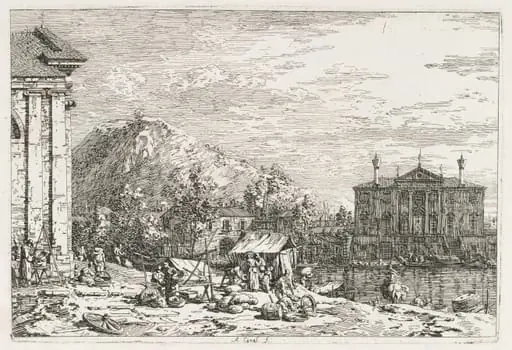
The Market at Dolo [lower left]
![The Market at Dolo [lower left], by Canaletto, ink, 1740](https://artifactworldgallery.com/img/canaletto--the-market-at-dolo-lower-left--67bc6365ace095d4-w1024.webp)
The Market at Dolo [lower left] is an ink print by the Baroque artist Canaletto. It dates from 1740 and is held in the collection of the National Gallery of Art.
About this work
Overview
Created around 1740, *The Market at Dolo* is an etching on laid paper by Giovanni Antonio Canal, known as Canaletto.
Created around 1740, *The Market at Dolo* is an etching on laid paper by Giovanni Antonio Canal, known as Canaletto. It belongs to his broader body of printmaking work, which complemented his painted vedute. Unlike his finished oil paintings, this piece captures a fleeting moment of daily life in the Venetian lagoon, rendered in fine linear detail typical of etched impressions. The work reflects his engagement with both topographical accuracy and the expressive potential of the print medium.
Subject & Meaning
The scene portrays a bustling riverside market at Dolo, a town near Venice, where merchants sell goods beneath temporary awnings. Boats moored along the bank suggest the waterway’s role in commerce. Behind them, architectural elements—a columned building and a small temple-like structure—anchor the setting in the regional landscape. The composition emphasizes activity and transience, not idealized grandeur, revealing Canaletto’s interest in the rhythms of ordinary life within his native environment.
Technique & Style
Canaletto employed etching to achieve precise, intricate detail. Fine, controlled lines define the textures of fabric, water, and stone, with cross-hatching suggesting shadow and movement. The choppy water and wavy sky are rendered not with washes but with delicate, rhythmic strokes, characteristic of his printmaking approach. The absence of color focuses attention on form and composition, highlighting his skill in translating observed reality into linear notation on metal plate and paper.
History & Provenance
The print likely originated as part of a series documenting Venetian scenes, produced for collectors interested in topographical accuracy. While specific early ownership records are sparse, such etchings circulated widely among Grand Tour travelers and connoisseurs in the mid-18th century. Its survival in good condition suggests it was carefully preserved, possibly as a study or independent work rather than a reproduction of a painting.
Context
In the 1740s, Canaletto was refining his reputation as a chronicler of Venice’s urban fabric, both in paint and print. While his paintings often idealized the city’s monuments, his etchings like this one offered more intimate, unembellished views of its peripheries. Dolo, though not central to Venice, was accessible by boat and frequented by locals, making it a plausible subject for an artist attuned to the rhythms of daily commerce and transport.
Legacy
This etching contributes to Canaletto’s role in elevating printmaking as a medium for topographical observation. Though less celebrated than his paintings, his prints influenced later artists interested in urban documentation and the expressive potential of line. The work remains a testament to his ability to capture the texture of everyday life with clarity and restraint, bridging the gap between artistic precision and documentary observation.
Own this work as a print
Artist & collection
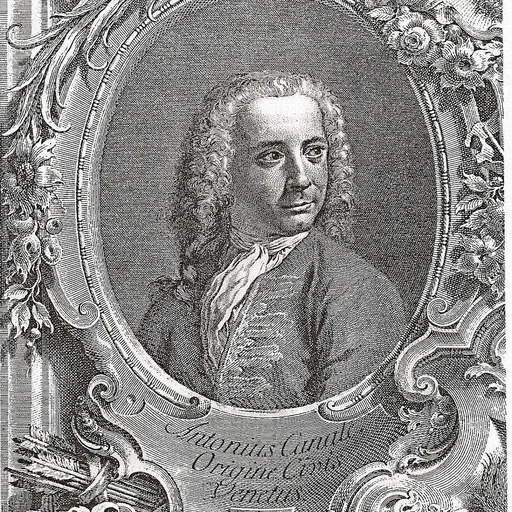
Artist
Giovanni Antonio Canal (18 October 1697 – 19 April 1768), commonly known as Canaletto (Italian: ), was an Italian painter from the Republic of Venice, considered an important member of the 18th-century Venetian school.

 Views: A City Beyond a River
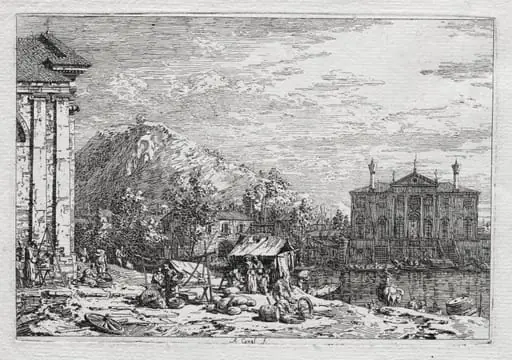 Views of Venice and Environs: A City Beyond a River
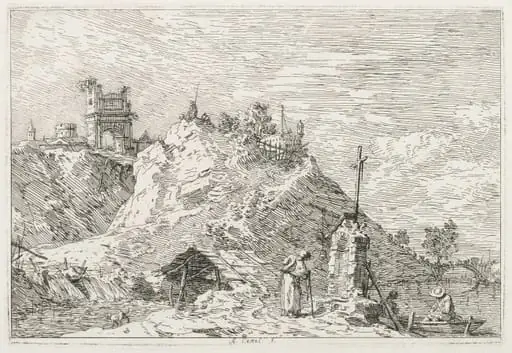 Views: A Pilgrim at Prayer
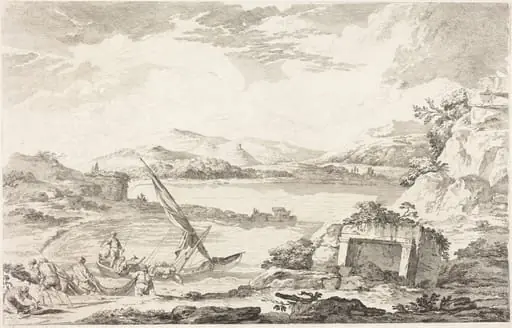 View of the Ancient Port of Phaleron, Athens
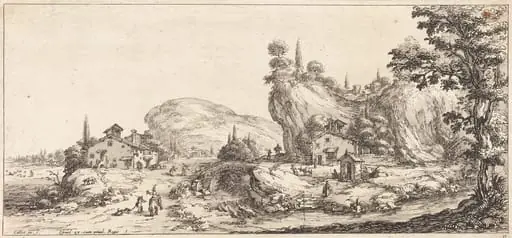 Returning Home from the Hunt
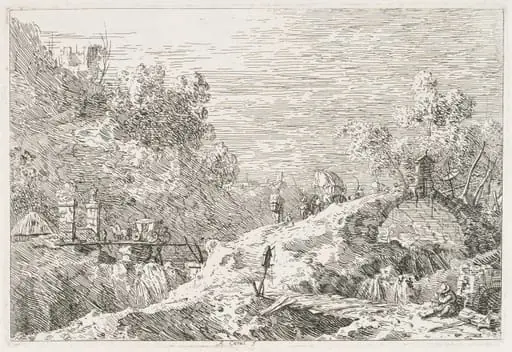 Views: Mountain Landscape with Five Bridges
![Landscape with the Pilgrim at Prayer [upper left], by Canaletto](https://artifactworldgallery.com/img/canaletto--landscape-with-the-pilgrim-at-prayer-upper-left--38f583de7d08bebc-w320.webp) Landscape with the Pilgrim at Prayer [upper left]
Landscape with the Pilgrim at Prayer [upper left]![Mountain Landscape with Five Bridges [lower right], by Canaletto](https://artifactworldgallery.com/img/canaletto--mountain-landscape-with-five-bridges-lower-right--69277fee18bd5080-w320.webp) Mountain Landscape with Five Bridges [lower right]
Mountain Landscape with Five Bridges [lower right]