Artwork
Otto Messinger
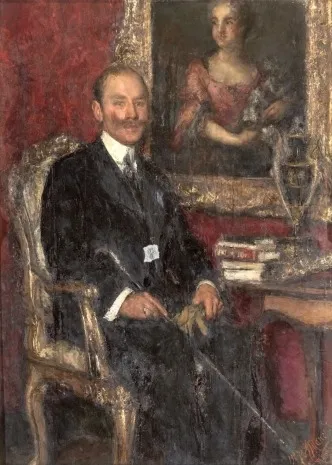
Otto Messinger is an oil painting by the Post-Impressionist artist Antonio Mancini. It dates from 1907 and is held in the collection of the Museo del Prado.
About this work
Overview
Antonio Mancini’s 1907 oil portrait, titled Otto Messinger, presents the German‑born banker Otto Eugen Messinger seated in a formal interior. The work measures roughly a standard easel size and is part of the collection of Madrid’s Museo del Prado, where it is displayed among other early‑20th‑century European portraits.
Subject & Meaning
Messenger is shown in a black suit with a crisp white shirt and tie, his right hand resting on a cane while a small white object—interpreted as a book—lies on his lap. The inclusion of the book suggests intellectual pursuits or personal interests, and the composed pose conveys a sense of dignity and self‑assurance typical of portraiture intended to affirm status.
Technique & Style
Mancini employs a restrained palette of deep reds, blacks, and muted golds, allowing the figure to emerge from a richly colored backdrop. Subtle chiaroscuro models the sitter’s features, while the gold‑framed miniature of a woman in a red dress on the wall adds a decorative counterpoint, enhancing depth through layered pictorial space.
History & Provenance
Created in 1907, the portrait entered the Prado’s holdings through a 20th‑century acquisition, reflecting the museum’s expanding interest in Italian modernists. Documentation traces its ownership from the sitter’s family to the Spanish state, where it has remained a representative example of Mancini’s late career.
Context
The painting belongs to a period when Mancini, known for his expressive brushwork and nuanced lighting, turned to formal commissions for affluent patrons. Otto Messinger’s portrait aligns with contemporary European trends that combined realistic representation with a hint of psychological insight, situating the work within the broader shift toward modern portraiture.
Artist & collection