Artwork
The Oil Ship
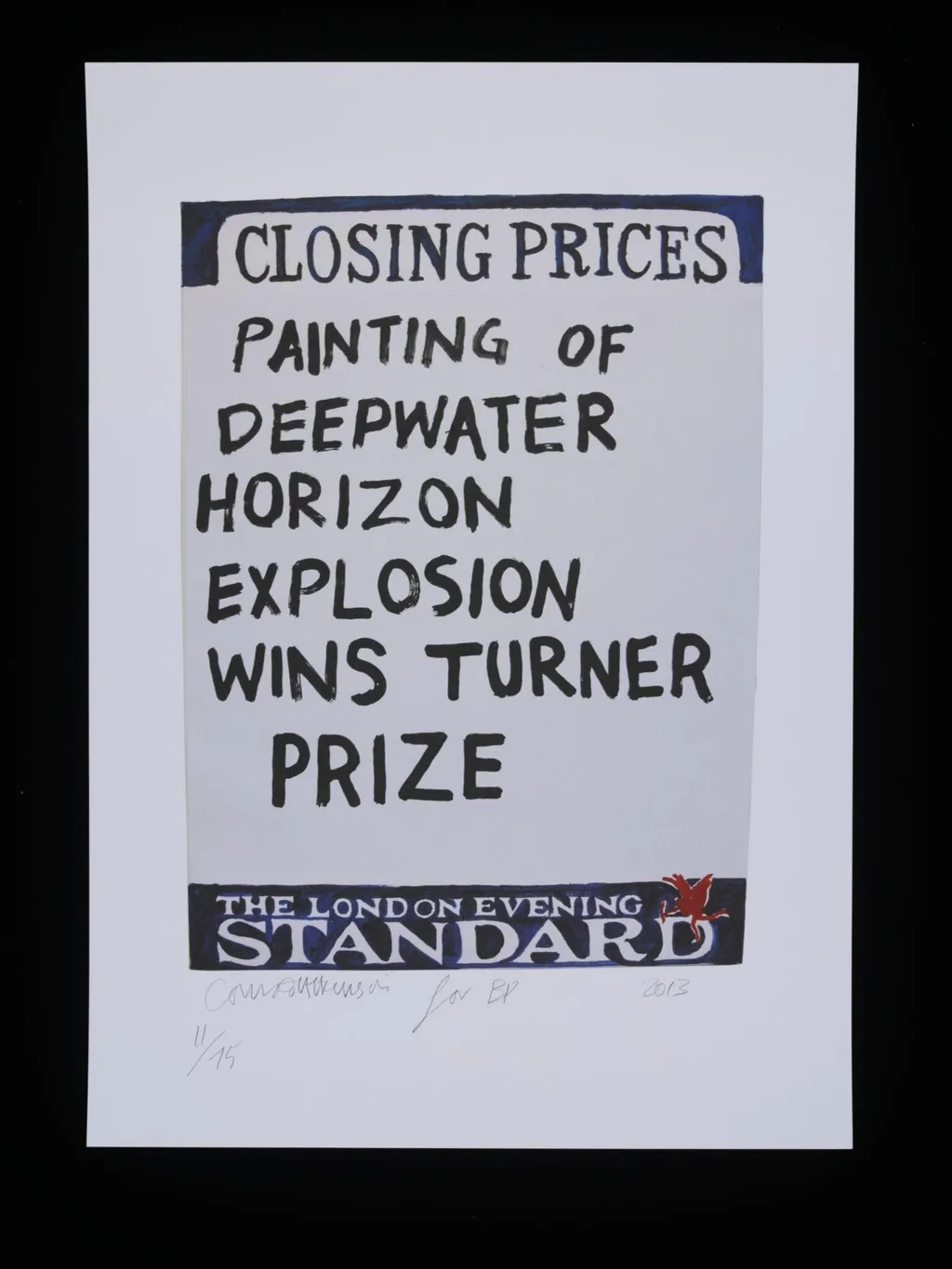
The Oil Ship is a print by Atkinson. It is held in the collection of the Victoria and Albert Museum.
About this work
This print pokes at big oil and big art. Atkinson made it in 2013 to raise cash for a protest group. It looks like a fake newspaper front page.
The headline jokes that a painting of the Deepwater Horizon blast won the Turner Prize. Atkinson has spent years turning real headlines into art.
If you like this kind of sharp, funny print, check out more work by the artist Atkinson.
Overview
It was not intended as a commercial product but as a tool for political engagement, raising funds for protests against BP’s patronage of Tate galleries.
Created in 2013 by Conrad Atkinson, The Oil Ship is a printed parody of a newspaper front page, produced to support the activist group Liberate Tate. The work critiques corporate sponsorship in the arts by mimicking the visual language of tabloid journalism. It was not intended as a commercial product but as a tool for political engagement, raising funds for protests against BP’s patronage of Tate galleries. Atkinson’s practice consistently uses newspaper formats to interrogate power structures in media and culture.
Subject & Meaning
The print’s headline falsely declares that a painting of the Deepwater Horizon oil spill won the Turner Prize, satirizing the commodification of disaster and the art world’s complicity with fossil fuel interests. By referencing J.M.W. Turner’s The Slave Ship, Atkinson draws a parallel between historical exploitation and contemporary environmental harm. The work implicates both corporate sponsors and cultural institutions, suggesting that artistic prestige can be co-opted to legitimize unethical practices.
Technique & Style
Atkinson employs a precise, mimetic style to replicate the layout, typography, and graphic conventions of mainstream newspapers, particularly the Evening Standard. The print’s realism is deliberate, designed to deceive at first glance before revealing its subversive content. He uses oil and acrylic to construct these facsimiles, blending fine art techniques with mass media aesthetics. This method reinforces the tension between authenticity and fabrication in public discourse.
History & Provenance
The work was produced specifically to fundraise for Liberate Tate, an initiative formed to end BP’s sponsorship of Tate institutions. Atkinson, who has had multiple works acquired by the Tate over decades, maintains a complex relationship with the institution: he respects its curatorial integrity while opposing its funding sources. The print is part of a broader series of newspaper parodies held by the V&A and other collections, reflecting his long-standing engagement with media critique.
Context
Atkinson’s practice emerged amid growing public scrutiny of corporate sponsorship in the arts during the 2000s and 2010s. His newspaper works respond to a global pattern of corporate influence over cultural institutions, from Russian state media to Western outlets. The Deepwater Horizon disaster, which occurred in 2010, became a symbol of ecological negligence, and its appropriation in art underscored the moral contradictions of corporate philanthropy in the cultural sphere.
Legacy
The Oil Ship contributes to a tradition of artist-led activism that uses institutional critique to expose ethical conflicts within cultural organizations. While not widely exhibited, the print remains a significant example of how print media can be repurposed as political commentary. Atkinson’s sustained engagement with this form has influenced subsequent generations of artists who use appropriation and parody to challenge the alignment of art with corporate power.
Artist & collection