Artwork
Sts Peter and Paul
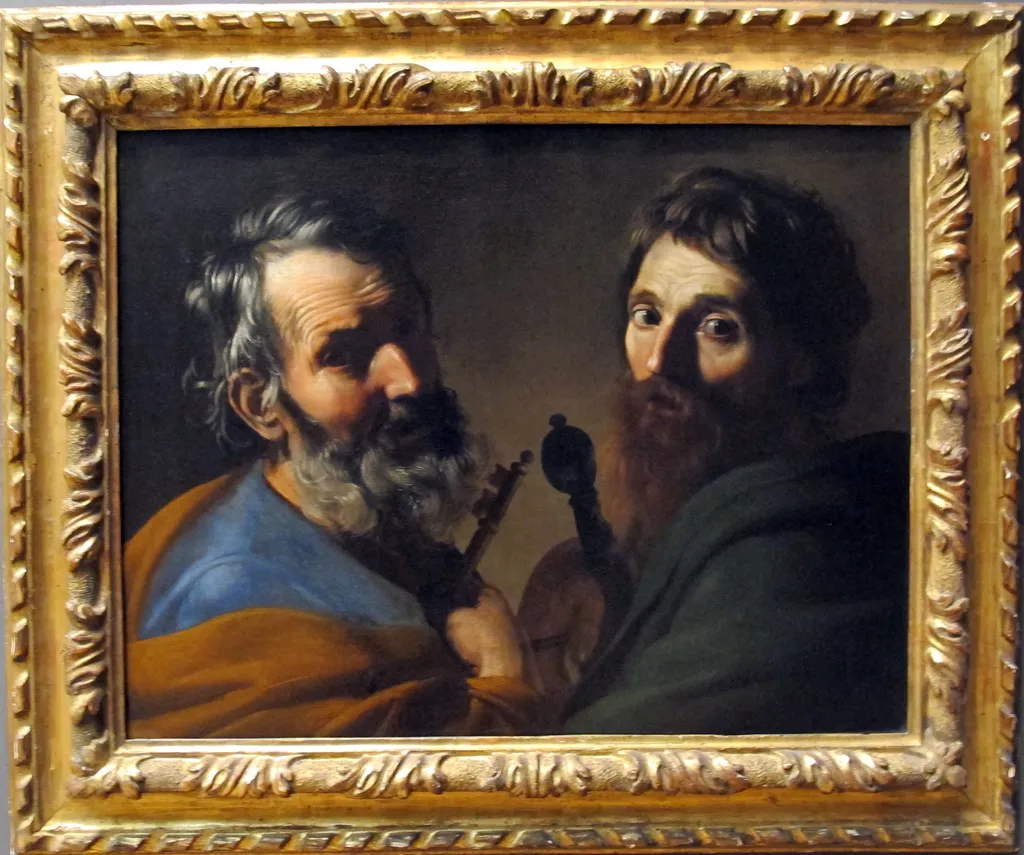
Sts Peter and Paul is an unspecified painting by the Early Baroque Italian artist Bartolomeo Manfredi. It dates from 1612 and is held in the collection of the Metropolitan Museum of Art.
About this work
Overview
The figures are positioned close together, their heads turned toward one another, creating a sense of immediate interaction rather than static iconography.
Bartolomeo Manfredi's 'Sts Peter and Paul,' executed in 1612, presents a half-length depiction of the two apostles engaged in a quiet, intimate dialogue. The composition adheres to the Caravaggist tradition of tenebrism, utilizing a dark, indistinct background to isolate the figures and emphasize their facial expressions and gestures. On the left, Saint Peter is identified by his gray hair, beard, and the key he holds in his right hand; he wears a blue tunic beneath a yellow mantle. Opposite him, Saint Paul is characterized by his dark hair and beard, dressed in a deep green robe. The figures are positioned close together, their heads turned toward one another, creating a sense of immediate interaction rather than static iconography. Painted during the height of Manfredi's influence on the Roman art scene, this work exemplifies his role in popularizing the half-length genre scenes of religious subjects, often featuring common models dressed in contemporary or semi-contemporary attire. The painting reflects the artist's mastery of chiaroscuro and his ability to infuse biblical figures with a palpable human presence, bridging the gap between sacred narrative and the naturalistic observation championed by Caravaggio.
Subject & Meaning
The painting portrays the traditional attributes of Peter and Paul: the former with a key, symbolising the keys of heaven, and the latter in a green habit, indicating his martyrdom. Their turned heads and earnest expressions suggest a moment of theological dialogue, emphasizing themes of authority, unity, and the shared mission of the early Church.
Technique & Style
Manfredi employs a chiaroscuro scheme characteristic of the Caravaggisti, using a single, directional light to model the figures against a deep, indeterminate background. The contrast of bright flesh tones with dark drapery heightens the three‑dimensionality of the bodies, while the restrained palette of blues, greens, and ochres reinforces the painting’s contemplative tone.
History & Provenance
Created around 1612, the canvas likely originated in Rome, where Manfredi was active in the circle of Caravaggio’s followers. It entered the Metropolitan Museum of Art’s holdings in the early 20th century through a private acquisition, and has since been displayed as an example of early Baroque religious portraiture.
Artist & collection

Artist
Bartolomeo Manfredi was an Italian painter, a leading member of the Caravaggisti of the early 17th century.
