Artwork
Untitled
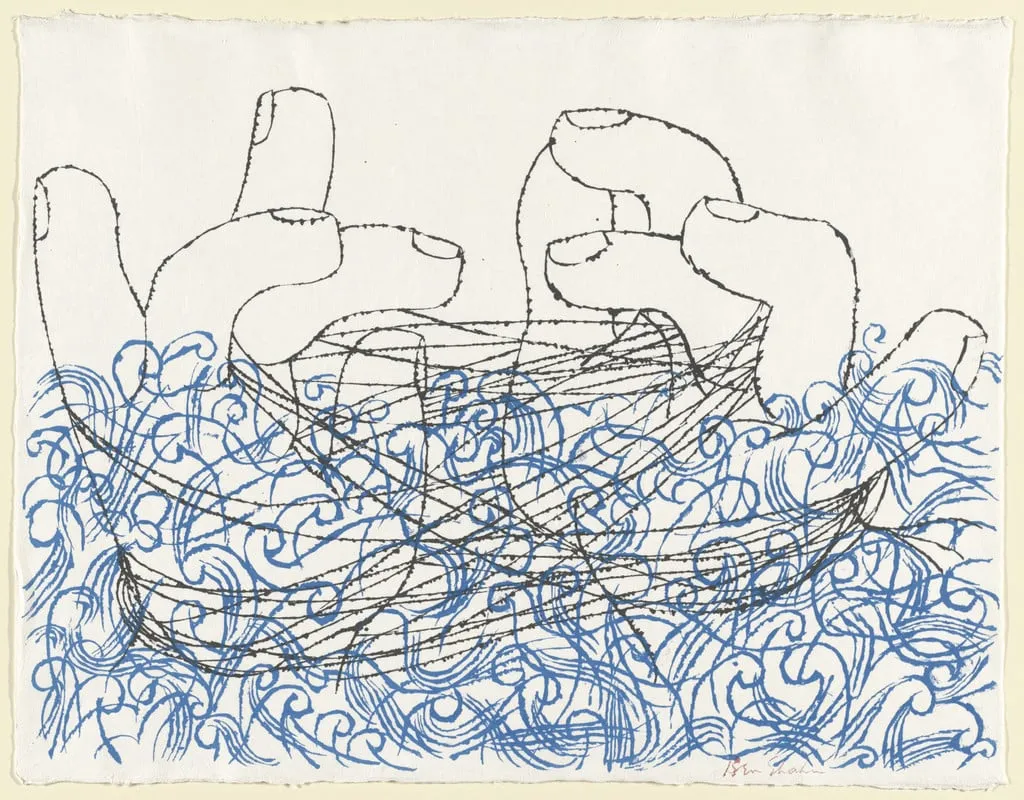
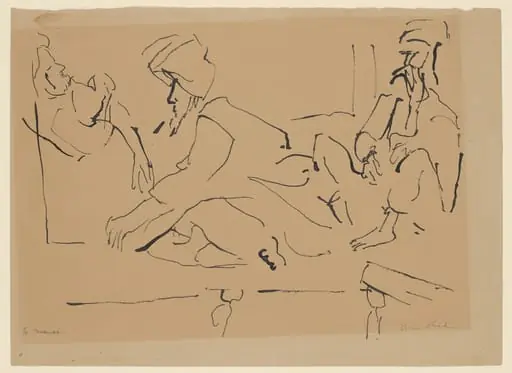
Untitled is an ink print by Ben Shahn. It dates from 1959 and is held in the collection of the Museum of Modern Art.
About this work
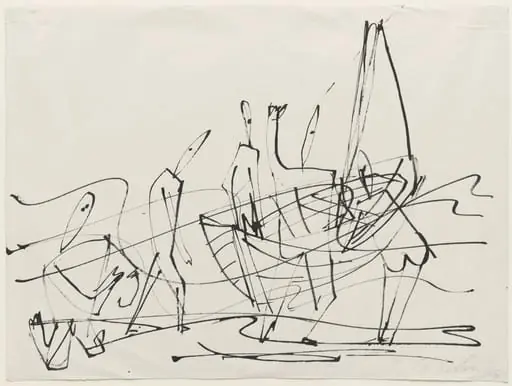
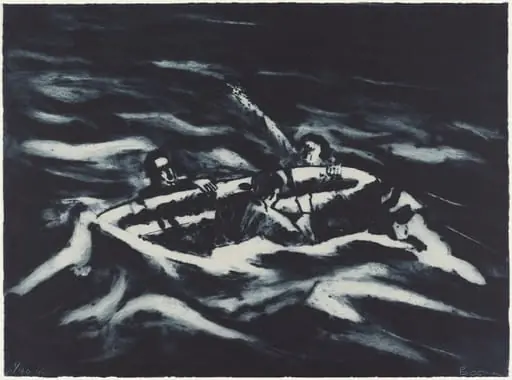
The use of blue and black ink creates a striking contrast, drawing the viewer's eye to the central image of the boat and its occupants.
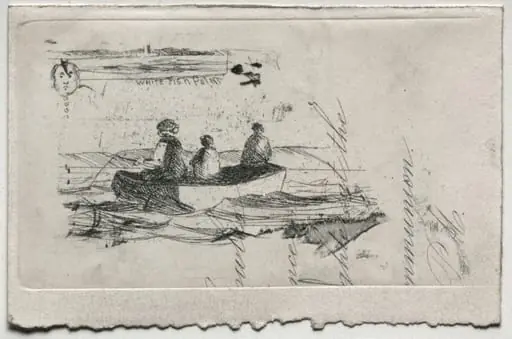
This image depicts a screenprint by Ben Shahn, created in 1959. The artwork features a black outline of a boat with two people, possibly a man and a woman, sitting in it. The boat is surrounded by blue waves, which are drawn in a loose, expressive style.
The screenprint has a rough, textured quality, with visible lines and marks that give it a sense of energy and spontaneity. The use of blue and black ink creates a striking contrast, drawing the viewer's eye to the central image of the boat and its occupants.
To learn more about the artist's use of bold lines and expressive brushstrokes, explore the work of Ben Shahn.
Overview
Ben Shahn produced this screenprint in 1959, part of his later body of work that continued to engage with human experience through simplified forms. Born in the Russian Empire and raised in New Jersey after immigrating in 1906, Shahn developed a visual language rooted in observation and social awareness. His training as a lithographer informed his precise yet expressive approach to printmaking, which he used to convey quiet narratives of everyday life.
Subject & Meaning
The print shows a small boat with two figures, their forms outlined in black against undulating blue waves. The figures are anonymous, their identities unmarked, suggesting a universal human condition rather than a specific story. The isolation of the boat in a vast, rhythmic sea evokes themes of journey, vulnerability, or quiet endurance. Shahn avoids overt political messaging here, instead inviting contemplation through restraint and ambiguity.
Technique & Style
Using screenprint, Shahn layered black ink for strong contours and blue for the water, creating a stark yet harmonious contrast. The texture arises from the screen’s mesh and the hand-applied ink, leaving visible brushstrokes and irregular edges. This deliberate roughness rejects mechanical precision, emphasizing the artist’s hand and the immediacy of the gesture. The composition is sparse, focusing attention on the boat’s movement through the fluid space.
History & Provenance
The work entered the collection of The Museum of Modern Art in New York, where it remains part of its permanent holdings. While not widely exhibited, it reflects Shahn’s sustained interest in printmaking during the 1950s, a period when he increasingly turned to quieter, more personal subjects. The piece was made after his major public commissions, indicating a shift toward introspective expression rather than overt social commentary.
Context
In the late 1950s, American art was dominated by abstraction and expressionism, yet Shahn remained committed to figurative work grounded in real life. His screenprints from this era, including this one, represent a quiet resistance to prevailing trends. They align with a broader, less visible current of artists who valued narrative clarity and emotional resonance over formal innovation alone.
Legacy
Shahn’s screenprints, though less celebrated than his murals or photographs, demonstrate his consistent belief in art as a medium for human connection. This untitled work exemplifies his ability to convey depth with minimal elements. It continues to be studied as an example of how social realism evolved in postwar America, retaining its emotional weight without relying on explicit political symbols.
Artist & collection
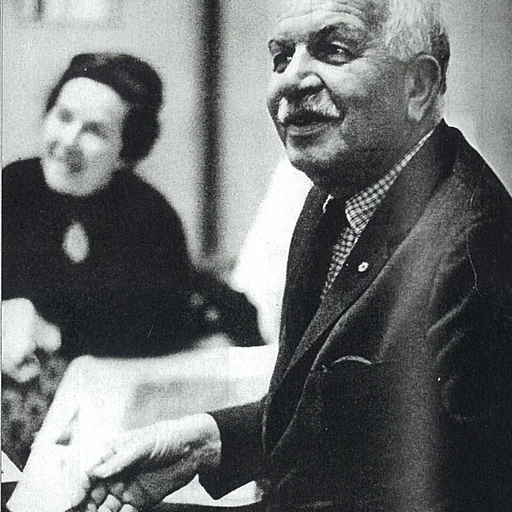
Artist
Ben Shahn (September 12, 1898 – March 14, 1969) was an American artist. He is best known for his works of social realism, his left-wing political views, and his series of lectures published as The Shape of Content. Born…