Artwork
Mountain Stream
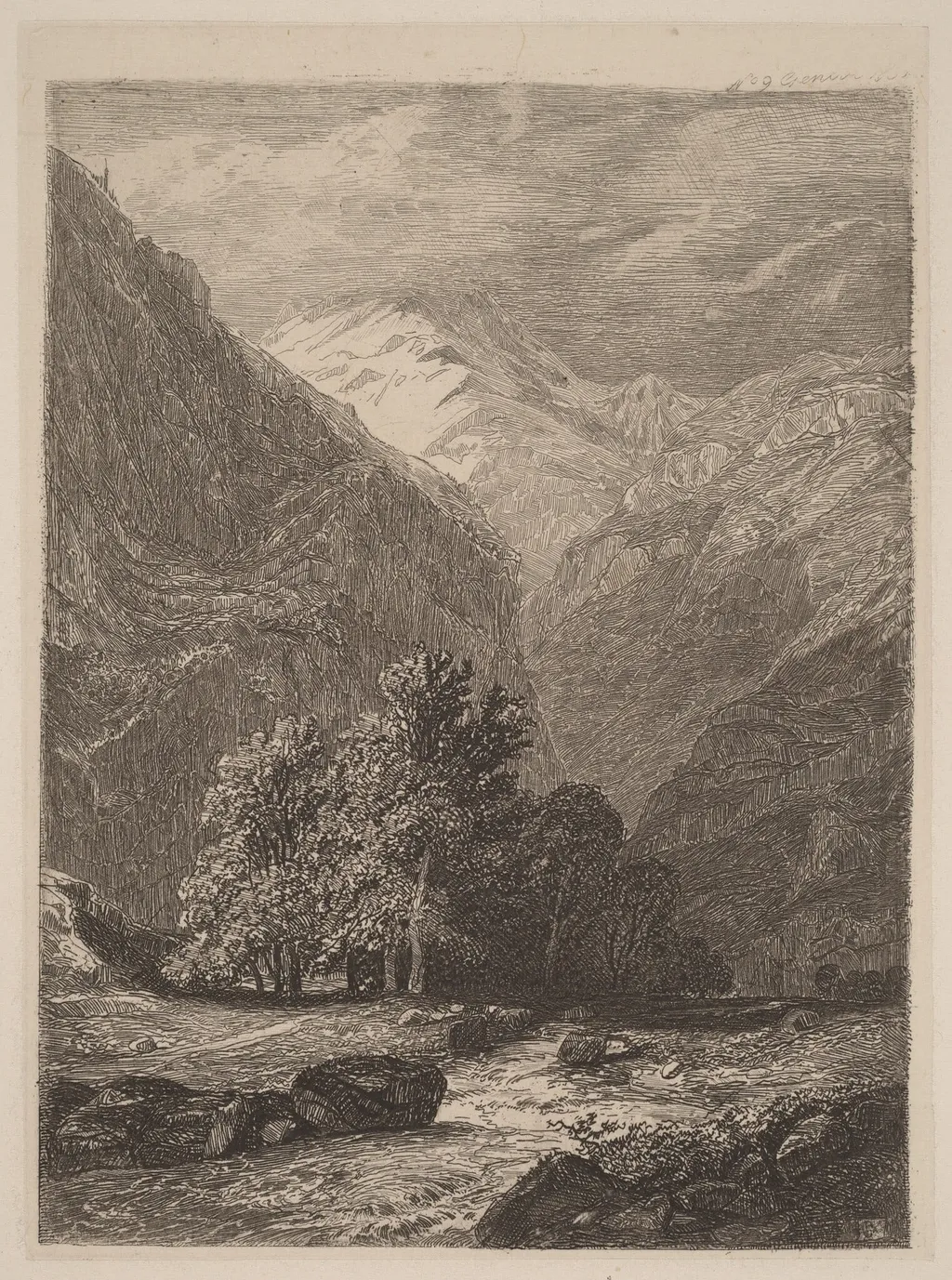
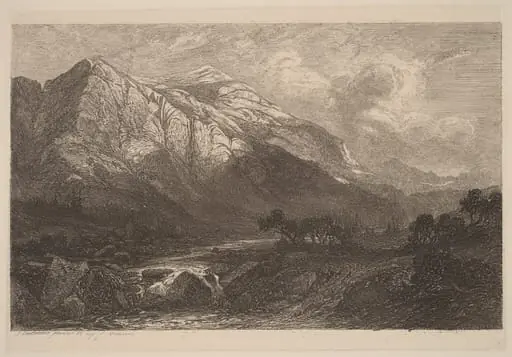
Mountain Stream is an ink print by the Romanticist artist Alexandre Calame. It dates from 1838 and is held in the collection of the National Gallery of Art.
About this work
Overview
The composition centers on a narrow watercourse winding among craggy stones, framed by densely packed trees whose twisted branches echo the rugged terrain.
Mountain Stream, an 1838 print by Alexandre Calame, presents a tranquil woodland landscape rendered through etching on chine collé. The composition centers on a narrow watercourse winding among craggy stones, framed by densely packed trees whose twisted branches echo the rugged terrain. In the background, a modest mountain ascends, its slopes cloaked in forest and sporadic snowcaps, establishing a sense of depth and natural continuity.
Subject & Meaning
The image captures a moment of quietude within a forested valley, emphasizing the harmonious interaction between water, rock, and vegetation. The gentle flow of the stream suggests continual movement amid stillness, while the distant mountain conveys a broader, enduring landscape. Calame’s focus on the subtle play of light across foliage and water invites contemplation of nature’s delicate equilibrium.
Technique & Style
Executed as an etching on chine collé, the work employs fine incised lines to delineate textures of bark, stone, and rippling water. Ink fills the metal-engraved grooves and is transferred onto a paper support adhered to a thin backing, allowing for crisp detail and a luminous surface. Calame’s precise line work and nuanced tonal gradations reflect the Romantic era’s interest in realistic yet atmospheric depictions of natural scenery.
History & Provenance
Created in 1838, Mountain Stream belongs to a period when Calame was establishing his reputation for Alpine and forest scenes. The print was likely produced in limited editions typical of 19th‑century etchers, though specific ownership records are sparse. It has appeared in several European collections of Romantic landscape prints, illustrating the artist’s broader influence on printmaking practices of his time.
Artist & collection