Artwork
Almshouse
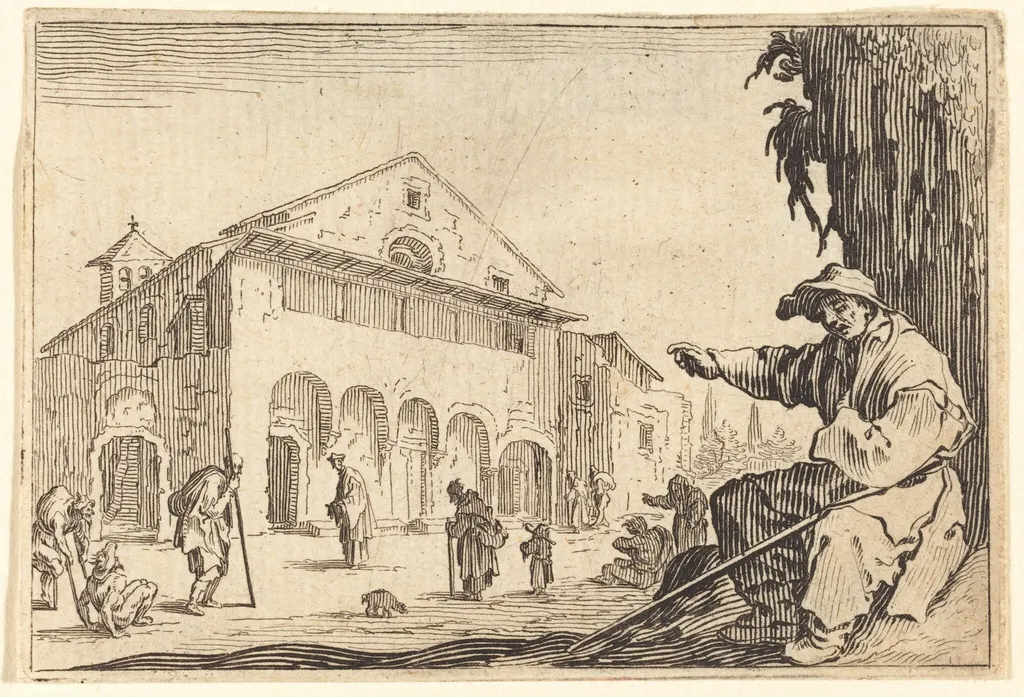
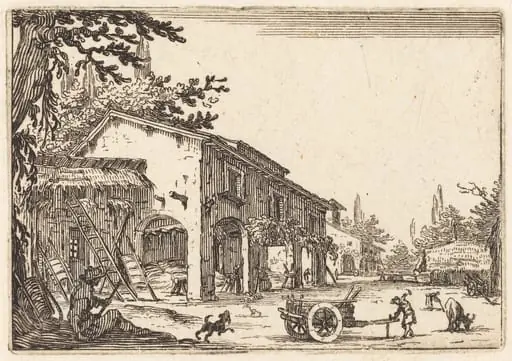
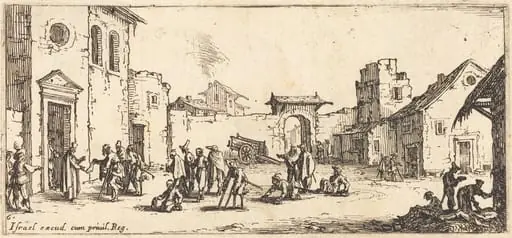
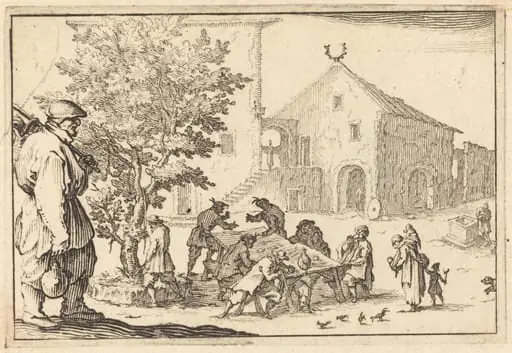
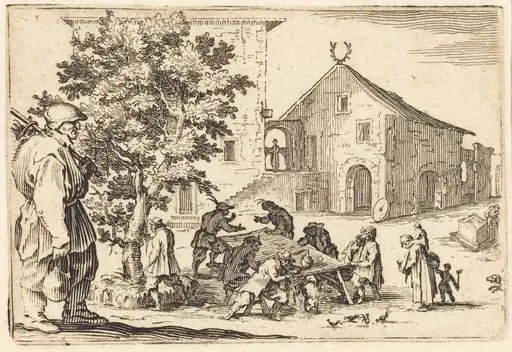
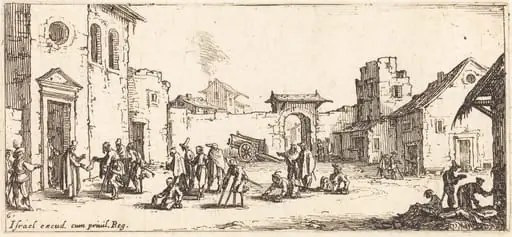
Almshouse is an ink print by the Baroque artist Jacques Callot. It dates from 1622 and is held in the collection of the National Gallery of Art.
About this work
Overview
Rather than idealized subjects, Callot turned to marginalized figures and institutional settings, capturing social realities with quiet precision.
Jacques Callot, a 17th-century printmaker from the Duchy of Lorraine, produced *Almshouse* circa 1622 as an etching on laid paper. Part of a vast body of over 1,400 prints, this work exemplifies his focus on everyday life in early modern Europe. Rather than idealized subjects, Callot turned to marginalized figures and institutional settings, capturing social realities with quiet precision. His technique emphasized fine line work and atmospheric depth, distinguishing his prints within the old master tradition.
Subject & Meaning
The scene portrays a group of individuals gathered before a substantial almshouse, its arched windows and steep roof suggesting institutional authority. A seated man on the right gestures toward the building, while others nearby beg, rest, or observe. The composition avoids sentimentality, instead presenting a quiet record of poverty and public charity. The almshouse looms as both refuge and monument, its scale contrasting with the vulnerability of those outside.
Technique & Style
Callot employed fine etched lines to render texture and spatial depth, using varied pressure and cross-hatching to suggest light, fabric, and stone. The meticulous detail in clothing, architecture, and gesture reflects his mastery of the medium. Unlike broad brushwork in painting, his etching relies on controlled incisions to build mood—shadows deepen near the building’s entrance, while distant figures fade into atmospheric haze, guiding the viewer’s eye through the scene.
History & Provenance
Created during Callot’s early career, *Almshouse* belongs to a series of prints documenting urban life in Nancy and surrounding regions. It likely circulated among collectors and civic patrons interested in social observation. The work survives in multiple impressions, preserved in major European collections, though its earliest ownership records remain fragmentary. Its survival reflects contemporary interest in prints as both art and documentary record.
Context
In early 17th-century France and the Holy Roman Empire, almshouses were common responses to poverty, often funded by religious or municipal authorities. Callot’s depiction aligns with a broader European trend of visualizing social conditions, influenced by humanist observation and the rise of print culture. His work avoids moralizing, instead offering a neutral record of institutional life amid economic hardship and urban growth.
Legacy
Callot’s *Almshouse* contributed to the legitimization of printmaking as a vehicle for social commentary. His precise technique and unembellished subjects influenced later artists, including Rembrandt and Goya, who similarly turned to etching for intimate, critical portrayals of daily life. The work remains a reference point for understanding how printmakers documented the margins of early modern society without romanticizing them.
Artist & collection
Artist
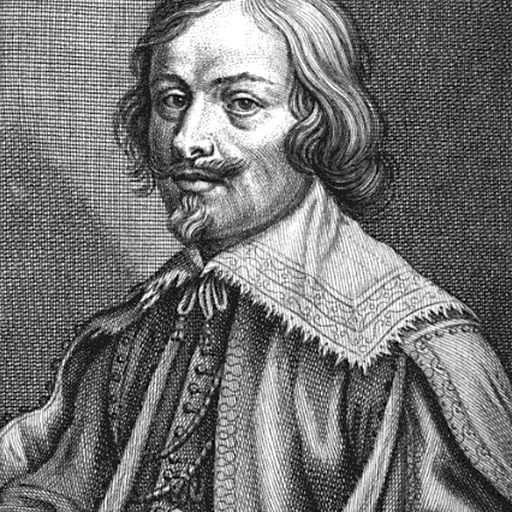
Jacques Callot was a baroque printmaker and draftsman from the Duchy of Lorraine.

 Holy Family at supper
 Restoration of the Aqueduct at Pisa
 Restoration of the Aqueduct at Pisa
 Square in Paris with Many Figures
 Square in Paris with Many Figures
 Horsemen Attacked by Robbers
 HOW WILL A COVERED PART BE CORRECTED?HOW WIKA A COVERED HEART DEED CORRECTED?
![Christ Walking on the Water [second plate], by Jacques Callot](https://artifactworldgallery.com/img/jacques-callot--christ-walking-on-the-water-second-plate--2069f3bfe4cb2126-w320.webp) Christ Walking on the Water [second plate]
Christ Walking on the Water [second plate]