Artwork
Fireworks on the Arno, Florence
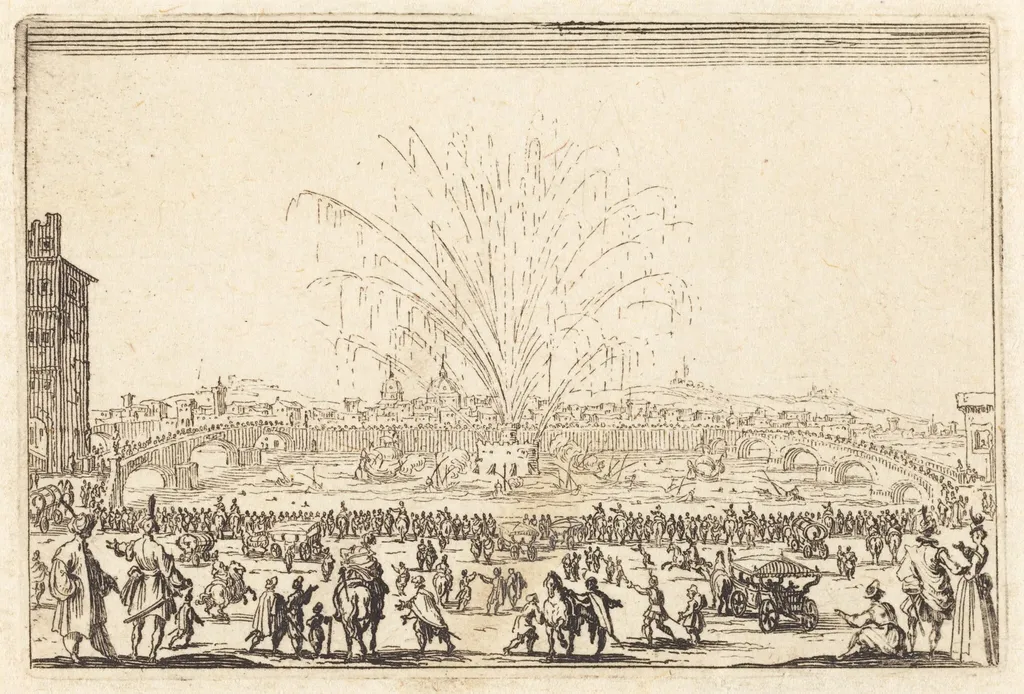
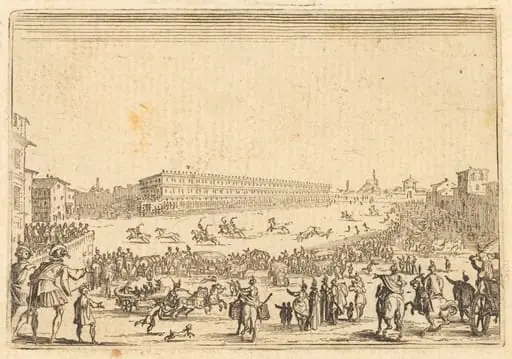
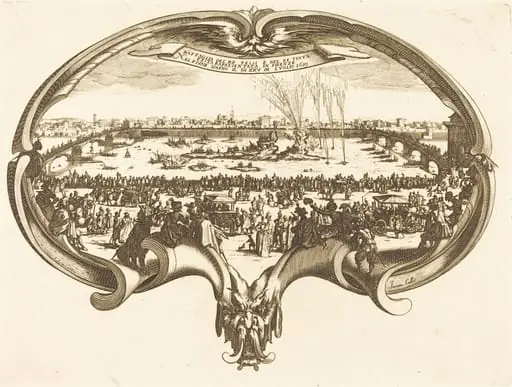
Fireworks on the Arno, Florence is an ink print by the Baroque artist Jacques Callot. It dates from 1622 and is held in the collection of the National Gallery of Art.
About this work
Overview
Executed on laid paper, the work belongs to a broader series of prints in which Callot recorded public events with precision and atmosphere.
Created around 1622, this etching by Jacques Callot captures a nocturnal fireworks display above the Arno River in Florence. Executed on laid paper, the work belongs to a broader series of prints in which Callot recorded public events with precision and atmosphere. As a prolific printmaker from Lorraine, he specialized in documenting urban life through intricate, finely detailed compositions that balanced observation with artistic expression.
Subject & Meaning
The scene depicts a crowd gathered along the riverbank and bridge, observing an aerial fireworks show. Figures are arranged in varied postures—standing, leaning, riding—suggesting a diverse audience drawn to the spectacle. The central tree, illuminated by falling sparks, anchors the composition, while the darkened buildings frame the event. The image conveys civic celebration and collective experience, reflecting the role of public spectacles in early 17th-century Florentine society.
Technique & Style
Callot employed fine, rapid etching lines to suggest motion and texture, particularly in the crowd and the flickering light of the fireworks. The contrast between the bright, radiant bursts and the deep shadows of the night enhances the drama. His use of atmospheric perspective and delicate hatching gives depth to the architecture and river, while the sketch-like quality conveys immediacy, as if capturing a fleeting moment in real time.
History & Provenance
The print was made during Callot’s time in Florence, where he was employed by the Medici court. Though the exact circumstances of its commission are unrecorded, it aligns with his documented interest in Italian festivals and urban life. The work survives in multiple impressions across major print collections, indicating its circulation among collectors and artists who valued his technical skill and observational clarity.
Context
In early 17th-century Florence, fireworks displays were organized for religious feasts, royal events, or diplomatic visits, serving as both entertainment and political spectacle. Callot’s depiction reflects the city’s cultural vibrancy and the Medici’s patronage of public pageantry. His prints from this period contributed to a growing European interest in documenting urban rituals through print, bridging art and chronicle.
Legacy
Callot’s detailed etchings influenced later generations of printmakers, particularly in their treatment of crowd scenes and nocturnal lighting. While not widely exhibited as a standalone work, 'Fireworks on the Arno' remains a representative example of his ability to transform transient events into enduring visual records. It exemplifies how printmaking could serve as both art and historical documentation in the Baroque era.
Artist & collection
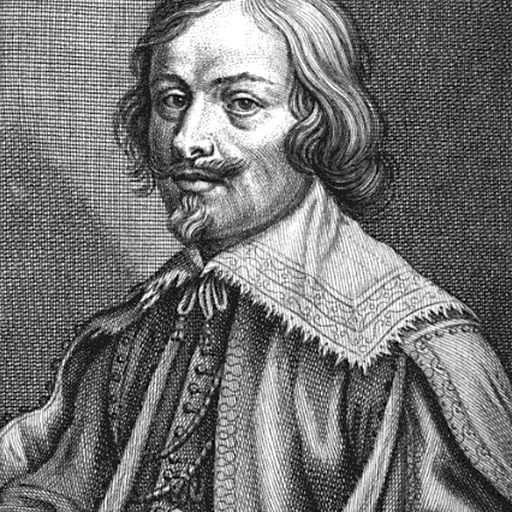
Artist
Jacques Callot was a baroque printmaker and draftsman from the Duchy of Lorraine.

 Holy Family at supper
 Restoration of the Aqueduct at Pisa
 Restoration of the Aqueduct at Pisa
 Square in Paris with Many Figures
 Square in Paris with Many Figures
 Horsemen Attacked by Robbers
 HOW WILL A COVERED PART BE CORRECTED?HOW WIKA A COVERED HEART DEED CORRECTED?
![Christ Walking on the Water [second plate], by Jacques Callot](https://artifactworldgallery.com/img/jacques-callot--christ-walking-on-the-water-second-plate--2069f3bfe4cb2126-w320.webp) Christ Walking on the Water [second plate]
Christ Walking on the Water [second plate]