Artwork
Horses Running
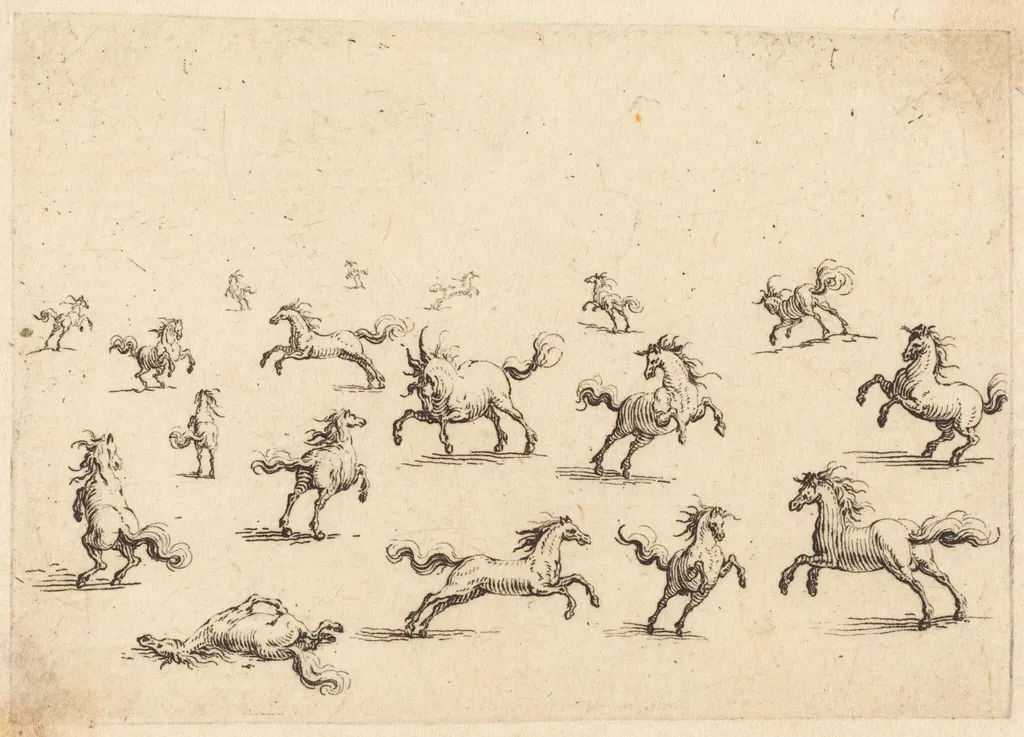
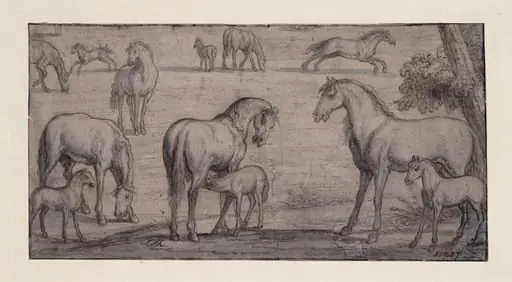
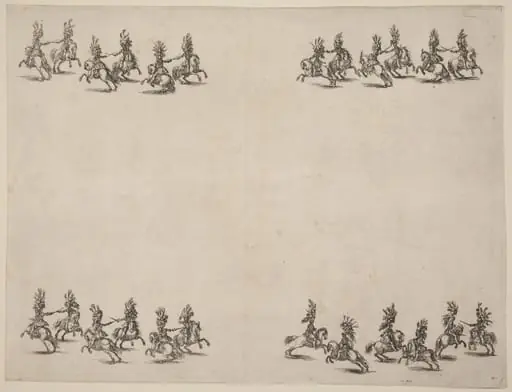
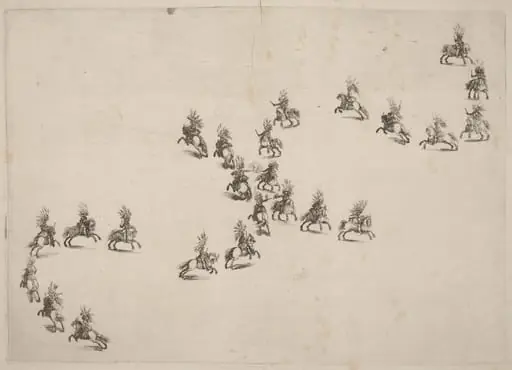
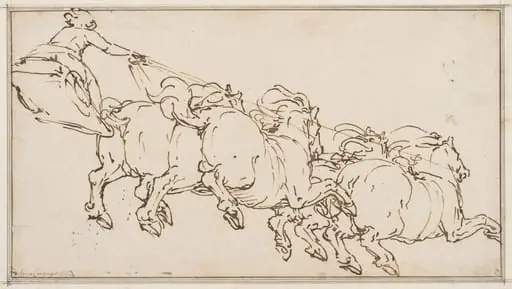
Horses Running is an ink print by the Baroque artist Jacques Callot. It dates from 1617 and is held in the collection of the National Gallery of Art.
About this work
Overview
Created around 1617, *Horses Running* is an etching on laid paper by Jacques Callot, a French artist from the Duchy of Lorraine.
Created around 1617, *Horses Running* is an etching on laid paper by Jacques Callot, a French artist from the Duchy of Lorraine. Part of a vast output of over 1,400 prints, this work exemplifies Callot’s focus on movement and everyday life. Unlike formal portraiture or grand historical scenes, it captures a fleeting moment of animal motion, revealing his interest in the natural world and kinetic energy.
Subject & Meaning
The print shows a group of horses in varied stages of gallop—some rearing, others low and stretched—moving in unison across the page. There is no narrative context, no rider or landscape to anchor them; the focus remains on their physicality and rhythm. This emphasis on motion without story suggests an observation of nature, possibly drawn from stables or military encampments, reflecting Callot’s attention to unidealized reality.
Technique & Style
Callot employed a fine-pointed burin to etch lines directly into a metal plate, creating a network of sharp, irregular strokes that mimic the energy of galloping hooves. The resulting print retains the spontaneity of a sketch, with uneven ink distribution and visible plate marks. The laid paper’s textured surface enhances the tactile quality of the lines, reinforcing the sense of immediacy and raw observation.
History & Provenance
The work originates from Callot’s early period in Florence, where he refined his etching technique under Italian influence. While no specific early ownership records survive, the print aligns with his broader practice of producing small-format studies for collectors and fellow artists. Its survival in multiple institutional collections suggests early recognition of its technical innovation and expressive power.
Context
In early 17th-century Europe, printmaking was increasingly valued for its ability to document the visible world with precision. Callot’s focus on animals in motion stood apart from the dominant religious and mythological themes. His depictions of horses, often linked to military or rural life, contributed to a growing interest in natural observation, paralleling scientific developments in anatomy and motion studies.
Legacy
Callot’s approach to etching—emphasizing line, speed, and texture over finish—influenced later printmakers in France and the Netherlands. *Horses Running* exemplifies his contribution to elevating the etching as a medium for capturing transient moments. Though not widely exhibited as a standalone work, its energy and technique remain a reference point in studies of Baroque draftsmanship and the evolution of printmaking as an art of observation.
Artist & collection
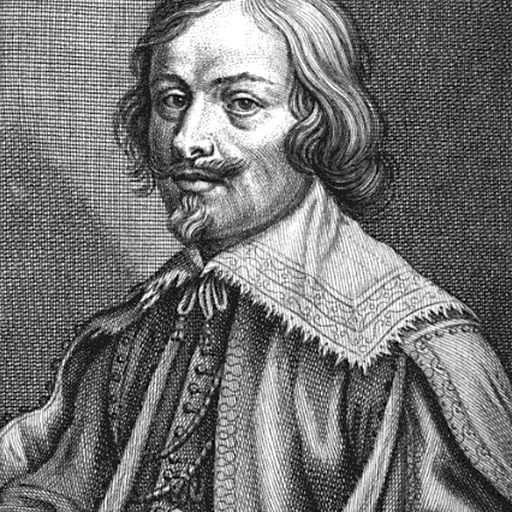
Artist
Jacques Callot was a baroque printmaker and draftsman from the Duchy of Lorraine.

 Holy Family at supper
 Restoration of the Aqueduct at Pisa
 Restoration of the Aqueduct at Pisa
 Square in Paris with Many Figures
 Square in Paris with Many Figures
 Horsemen Attacked by Robbers
 HOW WILL A COVERED PART BE CORRECTED?HOW WIKA A COVERED HEART DEED CORRECTED?
![Christ Walking on the Water [second plate], by Jacques Callot](https://artifactworldgallery.com/img/jacques-callot--christ-walking-on-the-water-second-plate--2069f3bfe4cb2126-w320.webp) Christ Walking on the Water [second plate]
Christ Walking on the Water [second plate]