Artwork
Loading the Cannon
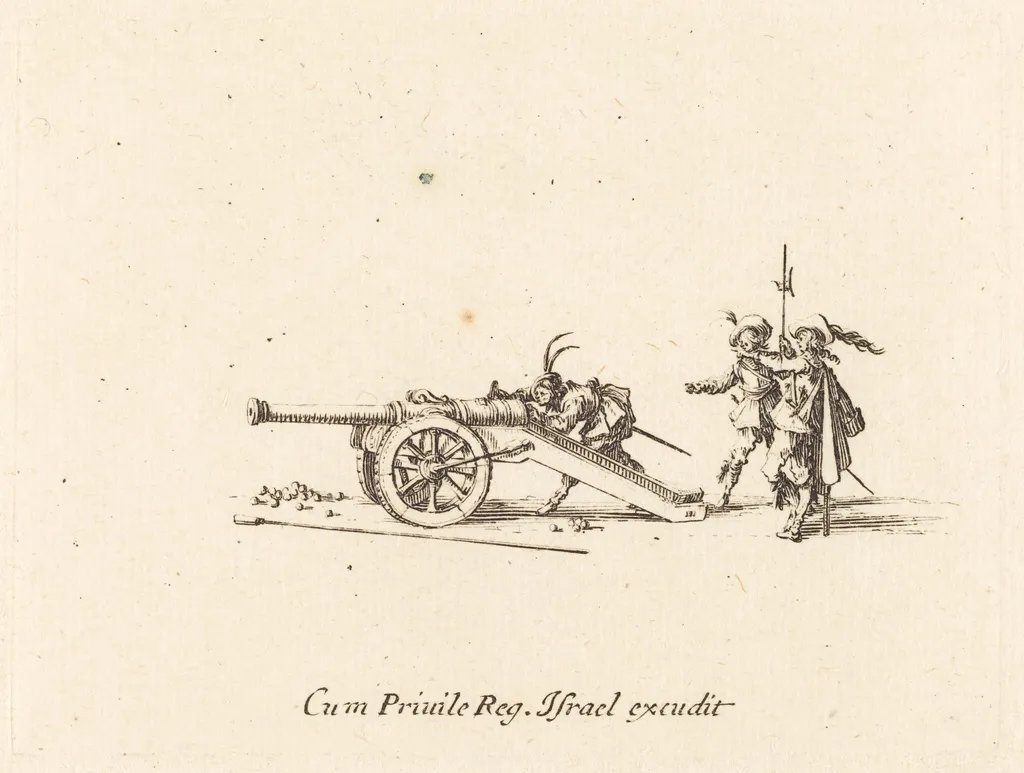
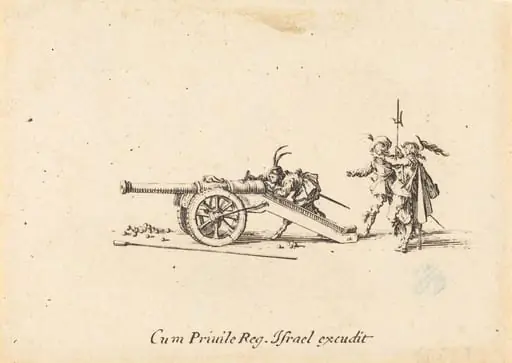
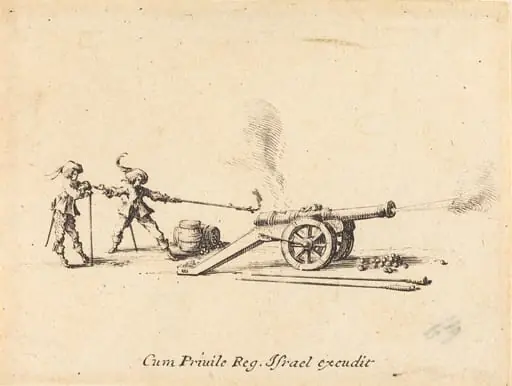
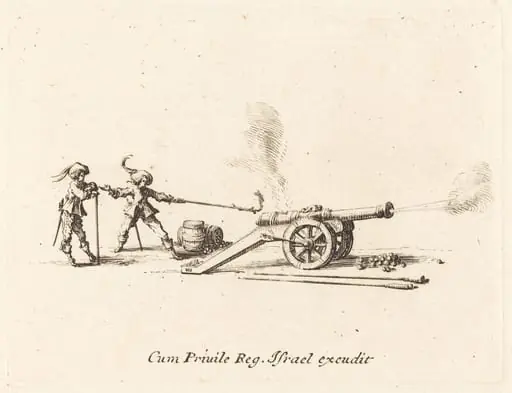
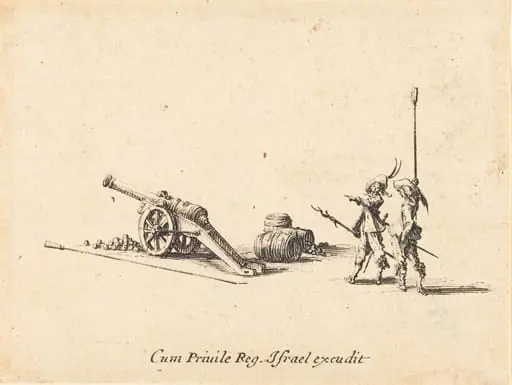
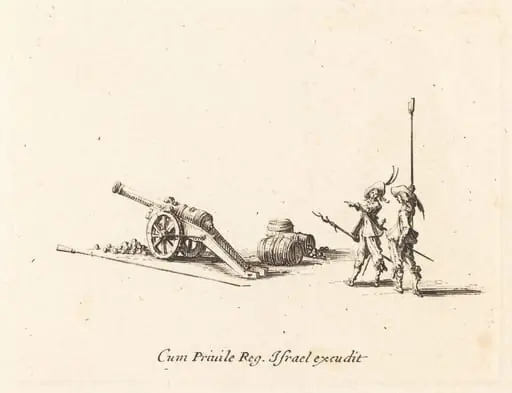
Loading the Cannon is an ink print by the Baroque artist Jacques Callot. It dates from 1634 and is held in the collection of the National Gallery of Art.
About this work
Overview
Part of a larger series documenting military life, the work exemplifies his technical precision and interest in the mechanics of war.
Jacques Callot, a printmaker from the Duchy of Lorraine, produced *Loading the Cannon* in 1634 as an etching on laid paper. Part of a larger series documenting military life, the work exemplifies his technical precision and interest in the mechanics of war. With over 1,400 etchings to his name, Callot distinguished himself through meticulous observation of everyday soldierly tasks, capturing moments often overlooked in grand historical narratives.
Subject & Meaning
The scene portrays two soldiers coordinating to position a cannon on a sloped ground. One pushes the wheel while the other guides the barrel with a long pole, emphasizing teamwork under physical strain. The image conveys no heroism or battle, but rather the laborious, methodical work behind artillery deployment. This focus on routine military labor reflects a shift toward documenting the lived experience of soldiers rather than glorifying combat.
Technique & Style
Callot employed fine, controlled lines to render textures of fabric, metal, and earth with remarkable clarity. His use of cross-hatching and subtle tonal gradations creates a sense of volume and spatial depth. The dramatic interplay of light and shadow enhances the physical effort of the figures, aligning with Baroque sensibilities without overt theatricality. The composition’s tight focus on action avoids distraction, heightening the immediacy of the moment.
History & Provenance
Created during the Thirty Years’ War, the etching likely originated from Callot’s observations of military encampments in Lorraine, a region frequently contested during the conflict. The work was part of a broader series on war, circulated among collectors and military officials. Its survival in multiple institutional collections suggests early recognition of its documentary value and technical mastery within printmaking circles.
Context
In early 17th-century Europe, printmaking emerged as a key medium for disseminating images of current events. Callot’s work stood apart by avoiding idealized depictions of war, instead recording its logistical realities. His prints influenced contemporaries and later artists who sought to portray military life with authenticity, contributing to a growing tradition of observational printmaking in the Baroque era.
Legacy
Callot’s detailed renderings of military labor set a precedent for later documentary printmakers. His ability to convey complex actions through fine etching techniques inspired generations of artists interested in the mechanics of war and daily soldiering. Though not widely known to the public today, his prints remain referenced in scholarly studies of early modern visual culture and the history of warfare imagery.
Artist & collection
Artist
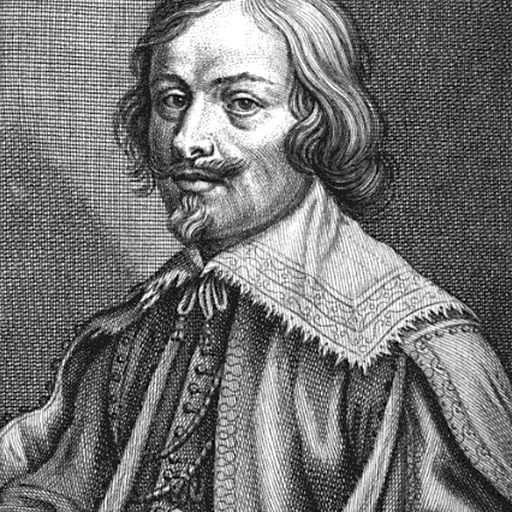
Jacques Callot was a baroque printmaker and draftsman from the Duchy of Lorraine.

 Holy Family at supper
 Restoration of the Aqueduct at Pisa
 Restoration of the Aqueduct at Pisa
 Square in Paris with Many Figures
 Square in Paris with Many Figures
 Horsemen Attacked by Robbers
 HOW WILL A COVERED PART BE CORRECTED?HOW WIKA A COVERED HEART DEED CORRECTED?
![Christ Walking on the Water [second plate], by Jacques Callot](https://artifactworldgallery.com/img/jacques-callot--christ-walking-on-the-water-second-plate--2069f3bfe4cb2126-w320.webp) Christ Walking on the Water [second plate]
Christ Walking on the Water [second plate]