Artwork
Preparing to Fire the Cannon
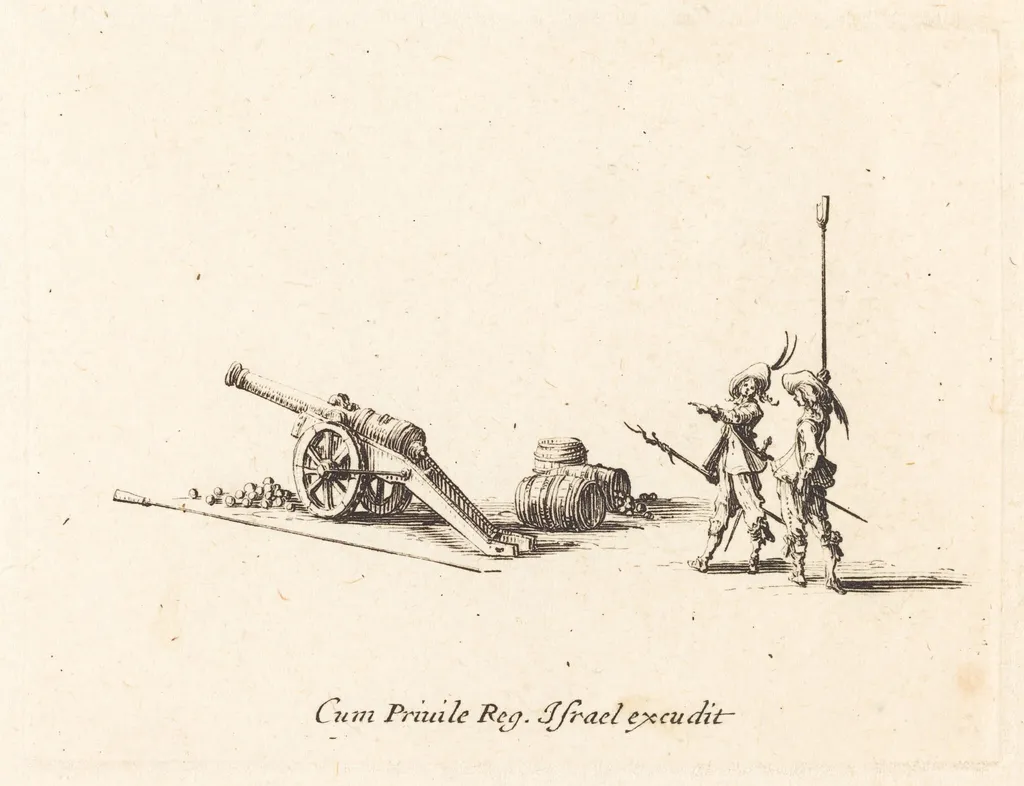
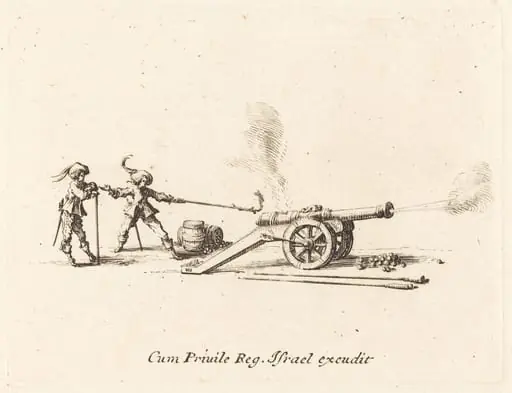
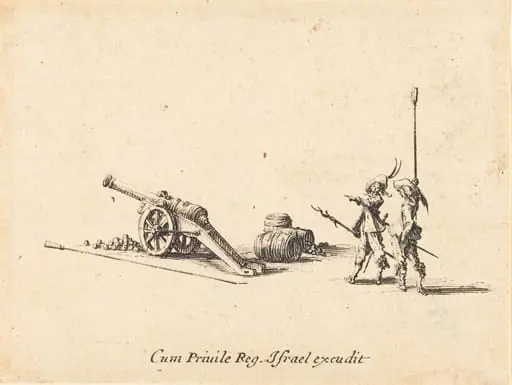
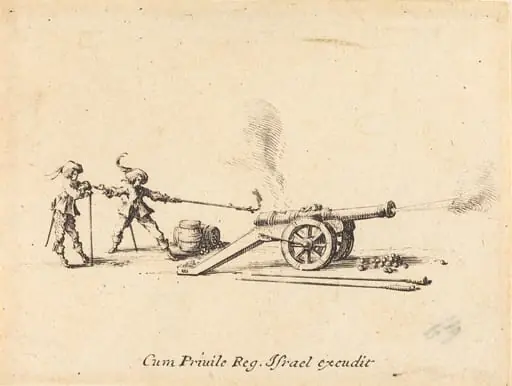
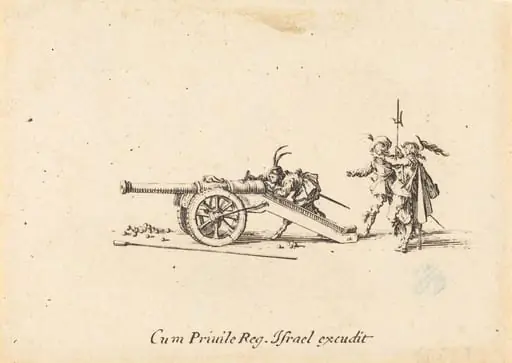
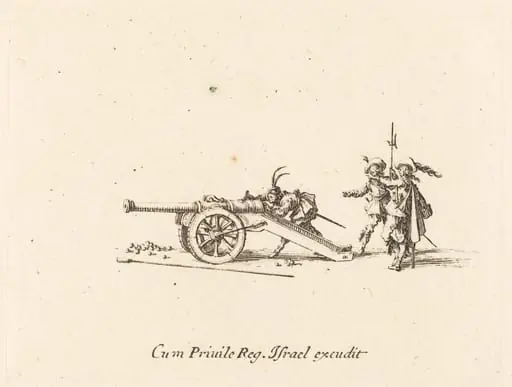
Preparing to Fire the Cannon is an ink print by the Baroque artist Jacques Callot. It dates from 1634 and is held in the collection of the National Gallery of Art.
About this work
Overview
Jacques Callot, a printmaker from the Duchy of Lorraine, produced this small etching in 1634 as part of a broader series documenting military life.
Jacques Callot, a printmaker from the Duchy of Lorraine, produced this small etching in 1634 as part of a broader series documenting military life. Executed on laid paper, the work exemplifies his technical precision and sustained interest in the mechanics and human dynamics of warfare. Though modest in scale, the composition conveys a dense, active scene with careful attention to gesture and spatial arrangement.
Subject & Meaning
The scene captures a moment of coordinated labor among artillerymen as they ready a cannon for discharge. Figures are arranged in a tight, functional group, each engaged in a specific task—loading, aiming, or securing the weapon. The absence of battle or glory emphasizes the mundane, disciplined routine behind military action, reflecting Callot’s interest in the everyday realities of soldiers rather than heroic narratives.
Technique & Style
Callot employed fine, controlled lines to render textures of fabric, metal, and skin with remarkable clarity. His use of etching allowed for intricate detail, particularly in the folds of clothing and the rough surfaces of the cannon. The composition is tightly framed, focusing attention on the figures’ gestures and the cannon’s bulk, while subtle tonal gradations suggest depth without overt shading.
History & Provenance
Created during Callot’s mature period, the etching likely belonged to a larger set of military scenes commissioned or circulated among collectors in early 17th-century Europe. While its early ownership is undocumented, it aligns with known prints from his series on war, many of which were widely distributed and later collected by institutions across France and the Low Countries.
Context
This work emerged during the Thirty Years’ War, a conflict that brought widespread disruption to the Lorraine region. Callot, who witnessed the movement of troops and the devastation of war firsthand, turned his lens toward its human infrastructure. His prints offered a rare, unsentimental view of soldiers’ lives, distinguishing his work from idealized depictions common in contemporary art.
Legacy
Callot’s detailed etchings influenced later generations of printmakers, particularly in their focus on observational realism. His ability to convey complex scenes with minimal means set a precedent for narrative printmaking. Though not widely exhibited in his lifetime, his body of work became a reference for artists and historians seeking authentic portrayals of early modern military life.
Artist & collection

Artist
Jacques Callot was a baroque printmaker and draftsman from the Duchy of Lorraine.

 Holy Family at supper
 Restoration of the Aqueduct at Pisa
 Restoration of the Aqueduct at Pisa
 Square in Paris with Many Figures
 Square in Paris with Many Figures
 Horsemen Attacked by Robbers
 HOW WILL A COVERED PART BE CORRECTED?HOW WIKA A COVERED HEART DEED CORRECTED?
![Christ Walking on the Water [second plate], by Jacques Callot](https://artifactworldgallery.com/img/jacques-callot--christ-walking-on-the-water-second-plate--2069f3bfe4cb2126-w320.webp) Christ Walking on the Water [second plate]
Christ Walking on the Water [second plate]