Artwork
Oyster with Pearl
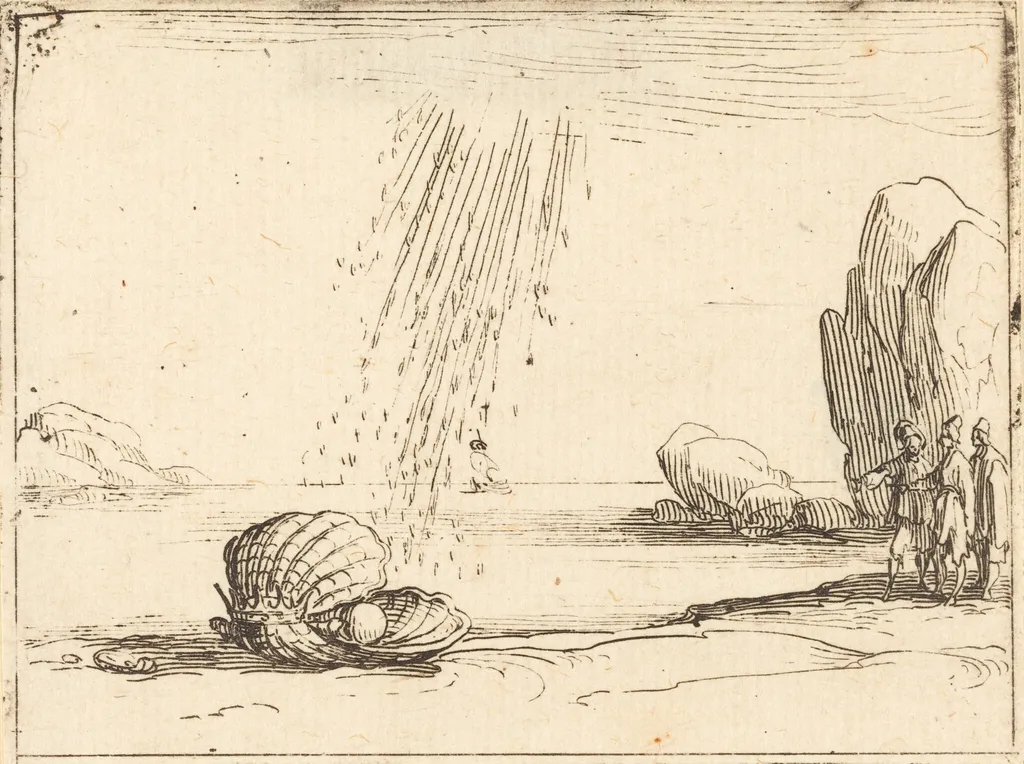
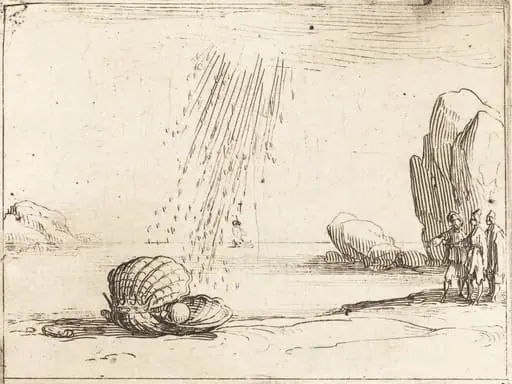
Oyster with Pearl is an ink print by the Renaissance artist Jacques Callot. It dates from 1628 and is held in the collection of the National Gallery of Art.
About this work
Overview
Instead, it presents a quiet coastal moment: two figures near a boat, an open oyster shell on the sand, and a single pearl catching the light.
Created in 1628, Jacques Callot’s *Oyster with Pearl* is a small etching on laid paper that departs from his more crowded narrative scenes. Instead, it presents a quiet coastal moment: two figures near a boat, an open oyster shell on the sand, and a single pearl catching the light. The composition’s restraint highlights Callot’s ability to convey depth and atmosphere with minimal elements, focusing attention on the subtle interplay of natural forms and human presence.
Subject & Meaning
The image juxtaposes the humble, transient world of beach labor with the rare, luminous pearl—a symbol of value emerging from ordinary matter. The figures, dressed plainly and engaged in quiet activity, suggest coastal life without romanticization. The pearl, glowing softly against the muted tones, invites contemplation on hidden worth, perhaps alluding to spiritual or material discovery, but without overt religious or allegorical framing.
Technique & Style
Callot employed fine, controlled etching lines to model light and texture with remarkable economy. The oyster’s interior is rendered with delicate hatching that suggests the pearl’s luminosity, while the figures and waves are suggested through loose, rapid strokes. The use of laid paper enhances the tactile quality of the print, and Callot’s precision in capturing subtle gradations of tone reflects his mastery of the medium’s potential for nuance over grandeur.
History & Provenance
This print belongs to Callot’s later period, when he increasingly turned to intimate, observational subjects after years of producing large-scale military and courtly scenes. Though its early ownership is undocumented, it appears in several 18th- and 19th-century European print collections, likely acquired by connoisseurs drawn to its technical refinement and poetic simplicity. Its survival in good condition reflects its enduring appeal among collectors of graphic art.
Context
In early 17th-century France, printmaking was gaining recognition as a medium for both artistic expression and social documentation. Callot, working in Nancy and later Paris, stood apart by focusing on everyday life with psychological subtlety. *Oyster with Pearl* aligns with a broader trend among Northern European artists to elevate still life and landscape elements into quiet meditations, distinct from the theatricality of contemporaneous painting.
Legacy
Though less known than Callot’s battle scenes or grotesques, *Oyster with Pearl* influenced later printmakers who sought to convey emotion through restraint. Its emphasis on natural light, minimal composition, and symbolic detail prefigures 19th-century Japanese woodblock aesthetics and the quiet realism of modern graphic art. The work remains a quiet testament to the power of understatement in printmaking.
Artist & collection

Artist
Jacques Callot was a baroque printmaker and draftsman from the Duchy of Lorraine.

 Holy Family at supper
 Restoration of the Aqueduct at Pisa
 Restoration of the Aqueduct at Pisa
 Square in Paris with Many Figures
 Square in Paris with Many Figures
 Horsemen Attacked by Robbers
 HOW WILL A COVERED PART BE CORRECTED?HOW WIKA A COVERED HEART DEED CORRECTED?
![Christ Walking on the Water [second plate], by Jacques Callot](https://artifactworldgallery.com/img/jacques-callot--christ-walking-on-the-water-second-plate--2069f3bfe4cb2126-w320.webp) Christ Walking on the Water [second plate]
Christ Walking on the Water [second plate]