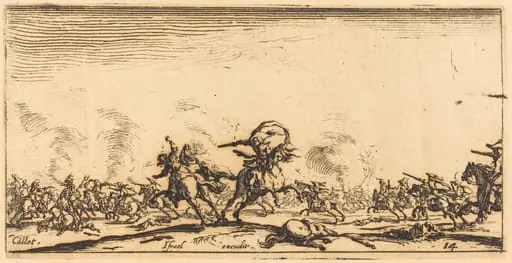
Artwork
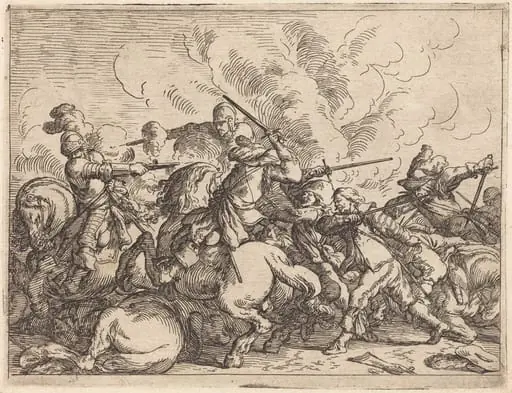
The Cavalry Combat with Swords
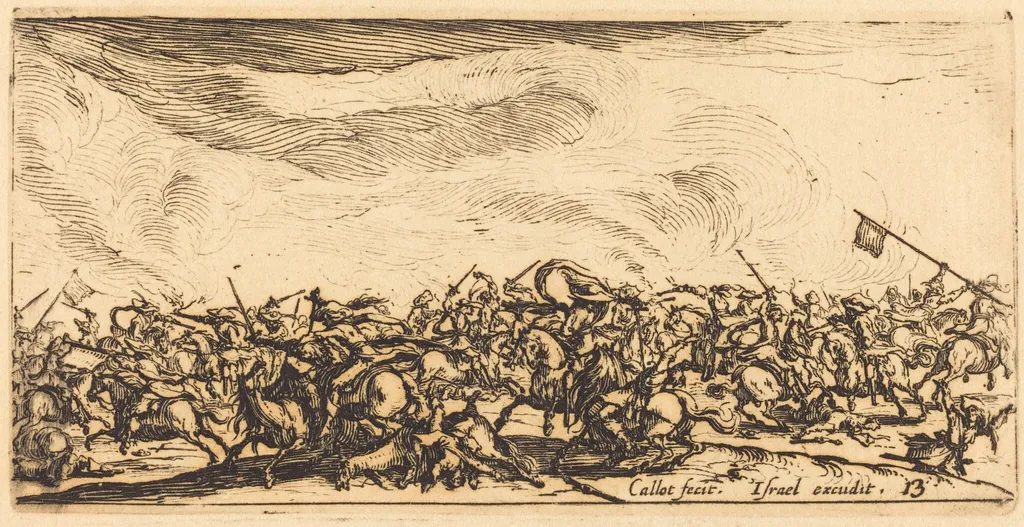
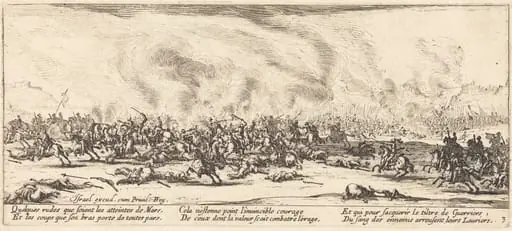
The Cavalry Combat with Swords is an ink print by the Baroque artist Jacques Callot. It dates from 1633 and is held in the collection of the National Gallery of Art.
About this work
Overview
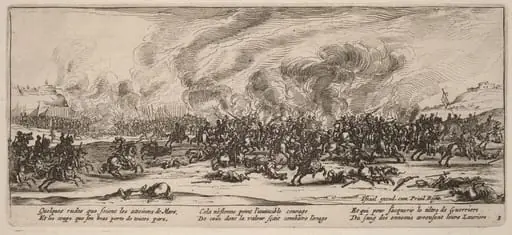
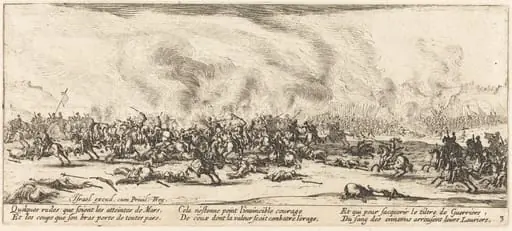
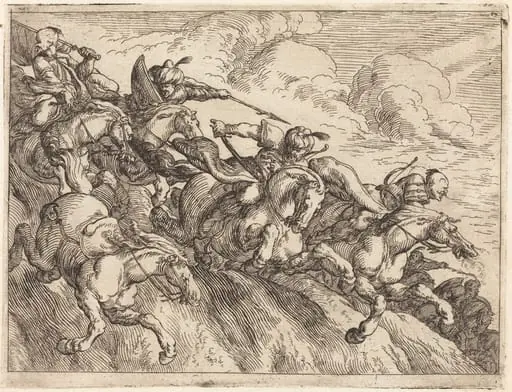
Created around 1633 by Jacques Callot, this etching captures a violent cavalry engagement on laid paper. As one of more than 1,400 prints in his career, it reflects Callot’s focus on military themes, rendered with precision and narrative clarity. The composition conveys motion and disorder without sacrificing structural legibility, characteristic of his approach to depicting war.
Subject & Meaning
The scene portrays mounted soldiers locked in close combat, swords raised, while a third horse rears in agitation. Below, foot soldiers engage in chaotic melee. The imagery does not glorify battle but presents it as a turbulent, immediate event. No clear victor emerges; the focus lies in the physical intensity and disarray of conflict, reflecting the grim reality of 17th-century warfare.
Technique & Style
Callot employed fine, controlled etching lines to define armor, weapons, and anatomy with remarkable detail.
Callot employed fine, controlled etching lines to define armor, weapons, and anatomy with remarkable detail. The background recedes through simplified trees and hills, guiding attention to the foreground violence. His use of dense, precise hatching creates texture and depth, enhancing the sense of proximity and urgency. The composition remains orderly despite its apparent chaos, a hallmark of his technical discipline.
History & Provenance
The print was made during Callot’s mature period in Nancy, following his time in Florence and Paris. It belongs to a series of military scenes he produced after witnessing troop movements in Lorraine during the Thirty Years’ War. While its early ownership is undocumented, it entered major collections in the 19th century, including the National Gallery of Art in Washington, D.C.
Context
Callot’s etchings emerged amid widespread military upheaval in Europe. His works served as visual records of camp life, sieges, and skirmishes, often commissioned or circulated among soldiers and nobility. Unlike idealized battle paintings, his prints emphasized realism and the human cost of war, aligning with emerging documentary tendencies in early modern print culture.
Legacy
Callot’s detailed etchings influenced generations of artists in depicting warfare with unflinching accuracy. His technical innovations in line control and composition became benchmarks for printmakers. Though not widely known to the public today, his military scenes remain important references for historians studying early modern conflict and visual representation.
Artist & collection

Artist
Jacques Callot was a baroque printmaker and draftsman from the Duchy of Lorraine.

 Holy Family at supper
 Restoration of the Aqueduct at Pisa
 Restoration of the Aqueduct at Pisa
 Square in Paris with Many Figures
 Square in Paris with Many Figures
 Horsemen Attacked by Robbers
 HOW WILL A COVERED PART BE CORRECTED?HOW WIKA A COVERED HEART DEED CORRECTED?
![Christ Walking on the Water [second plate], by Jacques Callot](https://artifactworldgallery.com/img/jacques-callot--christ-walking-on-the-water-second-plate--2069f3bfe4cb2126-w320.webp) Christ Walking on the Water [second plate]
Christ Walking on the Water [second plate]