Artwork
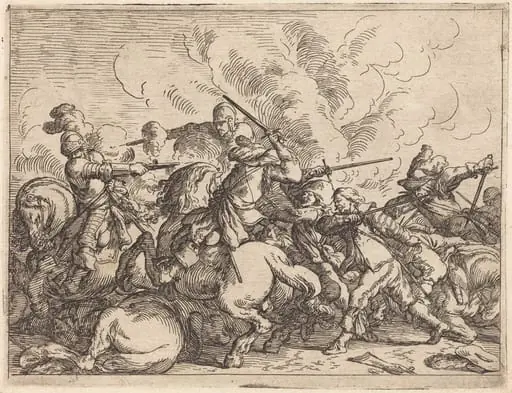
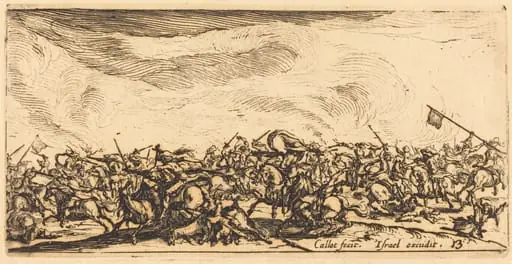
The Cavalry Combat with Pistols
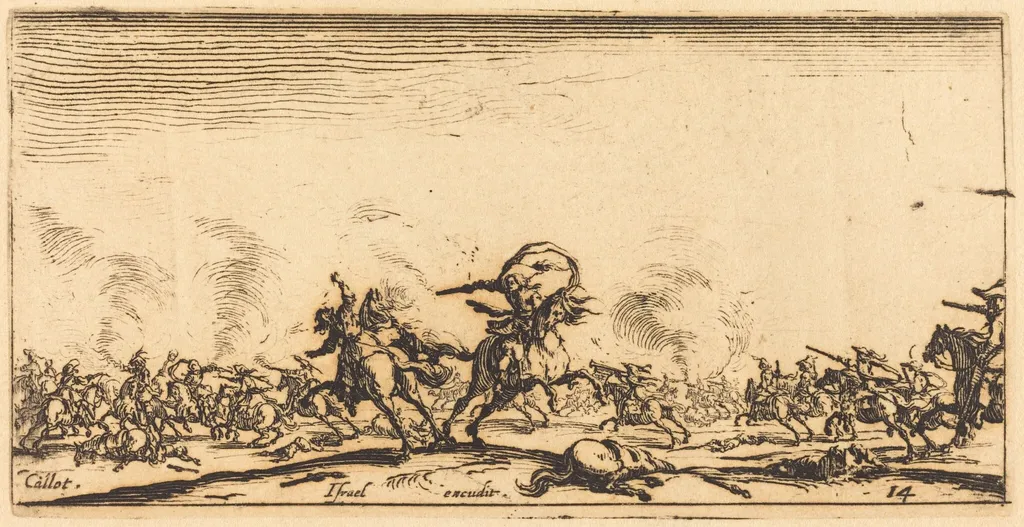
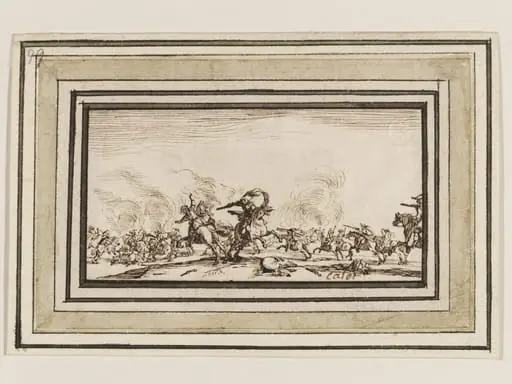
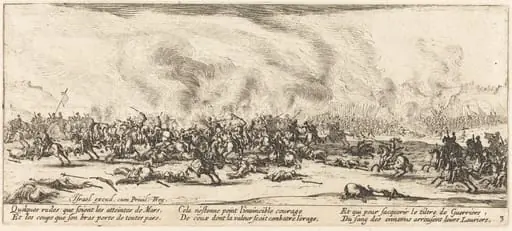
The Cavalry Combat with Pistols is an ink print by the Baroque artist Jacques Callot. It dates from 1633 and is held in the collection of the National Gallery of Art.
About this work
Overview
The composition emphasizes dynamic motion and atmospheric detail, typical of Callot’s approach to documenting contemporary conflict through printmaking.
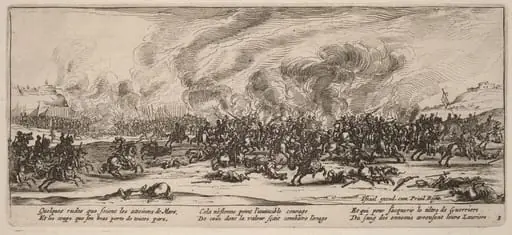
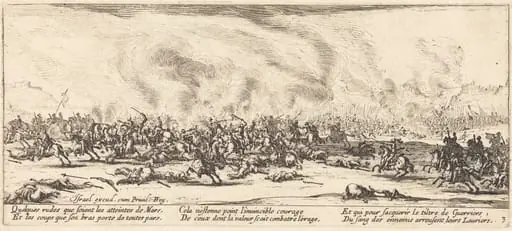
Created around 1633 by Jacques Callot, this etching on laid paper captures a moment of close-quarters cavalry combat. As one of over 1,400 prints produced by the Lorraine-born artist, it reflects his focus on military life during the Thirty Years’ War. The composition emphasizes dynamic motion and atmospheric detail, typical of Callot’s approach to documenting contemporary conflict through printmaking.
Subject & Meaning
Two mounted soldiers engage at point-blank range, pistols discharged, smoke rising from the barrels. Their horses arch and kick in violent motion, conveying chaos and immediacy. The scene reflects real battlefield tactics of the era, when pistols were increasingly used in shock combat rather than as secondary weapons. Callot presents no heroism—only the raw, unglamorized violence of war.
Technique & Style
Callot employed fine, controlled etching lines to render texture: the curl of gunsmoke, the musculature of rearing horses, the folds of armor and fabric. His use of deep shadow and intricate background detail enhances spatial depth without distracting from the central action. The precision of his line work demonstrates mastery of the etching needle, allowing for both clarity and emotional intensity.
History & Provenance
The print was made during Callot’s mature period in the 1630s, when he was producing numerous military scenes for collectors and patrons across Europe. While its early ownership is undocumented, examples of this work are held in major institutions, including the National Gallery of Art in Washington, D.C., where it remains part of a broader collection of his war-related prints.
Context
In the 1630s, cavalry tactics were evolving with the widespread adoption of pistols, replacing lances in close engagements. Callot, living through the devastation of the Thirty Years’ War, recorded these changes with observational accuracy. His prints served not as propaganda but as visual records of soldiering life, from camp routines to battlefield chaos.
Legacy
Callot’s detailed depictions of war influenced generations of printmakers and military illustrators. His ability to convey movement, atmosphere, and human behavior in etching set a standard for narrative printmaking. Though not widely exhibited in his lifetime, his works became foundational references for later artists studying the visual language of conflict.
Artist & collection

Artist
Jacques Callot was a baroque printmaker and draftsman from the Duchy of Lorraine.

 Holy Family at supper
 Restoration of the Aqueduct at Pisa
 Restoration of the Aqueduct at Pisa
 Square in Paris with Many Figures
 Square in Paris with Many Figures
 Horsemen Attacked by Robbers
 HOW WILL A COVERED PART BE CORRECTED?HOW WIKA A COVERED HEART DEED CORRECTED?
![Christ Walking on the Water [second plate], by Jacques Callot](https://artifactworldgallery.com/img/jacques-callot--christ-walking-on-the-water-second-plate--2069f3bfe4cb2126-w320.webp) Christ Walking on the Water [second plate]
Christ Walking on the Water [second plate]