Artwork
Untitled
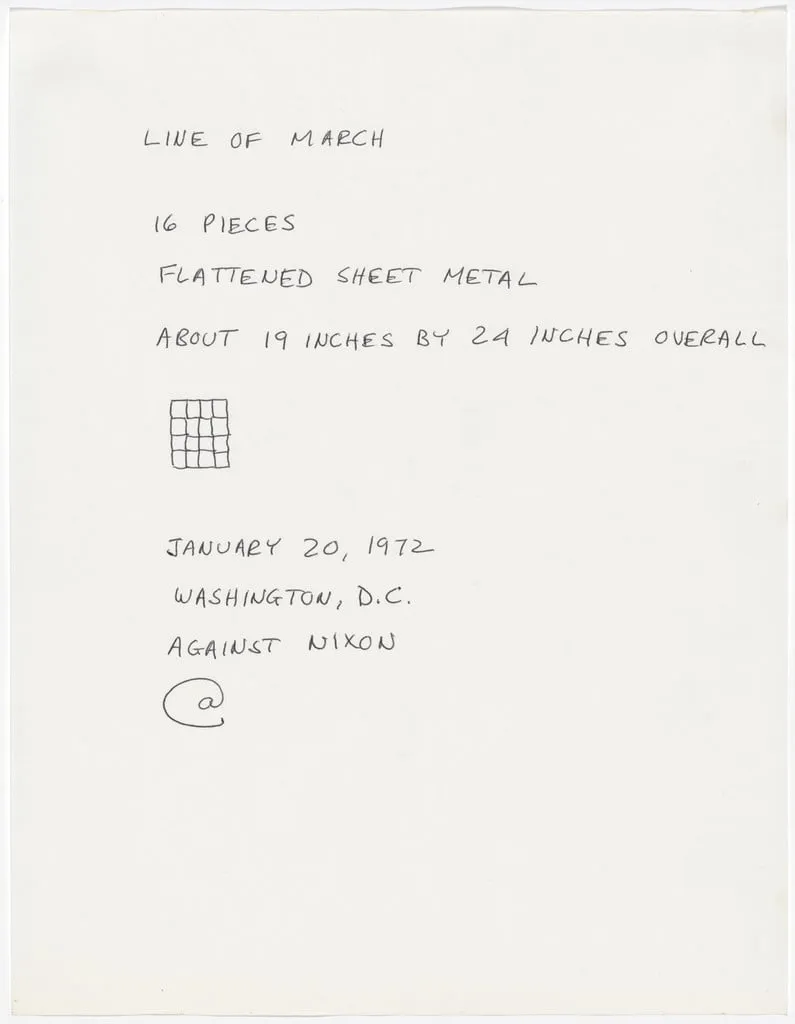
Untitled is an ink drawing by Carl Andre. It dates from 1973 and is held in the collection of the Museum of Modern Art.
About this work
Below the grid, there’s handwritten text: "LINE OF MARCH," "16 PIECES," "FLATTENED SHEET METAL," "ABOUT 19 INCHES BY 24 INCHES OVERALL," and "AGAINST NIXON.
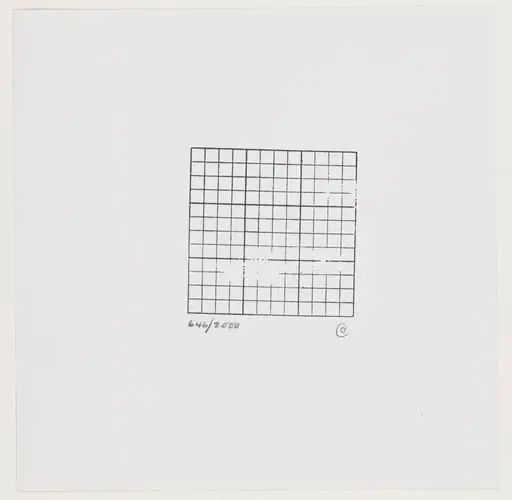
This is a simple black ink drawing on paper. It shows a grid of 16 squares arranged in four rows of four. Below the grid, there’s handwritten text: "LINE OF MARCH," "16 PIECES," "FLATTENED SHEET METAL," "ABOUT 19 INCHES BY 24 INCHES OVERALL," and "AGAINST NIXON." The date "JANUARY 20, 1972" and location "WASHINGTON, D.C." are also written in the same style.
The squares look like a sketch for a larger metal piece, but here it’s just ink. The words "AGAINST NIXON" suggest it’s tied to a protest or political statement from that time.
Next, check out Carl Andre to see how he turned simple materials into bold art.
Overview
Carl Andre’s 1973 ink drawing on paper presents a restrained composition of sixteen evenly spaced squares arranged in a four-by-four grid. Below the grid, handwritten notes reference materials, dimensions, and a political context. Though executed in simple ink, the work functions as both a schematic and a statement, bridging minimal form with contemporary social concern.
Subject & Meaning
The grid of squares may represent a proposed sculpture of flattened sheet metal, aligning with Andre’s interest in industrial materials and modular arrangements. The handwritten phrase 'AGAINST NIXON' anchors the piece in the political climate of early 1970s America, linking its geometric structure to dissent. The work transforms a formal study into a quiet act of protest.
Technique & Style
Executed in black ink on paper, the drawing employs precise, unadorned lines and uniform spacing. The handwritten annotations, rendered in the same medium, blend documentation with expression. Andre’s approach avoids embellishment, emphasizing clarity and directness—hallmarks of his broader practice in reducing art to essential elements.
History & Provenance
Created in 1973 and held by The Museum of Modern Art, the drawing references events from January 20, 1972, in Washington, D.C.—the day of Richard Nixon’s second presidential inauguration. The date and location, inscribed alongside the grid, suggest the work was made in response to that moment, embedding personal and political history within its structure.
Context
In the early 1970s, artists increasingly engaged with political unrest, using abstraction to convey dissent without overt imagery. Andre’s use of a grid—a recurring motif in his sculptural work—here becomes a neutral framework for a charged declaration. The drawing reflects a broader trend of conceptual art merging form with activism.
Legacy
This drawing exemplifies how Andre extended his sculptural concerns into two-dimensional formats, treating the page as a site for both planning and protest. Its preservation in a major museum underscores the significance of such works in documenting the intersection of minimalism and political consciousness during a turbulent era.
Artist & collection

Artist
Carl Andre was an American minimalist artist recognized for his ordered linear and grid format sculptures. His sculptures range from large public artworks, to large interior works exhibited on the floor, to small intimate works.