Artwork
Carapace
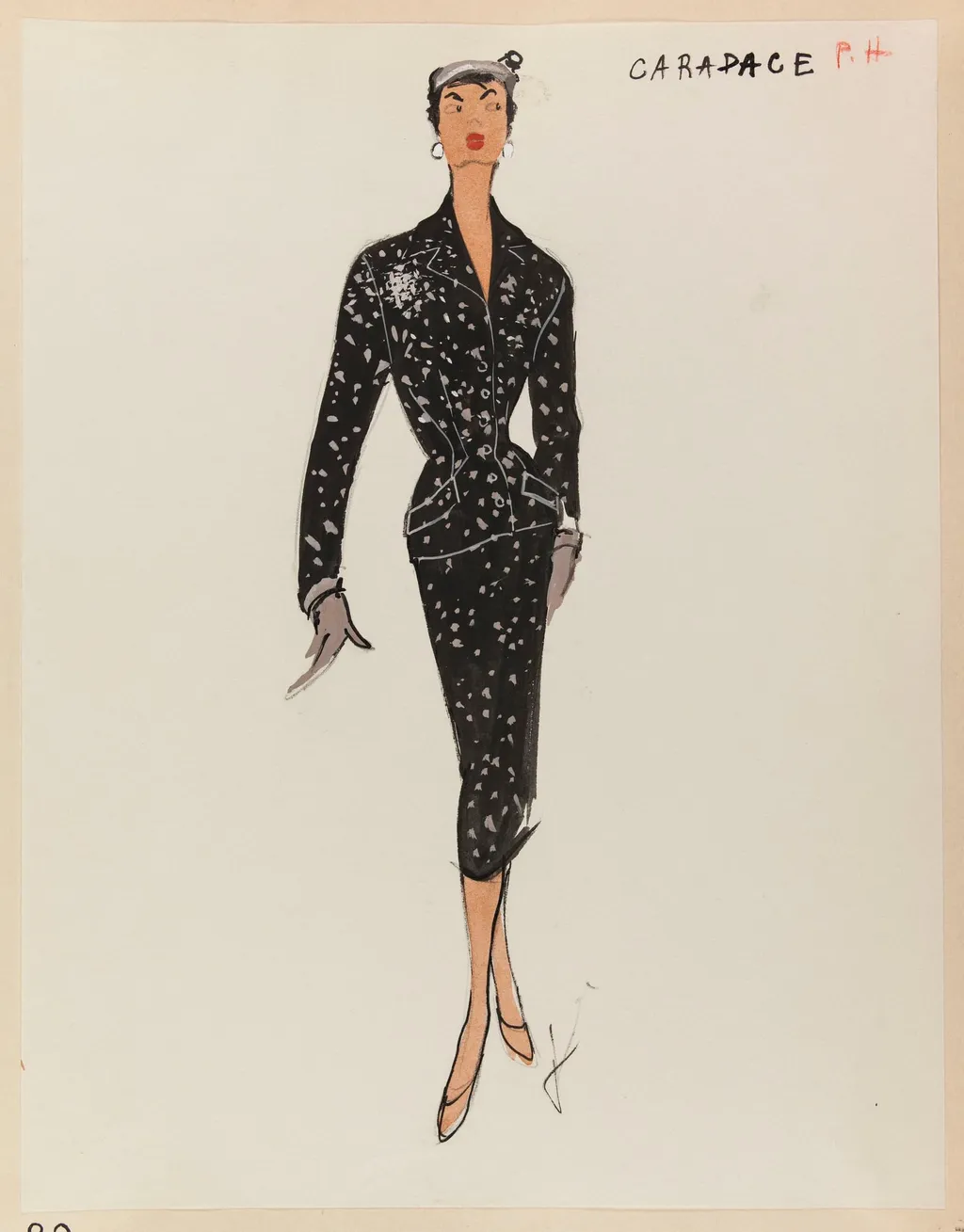
Carapace is a drawing by Carven. It dates from 1952 and is held in the collection of the Palais Galliera - Musée de la Mode de la Ville de Paris.
About this work
Overview
The work resides in the Museum of Ethnography, where it is preserved as a document of mid-century design thinking rather than a finished garment.
Carapace, dated around 1952, is a fashion sketch by the designer Carven. Executed in ink or pencil, it captures a minimalist ensemble in black and white, rendered with rapid, fluid lines. The work resides in the Museum of Ethnography, where it is preserved as a document of mid-century design thinking rather than a finished garment. Its informal, spontaneous quality suggests it was made as a conceptual note, not a presentation drawing.
Subject & Meaning
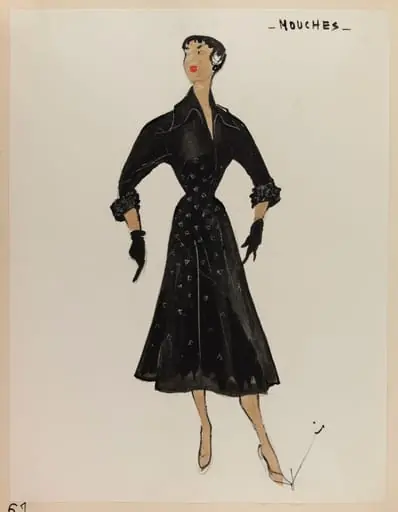
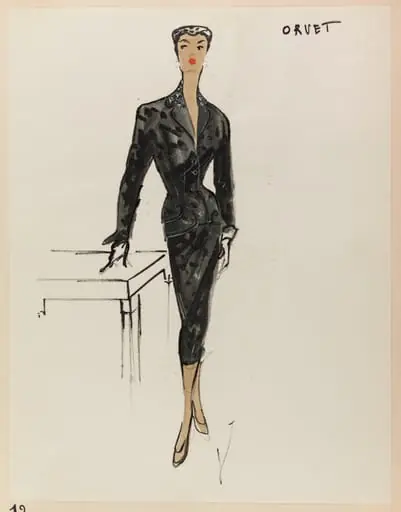
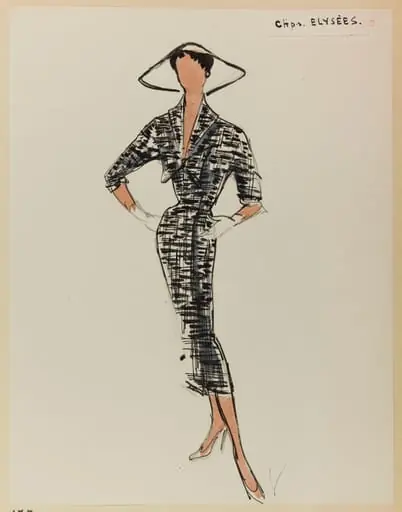
The figure wears a tailored jacket with sharp, angular shoulders and a matching skirt, both adorned with small white circular motifs. The outfit’s rigid silhouette evokes a protective shell, aligning with the title 'Carapace'—a biological term for a hard outer covering. The restrained accessories and pulled-back hair emphasize structure over ornament, suggesting a vision of femininity defined by form and containment rather than softness.
Technique & Style
The sketch employs loose, gestural lines that convey motion and immediacy. Details like the dot patterns and shoe contours are suggested rather than meticulously rendered, indicating a focus on silhouette and proportion over finish. The contrast between the dark fabric and white accents is achieved through negative space and minimal ink, reflecting a modernist sensibility that values clarity and economy of line.
History & Provenance
Created during Carven’s active years in postwar Paris, the sketch entered the Museum of Ethnography’s collection as part of a broader effort to document fashion as cultural artifact. Its preservation reflects institutional interest in design processes, not just final products. No record of public exhibition or commercial use exists, suggesting it remained a private working drawing within the designer’s studio.
Context
In the early 1950s, Parisian fashion emphasized structured silhouettes following wartime austerity. Carven’s work aligned with this trend, yet her sketches often revealed a playful, experimental edge. Carapace reflects a moment when designers began reimagining clothing as both functional and symbolic—blending tailoring with metaphor, and turning garments into extensions of the body’s architecture.
Legacy
Though not widely reproduced, Carapace contributes to understanding how fashion designers translated abstract ideas into wearable forms. Its presence in an ethnographic museum signals a shift in how fashion is studied—not merely as luxury, but as a material expression of cultural values. The sketch remains a quiet example of how conceptual thinking shaped mid-century design.
Artist & collection
Artist
These delicate ink-on-paper drawings capture the quiet poetry of everyday things: pinecones, reeds, apples.
Museum
Palais Galliera - Musée de la Mode de la Ville de Paris
Continue through works from the same source collection.