Artwork
'Lajou'
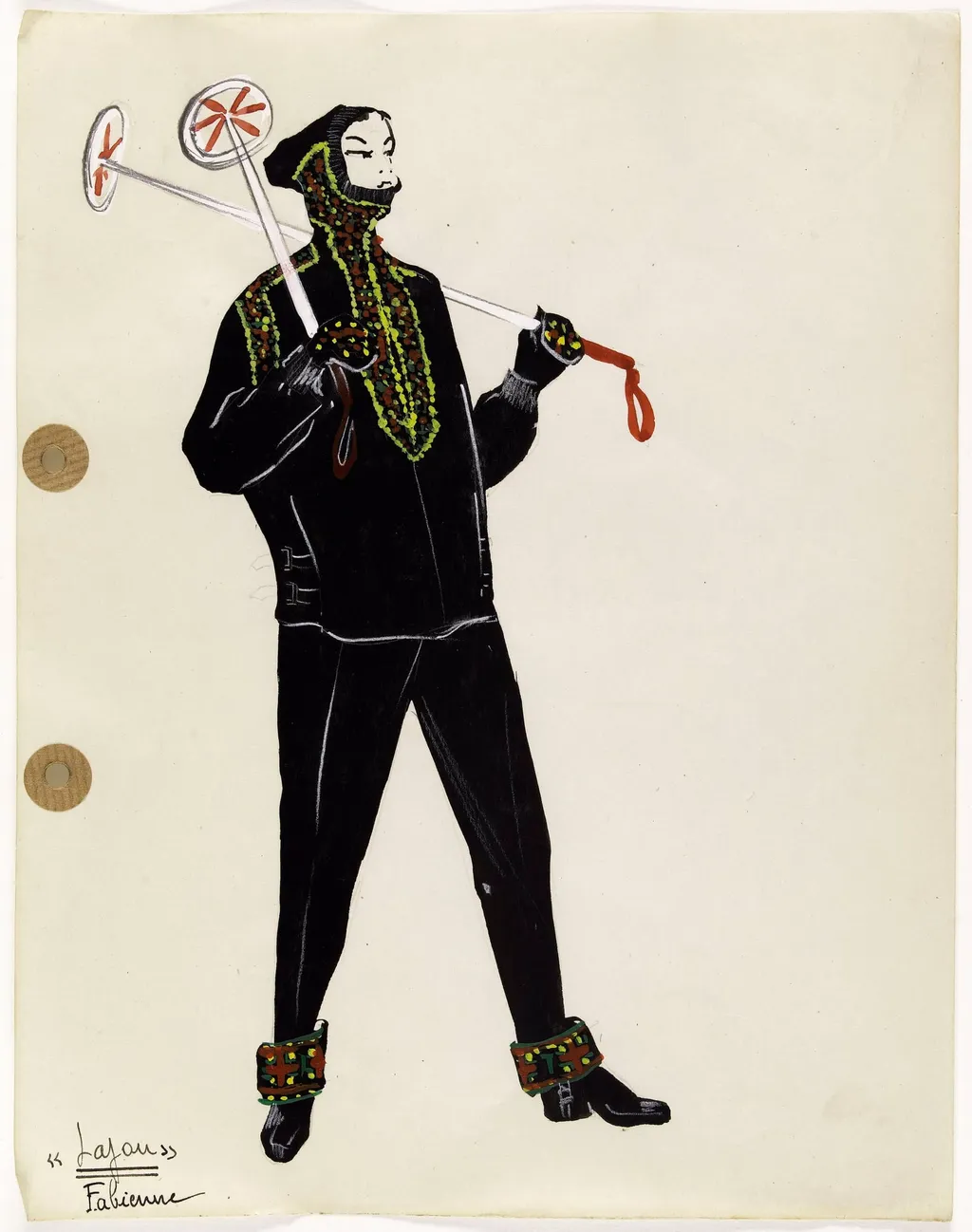
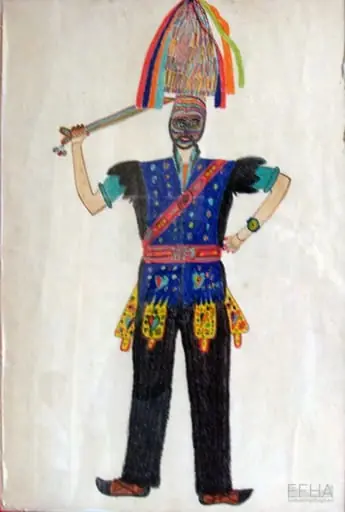
'Lajou' is a drawing by Carven. It dates from 1949 and is held in the collection of the Palais Galliera - Musée de la Mode de la Ville de Paris.
About this work
Overview
The piece lacks a title beyond its designation, and its cultural context remains partially obscured.
Lajou is a pencil drawing attributed to the artist Carven, dated around 1949. It is part of the collection at the Museum of Ethnography. The work depicts a figure in a stylized costume, rendered with minimal detail and bold outlines. The signature 'Carven' appears in the corner, suggesting the artist's direct involvement. The piece lacks a title beyond its designation, and its cultural context remains partially obscured.
Subject & Meaning
The figure appears to represent a performer or ritual participant, distinguished by vividly colored embroidery on the collar, cuffs, and footwear. Two staffs, topped with red and white circles, are held in the hands, while a red ribbon is tied to the wrist. The simplified facial features and uniform pattern suggest symbolic rather than individual representation. The costume’s intensity against a neutral background implies ceremonial or theatrical function, though its specific cultural origin is unconfirmed.
Technique & Style
Executed in pencil with minimal color accents, the drawing employs flat, clean lines and reduced facial features that evoke a graphic, almost caricature-like quality. The green and red embroidery is rendered with deliberate contrast, drawing attention to the costume’s details. The background is left blank, focusing attention entirely on the figure. The style suggests an interest in folk or theatrical dress, rendered with observational clarity rather than naturalism.
History & Provenance
The drawing entered the Museum of Ethnography’s collection in the mid-20th century, though its acquisition history is not fully documented. The signature 'Carven' is the primary identifier of the artist, but no other verified works by this hand are publicly recorded. The date of c. 1949 places it in a postwar period when ethnographic collecting was active, though the work’s origin—whether field sketch, studio piece, or cultural reconstruction—remains uncertain.
Context
The costume’s design bears resemblance to regional performance attire from parts of Europe and the Mediterranean, where embroidered garments and ritual staffs appear in folk traditions. However, no direct link to a known cultural practice has been established. The drawing may reflect Carven’s personal interpretation of such traditions, possibly inspired by travel, archival images, or local festivals observed in the late 1940s.
Legacy
Lajou remains an isolated work in the artist’s known output, with no other pieces by Carven identified in public archives. Its presence in an ethnographic museum suggests it was valued for its visual representation of costume and gesture, rather than as a document of a specific community. The drawing continues to prompt questions about authorship, cultural borrowing, and the boundaries between observation and invention in mid-century visual anthropology.
Artist & collection
Artist
These delicate ink-on-paper drawings capture the quiet poetry of everyday things: pinecones, reeds, apples.

Museum
Palais Galliera - Musée de la Mode de la Ville de Paris
Continue through works from the same source collection.
![Sans le v[illisible], by Madeleine & Madeleine](https://artifactworldgallery.com/img/madeleine-madeleine--sans-le-v-illisible--8212b979ada6b65a-w320.webp)