Artwork
Seville Surrenders to the king, Saint Ferdinand
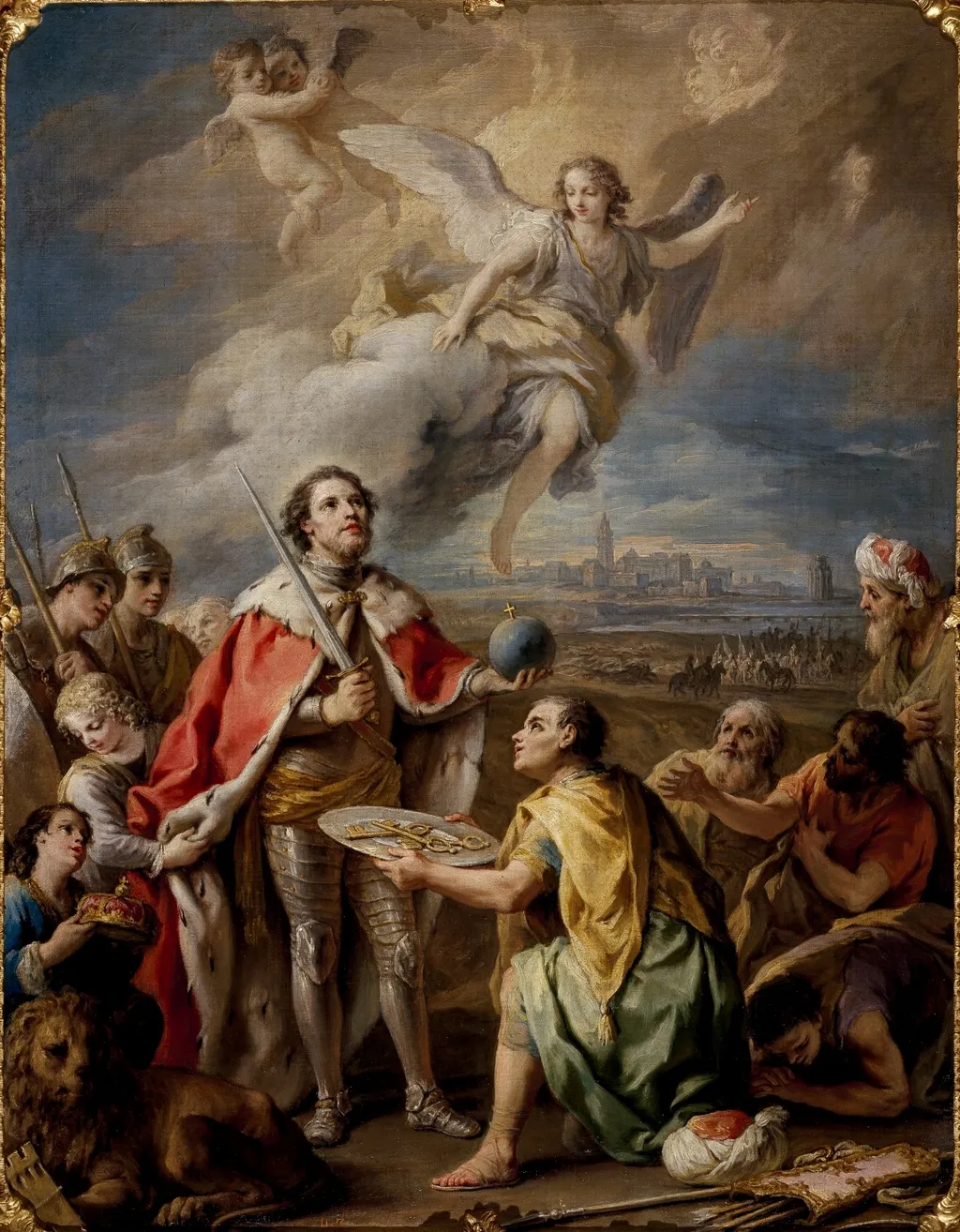
Seville Surrenders to the king, Saint Ferdinand is an oil painting by the Rococo painting artist Charles Joseph Flipart. It dates from 1775 and is held in the collection of the Museo del Prado.
About this work
Overview
This oil painting depicts a significant historical and religious event: the capitulation of Seville to Ferdinand III of Castile.
Charles Joseph Flipart completed *Seville Surrenders to the king, Saint Ferdinand* in 1775. This oil painting depicts a significant historical and religious event: the capitulation of Seville to Ferdinand III of Castile. The composition centers on the victorious monarch receiving a symbolic key, surrounded by various figures and an angelic presence, all rendered with the characteristic techniques of the era. The work is currently housed in the Museo del Prado.
Subject & Meaning
The painting illustrates the moment King Ferdinand III of Castile accepts the city's surrender. The armored king, holding a sword and an orb—symbols of his temporal and spiritual authority—stands over a kneeling figure presenting a key on a cushion. Surrounding figures, both military and civilian, observe the scene, while a burning city in the background underscores the conflict's resolution. An angel hovering above suggests divine sanction for the king's triumph, reinforcing the religious aspect of the conquest.
Technique & Style
Flipart's approach to this historical narrative employs a dramatic interplay of light and shadow to emphasize key figures and emotional intensity. The artist uses strong contrasts to highlight the central exchange between the king and the kneeling official, drawing the viewer's eye to the symbolic key. Figures are rendered with a sense of classical drapery and robust forms, typical of 18th-century academic painting, contributing to the work's solemn and weighty atmosphere.
History & Provenance
Created in 1775, *Seville Surrenders to the king, Saint Ferdinand* by Charles Joseph Flipart reflects the artistic trends and historical interests of its time. The painting's subject matter, celebrating a revered monarch and a pivotal event in Spanish history, would have resonated strongly with contemporary audiences. Today, this work is part of the esteemed collection at the Museo del Prado, where it offers insight into 18th-century historical painting.
Artist & collection