Artwork
The ships 'Race-horse' and 'Carcass' of Captain Phipps' expedition embedded in ice in the Polar Regions
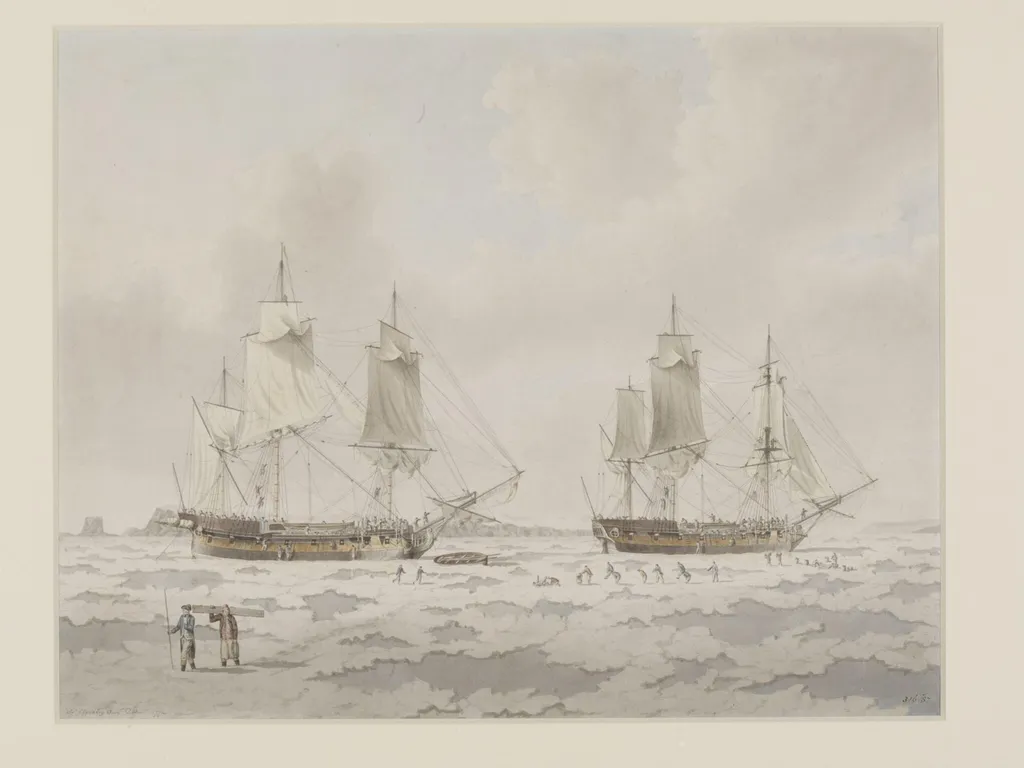
The ships 'Race-horse' and 'Carcass' of Captain Phipps' expedition embedded in ice in the Polar Regions is a watercolor work on paper by the Rococo painting artist John the younger Cleveley. It dates from 1774 and is held in the collection of the Victoria and Albert Museum. Painted in 1774 by John Cleveley the Younger, this watercolour documents the Arctic expedition led by Captain Constantine Phipps.
About this work
Overview
Painted in 1774 by John Cleveley the Younger, this watercolour documents the Arctic expedition led by Captain Constantine Phipps. It depicts the HMS Race-horse and HMS Carcass immobilized in sea ice near Spitzbergen during August 1773. The work is signed and dated by the artist, serving as a precise visual record of a scientific voyage aimed at exploring the North Pole.
Subject & Meaning
The painting captures the moment when two Royal Navy vessels became locked in pack ice during an attempt to reach the North Pole. The presence of small figures on the shore suggests scientific observation—possibly measuring ice thickness or surveying the landscape. The scene conveys the vulnerability of human endeavor against the vast, unyielding Arctic environment.
Technique & Style
Cleveley employed delicate watercolour washes to render the pale, diffused light of the polar summer. The ships’ rigging and ice formations are rendered with precise, linear detail, while the surrounding ice and water are softened with translucent layers. The muted palette—blues, greys, and pale whites—enhances the sense of cold and isolation.
History & Provenance
The artwork was created shortly after the expedition’s return to England, likely as a documentary record for patrons or naval authorities. It remained in the Cleveley family before entering institutional collections. The Victoria and Albert Museum acquired it as part of its holdings of 18th-century maritime art, preserving its historical and artistic significance.
Context
Phipps’ 1773 voyage was one of the first British expeditions commissioned by the Royal Society to investigate the possibility of a navigable passage to the North Pole. Though the ships failed to advance beyond 80°48′N, the expedition collected valuable data on ice conditions and Arctic wildlife, contributing to later polar exploration efforts.
Legacy
Cleveley’s watercolour stands as an early example of scientific illustration in British maritime art. Its factual accuracy and restrained aesthetic reflect the Enlightenment emphasis on observation and record-keeping. The painting remains a key visual source for understanding 18th-century Arctic exploration and the technological limits of naval vessels in extreme environments.
Artist & collection
Artist
John the younger Cleveley painted ships, harbors, and Arctic ice the way others painted portraits, with careful lines and soft watercolors.

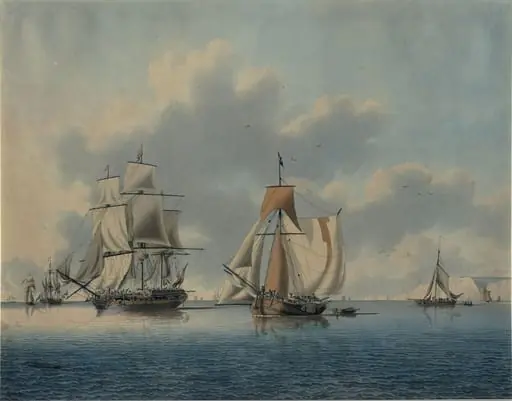
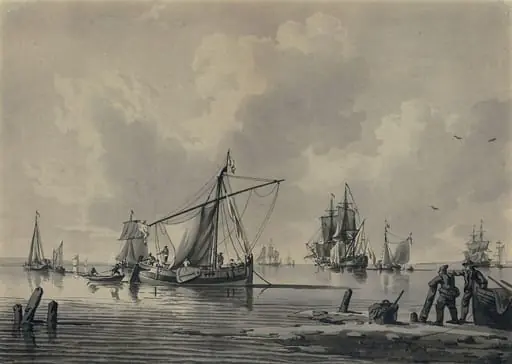
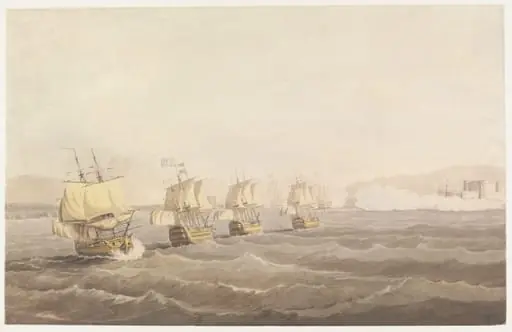 The Passage of Admiral Duckworth's Fleet in 1806-07 through the Dardanelles'
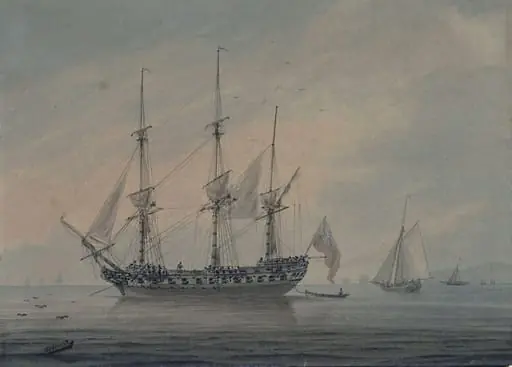 Seascape with a Frigate
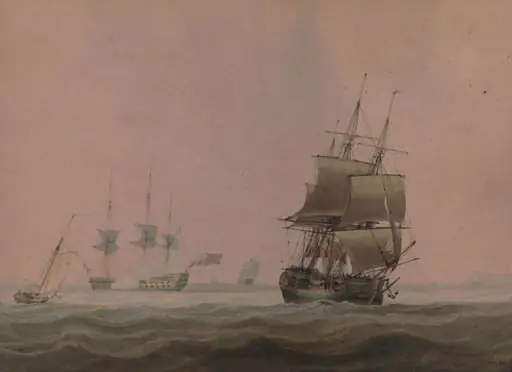 Shipping off the north foreland
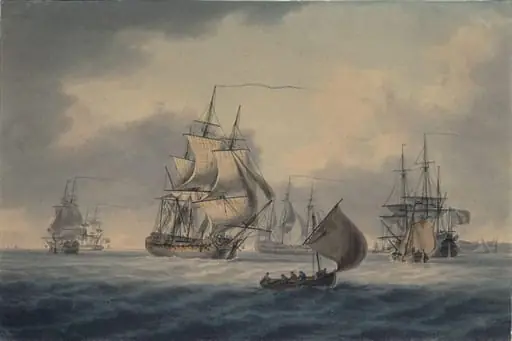 Shipping
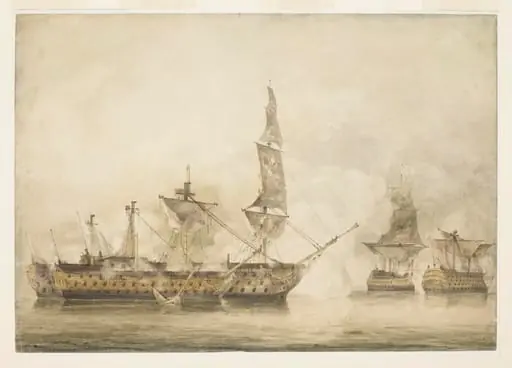 His Majesty's ship "Victory", Capt. E. Harvey, in the memorable battle of Trafalgar, between two French ships of the line
 Vessels and fishing boat
 H.M.S. Victory off N. Africa
 Shipping
 The Frigate
 Seapiece with Shipping
 Liber Studiorum: Ships in a Breeze
 English Ships of War