Artwork
Saint John on the Isle of Patmos
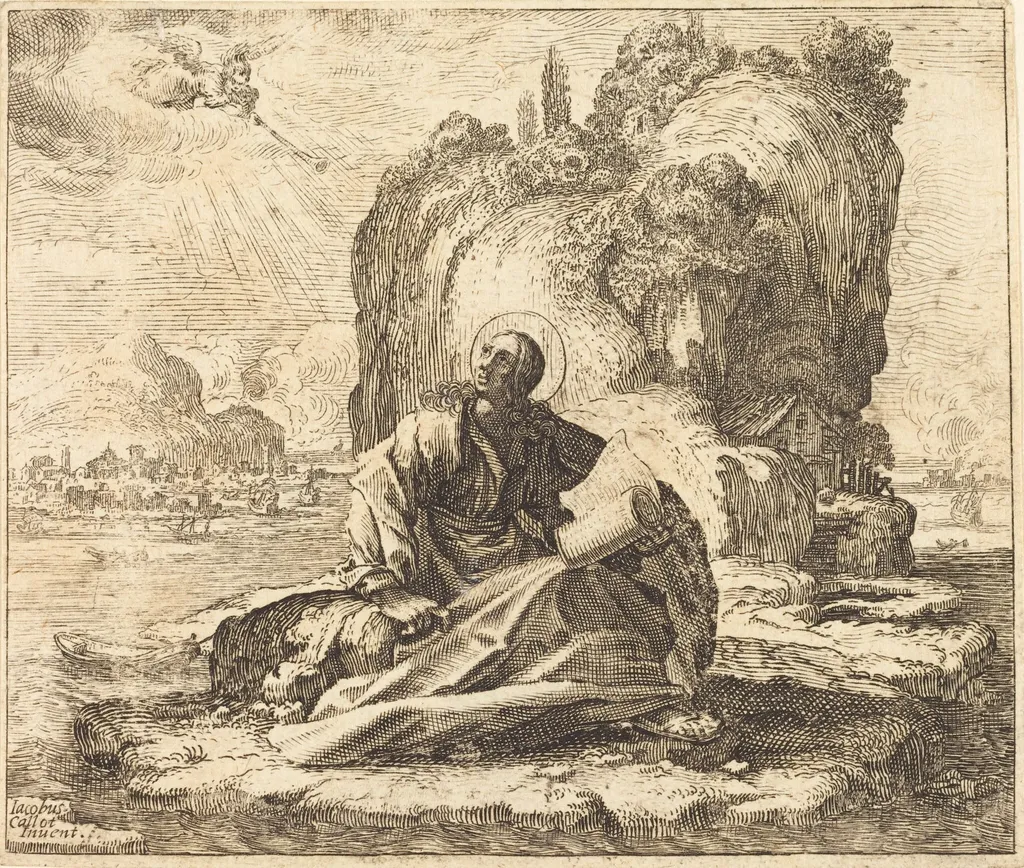
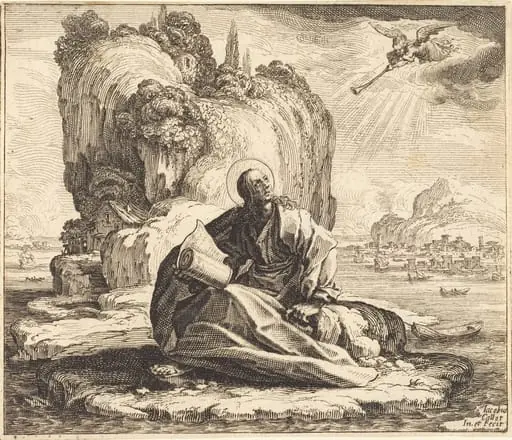
Saint John on the Isle of Patmos is an ink print by the Baroque artist François Collignon. It dates from 1630 and is held in the collection of the National Gallery of Art.
About this work
Overview
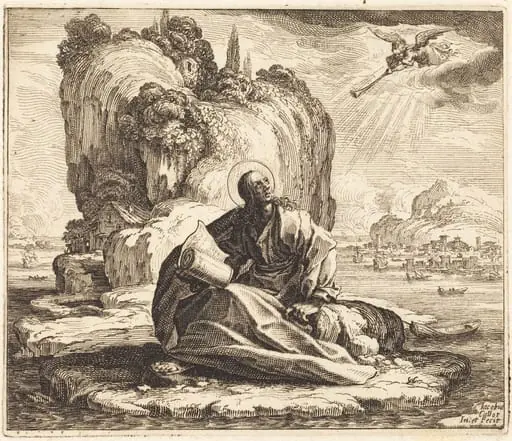
François Collignon created this etching around 1630, depicting Saint John the Evangelist during his exile on the island of Patmos.
François Collignon created this etching around 1630, depicting Saint John the Evangelist during his exile on the island of Patmos. Rendered in ink on laid paper, the work belongs to the printmaking tradition of early 17th-century France. Unlike grand religious narratives, it captures a contemplative, solitary moment, emphasizing stillness over spectacle. The medium of etching allowed for fine linear detail, suited to the quiet intimacy of the scene.
Subject & Meaning
The figure is Saint John, traditionally identified as the author of the Book of Revelation. Seated alone on a rocky shore, he is shown not in vision or divine encounter, but in the act of writing—suggesting reflection rather than revelation. The surrounding trees and distant structures imply isolation without hostility, framing his labor as a quiet spiritual duty. The absence of angels or celestial signs shifts focus to human endurance and devotion.
Technique & Style
Collignon employed etching, a technique involving acid-bitten lines on a metal plate, to achieve delicate tonal gradations and precise contours. The composition relies on fine, controlled strokes to define rock textures, foliage, and architectural forms. Soft shadows and sparse detail in the background create depth without clutter. The style reflects Northern European influences, prioritizing atmospheric nuance over dramatic contrast, typical of French printmakers of the period.
History & Provenance
The etching was produced in France during the 1630s, a time when religious imagery in print was widely circulated for private devotion. While no early ownership records are documented, its survival in institutional collections suggests it was valued by collectors of devotional prints. It was likely part of a broader series or portfolio of biblical scenes, though no complete set is known to survive.
Context
In early 17th-century Europe, religious subjects remained central to print culture, even as secular themes gained ground. Collignon’s work aligns with a trend toward intimate, humanized depictions of saints, moving away from theatrical Baroque drama. Patmos, as a symbol of exile and divine inspiration, resonated with audiences during a period of religious upheaval, offering a model of quiet faith amid uncertainty.
Legacy
Though not widely reproduced or studied today, the etching exemplifies the quiet elegance of French printmaking in the decades before the rise of large-scale public art. It preserves a moment of understated spirituality that contrasts with the era’s more flamboyant religious imagery. Its endurance in museum collections attests to its role as a thoughtful artifact of personal devotion in print form.
Artist & collection