Artwork
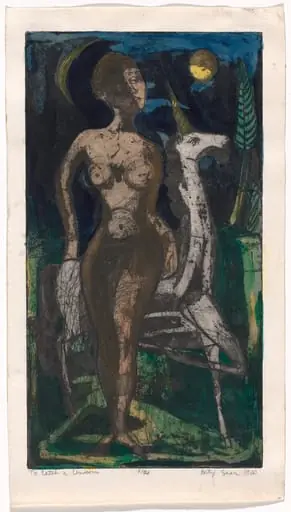
Two figures with a Unicorn
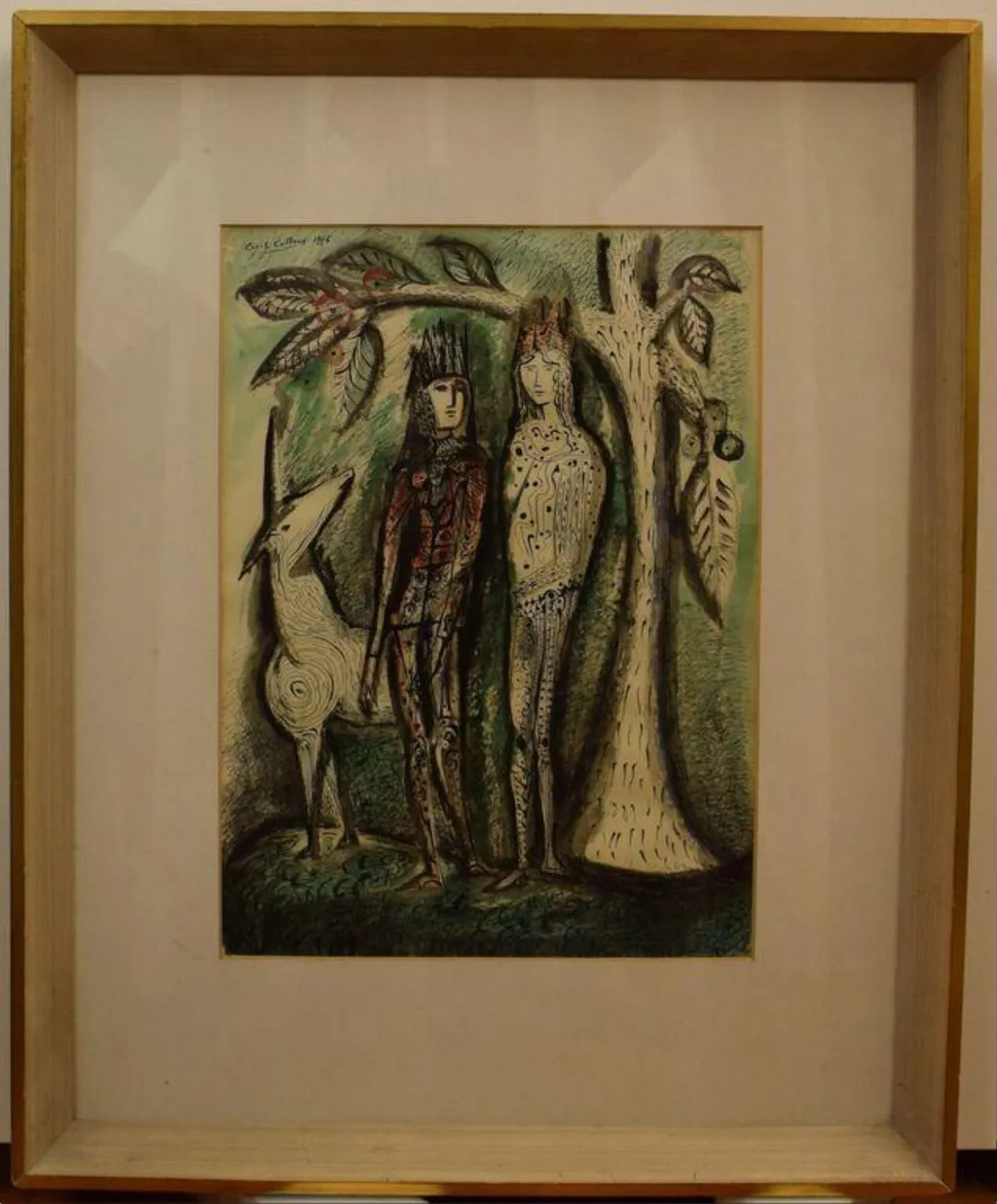
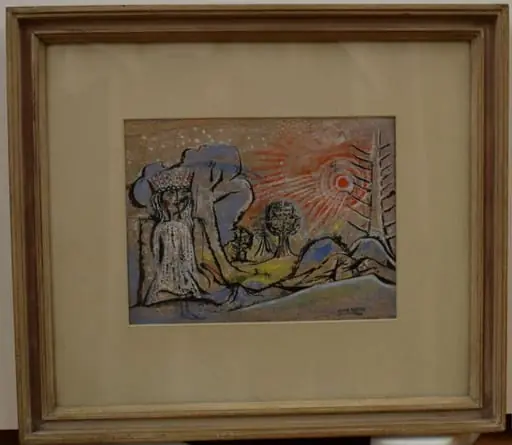
Two figures with a Unicorn is a watercolor work on paper by Cecil Collins. It dates from 1945 and is held in the collection of the Victoria and Albert Museum.
About this work
Overview
Executed with precise black outlines and subtle washes, it reveals his interest in transcendent themes and the interplay between the material and the mystical.
Cecil Collins created this watercolour in the mid-20th century, blending symbolic imagery with a restrained palette of deep red, green, and cream. The work reflects his shift from Surrealism toward a more personal, spiritual mode of expression. Executed with precise black outlines and subtle washes, it reveals his interest in transcendent themes and the interplay between the material and the mystical.
Subject & Meaning
Two crowned figures stand solemnly, gazing outward as if witnesses to something beyond the frame. A unicorn, a traditional symbol of purity and the divine, turns its head toward them, suggesting a moment of sacred recognition. The tree arching above them may imply protection or spiritual enclosure. Together, the elements form an allegory of inner vision, where human and mythical beings coexist in a quiet, otherworldly harmony.
Technique & Style
Collins employed a limited colour scheme—deep reds and greens—against the natural cream of the paper to heighten contrast and focus attention. Black ink outlines define forms with clarity, while delicate washes suggest texture: the rough bark of the tree, the soft drape of fabric, the smoothness of the unicorn’s hide. The technique merges medieval illumination with modernist simplification, creating a sense of timeless stillness.
History & Provenance
Painted after Collins left the Surrealist movement and settled in Devon, this work emerged during his tenure at Dartington Hall, where he taught and deepened his engagement with spiritual themes. Though its exact date is unrecorded, it aligns with his 1940s output, a period marked by introspection and a turn toward visionary imagery influenced by English Romantic and Symbolist predecessors.
Context
Collins’s work diverged from the dominant trends of his time, rejecting political or social realism in favour of inner experience. His engagement with Samuel Palmer’s mystical landscapes and Odilon Redon’s dreamlike forms positioned him within a quieter, esoteric tradition in British art—one that valued symbolism, myth, and the unseen over observable reality.
Legacy
This watercolour exemplifies Collins’s enduring commitment to art as a vehicle for spiritual inquiry. Though never widely celebrated in his lifetime, his focus on inner vision and symbolic form has since influenced later generations of British artists drawn to mysticism and the poetic potential of the imagination.
Artist & collection
Artist
James Henry Cecil Collins MBE was an English painter and printmaker, originally associated with the Surrealist movement.