Artwork
Still life with black rooster and two rabbits
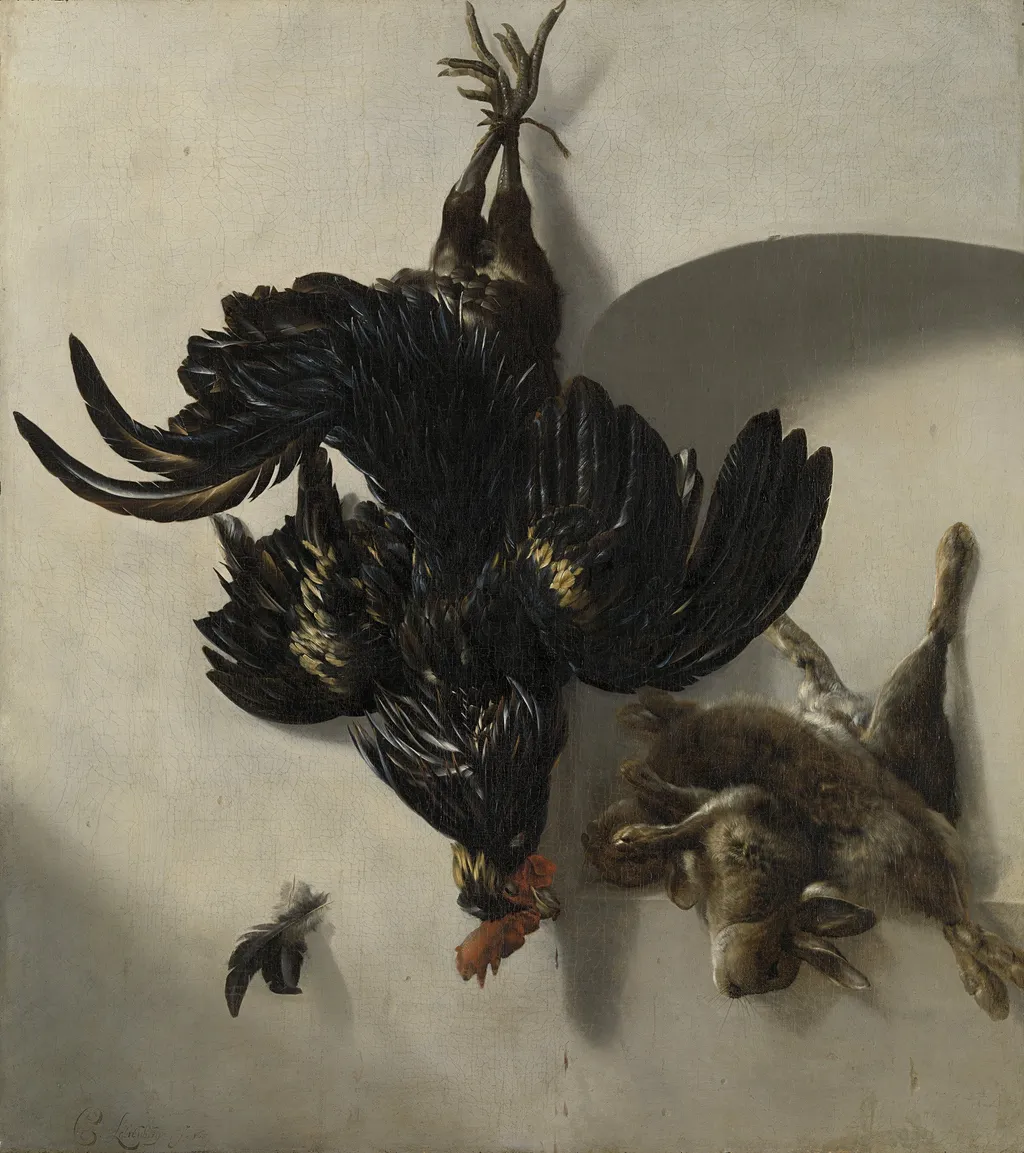
Still life with black rooster and two rabbits is an oil painting by the Dutch Golden Age artist Cornelis Lelienbergh. It dates from 1659 and is held in the collection of the Rijksmuseum.
About this work
Overview
Cornelis Lelienbergh’s 1659 oil painting, titled *Still Life with Black Rooster and Two Rabbits*, presents a quiet tableau of game animals rendered with meticulous detail. The composition centers on a black rooster, its plumage fully displayed, accompanied by two rabbits positioned on the ground. The work resides in the collection of the Rijksmuseum in Amsterdam.
Subject & Meaning
The canvas portrays a deceased black rooster with its feathers fanned outward and its head turned slightly, alongside two rabbits—one lying on its back, the other on its side. The lifeless posture of the animals, set against an unadorned light background, underscores themes of mortality and the transient nature of the hunt, common in 17th‑century Dutch still lifes.
Technique & Style
Lelienbergh employs fine, layered brushwork to render the texture of the rooster’s feathers and the softness of the rabbits’ fur, achieving a tactile realism. The subtle gradations of light and shadow create a modest chiaroscuro effect, allowing the dark forms to emerge sharply from the pale backdrop and giving the objects a three‑dimensional presence.
History & Provenance
Executed in 1659, the painting entered the Rijksmuseum’s holdings as part of its Dutch Golden Age collection, though the precise acquisition path remains undocumented. Its attribution to Lelienbergh has been affirmed through stylistic comparison with other works by the artist, confirming its place within his modest oeuvre of still‑life subjects.
Context
During the mid‑17th century, Dutch artists frequently depicted game and poultry to illustrate abundance and the skill of the painter. Lelienbergh’s choice of a black rooster—a symbol of vigor—and rabbits, often associated with fertility, reflects contemporary iconography while adhering to the period’s preference for sober, naturalistic representation.
Own this work as a print
Artist & collection