Artwork
The Angel Appearing to the Centurion Cornelius
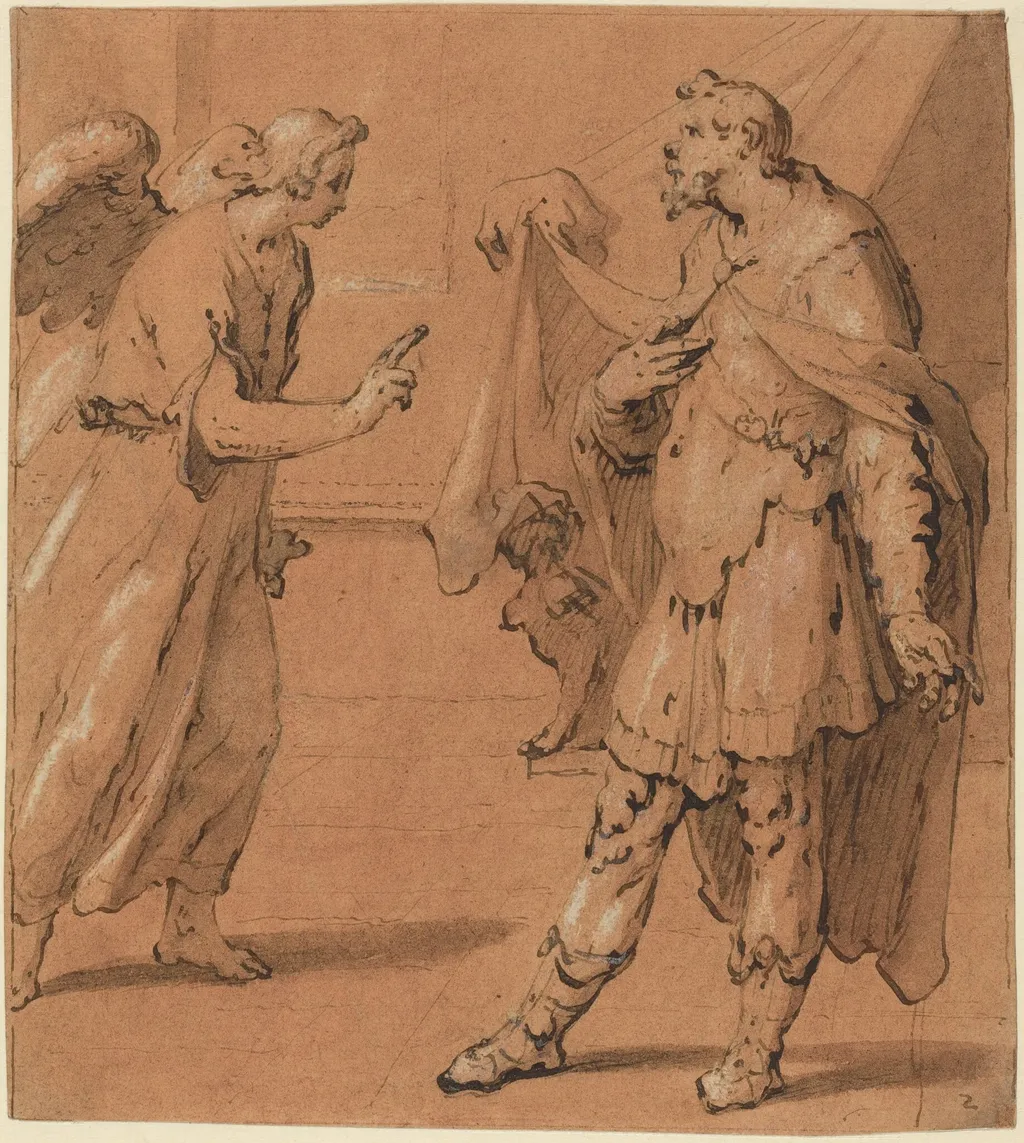
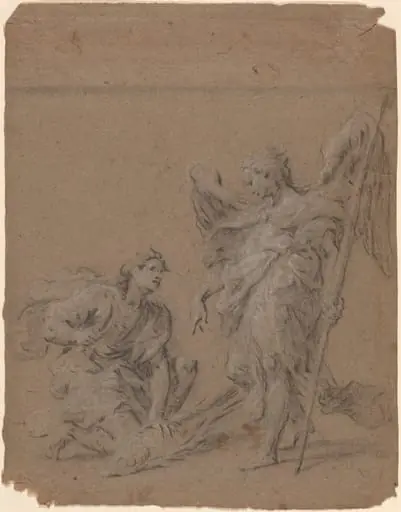
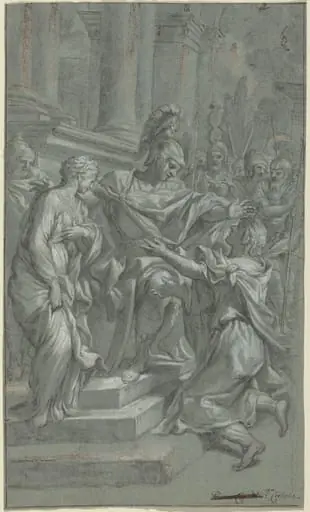
The Angel Appearing to the Centurion Cornelius is an ink drawing by the Renaissance artist Cornelis Cornelisz van Haarlem. It dates from 1594 and is held in the collection of the National Gallery of Art.
About this work
Overview
This drawing, created around 1594, portrays a moment from the Acts of the Apostles in which an angel appears to Cornelius, a Roman centurion.
This drawing, created around 1594, portrays a moment from the Acts of the Apostles in which an angel appears to Cornelius, a Roman centurion. Executed in pen and black ink with gray wash and white highlights on red-chalk-prepared paper, it reflects the Northern Mannerist approach to religious narrative. The composition is restrained, focusing on the interaction between two figures against a minimal architectural backdrop.
Subject & Meaning
The scene illustrates the divine instruction given to Cornelius, a Gentile, to seek out the apostle Peter—an event pivotal in early Christian history for opening the faith to non-Jews. The angel, gesturing toward Cornelius, conveys divine authority, while the centurion, clad in armor and holding a cloth, embodies readiness to receive revelation. The moment captures transition: earthly power yielding to spiritual guidance.
Technique & Style
The artist employs pen lines for precise contours, layered with gray wash to model form and suggest volume. White heightening accentuates folds in fabric and the angel’s wings, enhancing luminosity against the dimmed paper. The use of diluted red chalk as a ground unifies the tonal range and adds warmth. The restrained palette and controlled brushwork reflect a focus on clarity over ornamentation.
History & Provenance
Attributed to Cornelisz van Haarlem, the drawing entered the collection of the National Gallery of Art in Washington, D.C., where it remains part of its holdings of Renaissance and Mannerist works. Its survival in good condition suggests careful preservation, likely within a private or institutional collection since the late 16th century, though its exact early provenance remains undocumented.
Context
Created during the Dutch Revolt, this work reflects the Protestant emphasis on biblical narrative and personal revelation, even as its maker operated in a region still influenced by Catholic iconography. Van Haarlem’s style, rooted in Italianate Mannerism, adapts classical forms to intimate devotional subjects, bridging northern European precision with southern compositional ideals.
Legacy
The drawing stands as an example of how religious themes were rendered with psychological subtlety in late 16th-century Dutch art. Its technical discipline and narrative restraint influenced later generations of draftsmen who prioritized clarity and emotional gravity over theatricality. It remains a key reference for understanding the evolution of devotional drawing in the Northern Renaissance.
Artist & collection