Artwork
Drowsing Cattle (Le Dormoir des vaches)
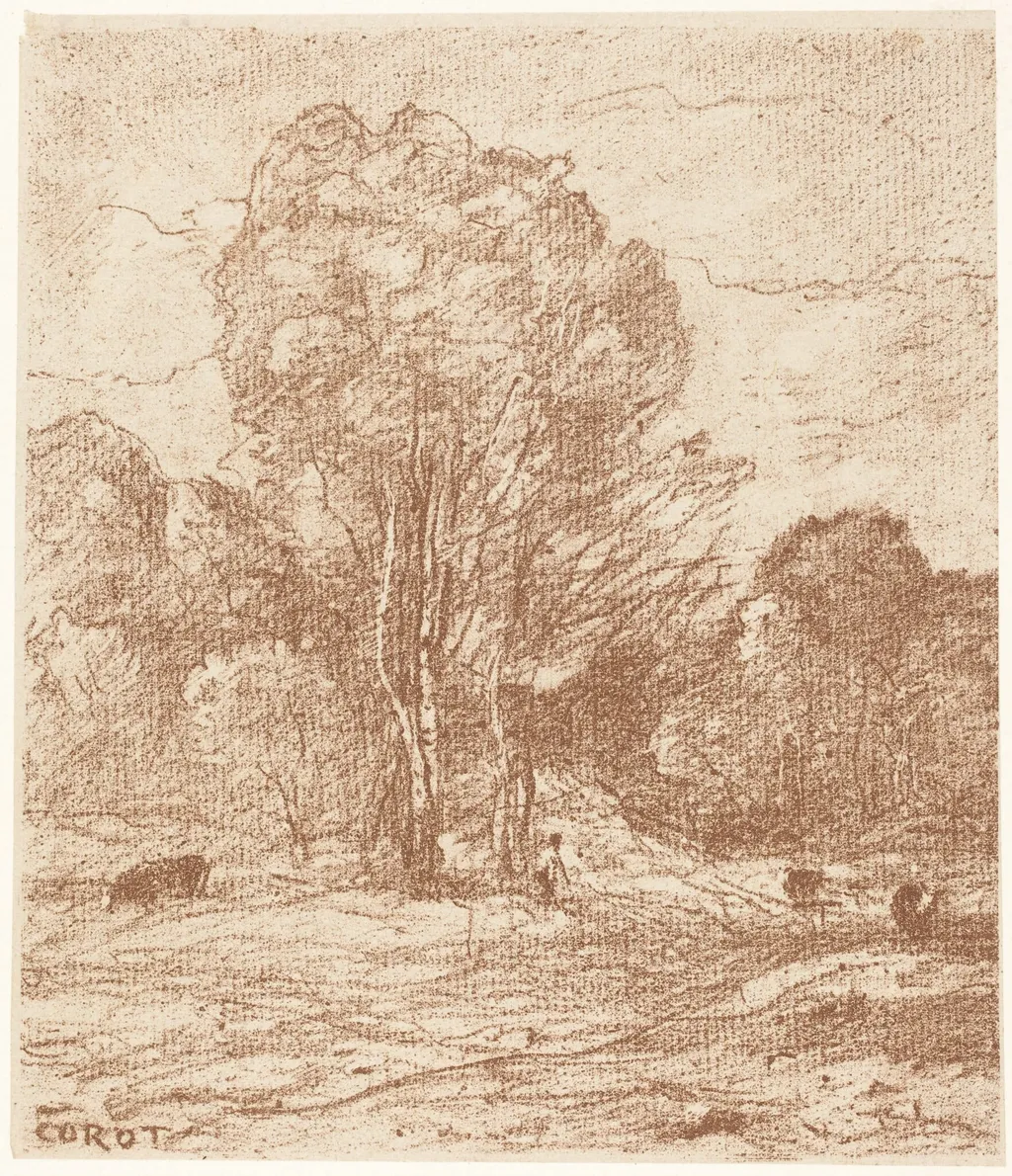
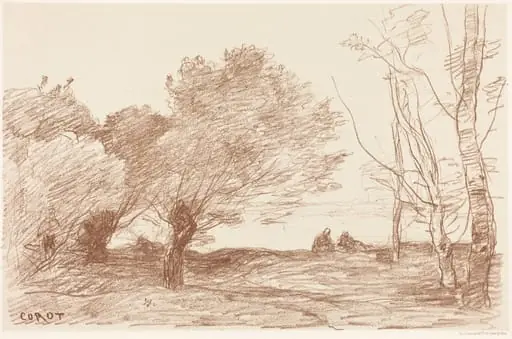
Drowsing Cattle (Le Dormoir des vaches) is an ink print by the Impressionist artist Jean Baptiste Camille Corot. It dates from 1871 and is held in the collection of the National Gallery of Art. Created in 1871, *Drowsing Cattle* is a lithograph by Jean-Baptiste-Camille Corot, reflecting his late-career focus on printmaking.
About this work
Overview
Created in 1871, *Drowsing Cattle* is a lithograph by Jean-Baptiste-Camille Corot, reflecting his late-career focus on printmaking. Though primarily known as a painter, Corot explored lithography to capture fleeting atmospheric effects. This work exemplifies his shift toward intimate, quiet rural scenes, moving away from grand historical subjects toward subtle, meditative observations of nature.
Subject & Meaning
Corot’s choice of subject reflects a poetic reverence for the ordinary, aligning with his broader interest in nature’s understated beauty.
The scene depicts a tranquil pastoral moment: cattle resting beneath a solitary, gnarled tree in a hazy field. There is no narrative action—only stillness and repose. The absence of human figures and the blurred horizon emphasize solitude and the quiet rhythm of rural life. Corot’s choice of subject reflects a poetic reverence for the ordinary, aligning with his broader interest in nature’s understated beauty.
Technique & Style
Corot employed a loose, sketch-like approach in lithography, using soft, smudged lines and tonal gradations to suggest form rather than define it. The muted palette of browns and tans enhances the dreamlike quality, while the indistinct ground and hazy atmosphere evoke a sense of time suspended. His technique prioritized mood over precision, leveraging the medium’s capacity for subtle tonal variation.
History & Provenance
Produced in 1871, the lithograph emerged during a period when Corot was increasingly dedicated to printmaking, often revisiting earlier painted compositions in new media. It was likely made for private circulation rather than public sale, consistent with his modest approach to prints. No major public collection records its early ownership, suggesting it remained within artist or collector circles.
Context
In the early 1870s, Corot was nearing the end of his career, observing the rise of Impressionism while maintaining his own lyrical style. Though not aligned with the movement’s radical techniques, his emphasis on light, atmosphere, and direct observation influenced younger artists. *Drowsing Cattle* reflects a broader 19th-century turn toward intimate, everyday landscapes as subjects worthy of artistic attention.
Legacy
The print stands as a quiet testament to Corot’s enduring interest in the expressive potential of printmaking. Its restrained aesthetic and atmospheric sensitivity prefigure later developments in modern graphic art, particularly in the use of tone and suggestion over detail. While not widely exhibited, it remains a significant example of how traditional landscape sensibilities were reimagined through the lithographic process.
Own this work as a print
Artist & collection
Artist
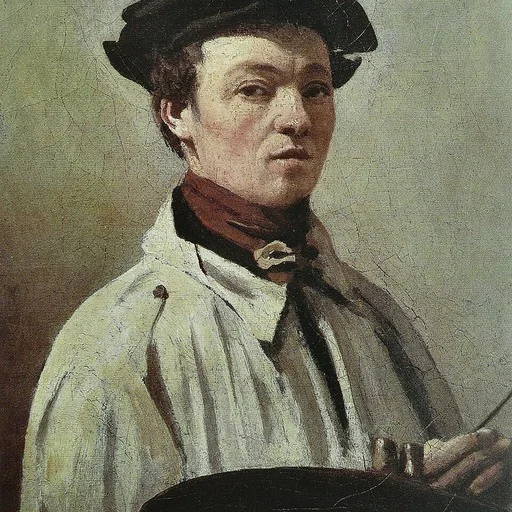
Jean-Baptiste-Camille Corot (UK: KORR-oh, US: kə-ROH, kor-OH; French: ; 16 July 1796 – 22 February 1875), or simply Camille Corot, was a French landscape and portrait painter as well as a printmaker in etching.

 Willows and White Poplars (Saules et peupliers blancs)
 Feast of Pan (La Fete de Pan)
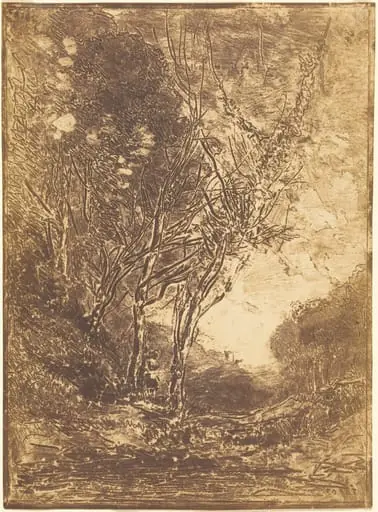 Ambush (L'Embuscade)
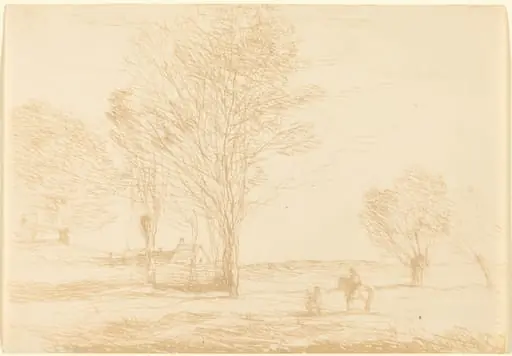 Horseman Halted in the Countryside (Cavalier arrete dans la campagna)
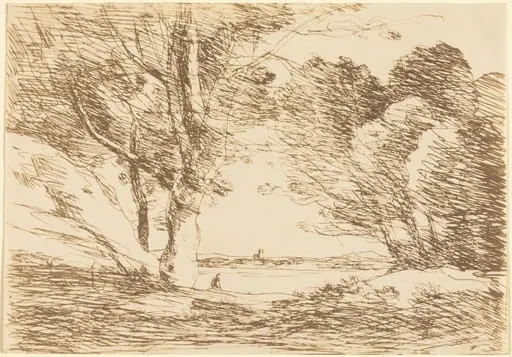 Tower on the Horizon of a Lake (Tour a l'horizon d'un lac)
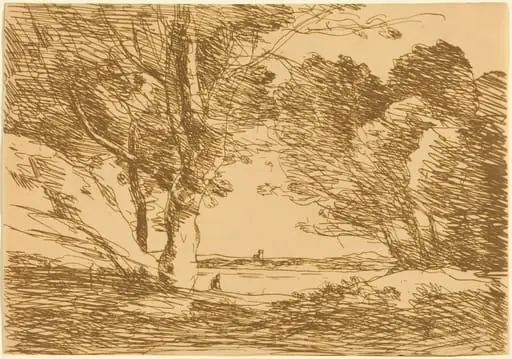 Tower on the Horizon of a Lake (Tour a l'horizon d'un lac)
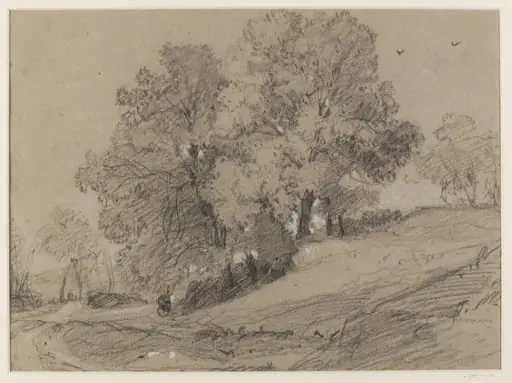 Untitled
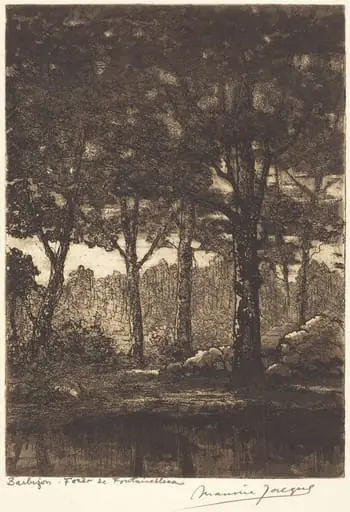 Barbizon: Foret de Fontainbleau
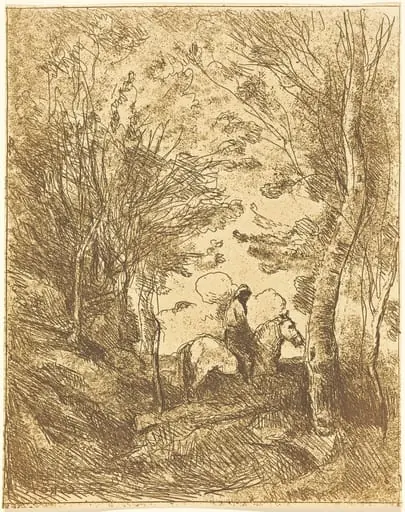 Horseman in the Woods, Large Plate (Le Grand Cavalier sous bois)
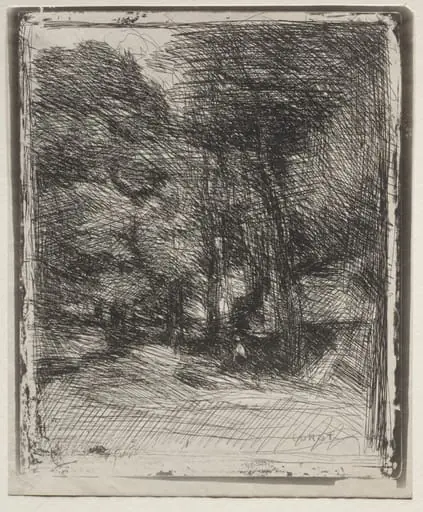 A Souvenir of the Bas-Bréau
 Banks of the Saint-Pre (Rive du Saint-Pre)
 The Philosophers' Retreat (Le Repos des Philosophes)