Artwork
Lutteurs
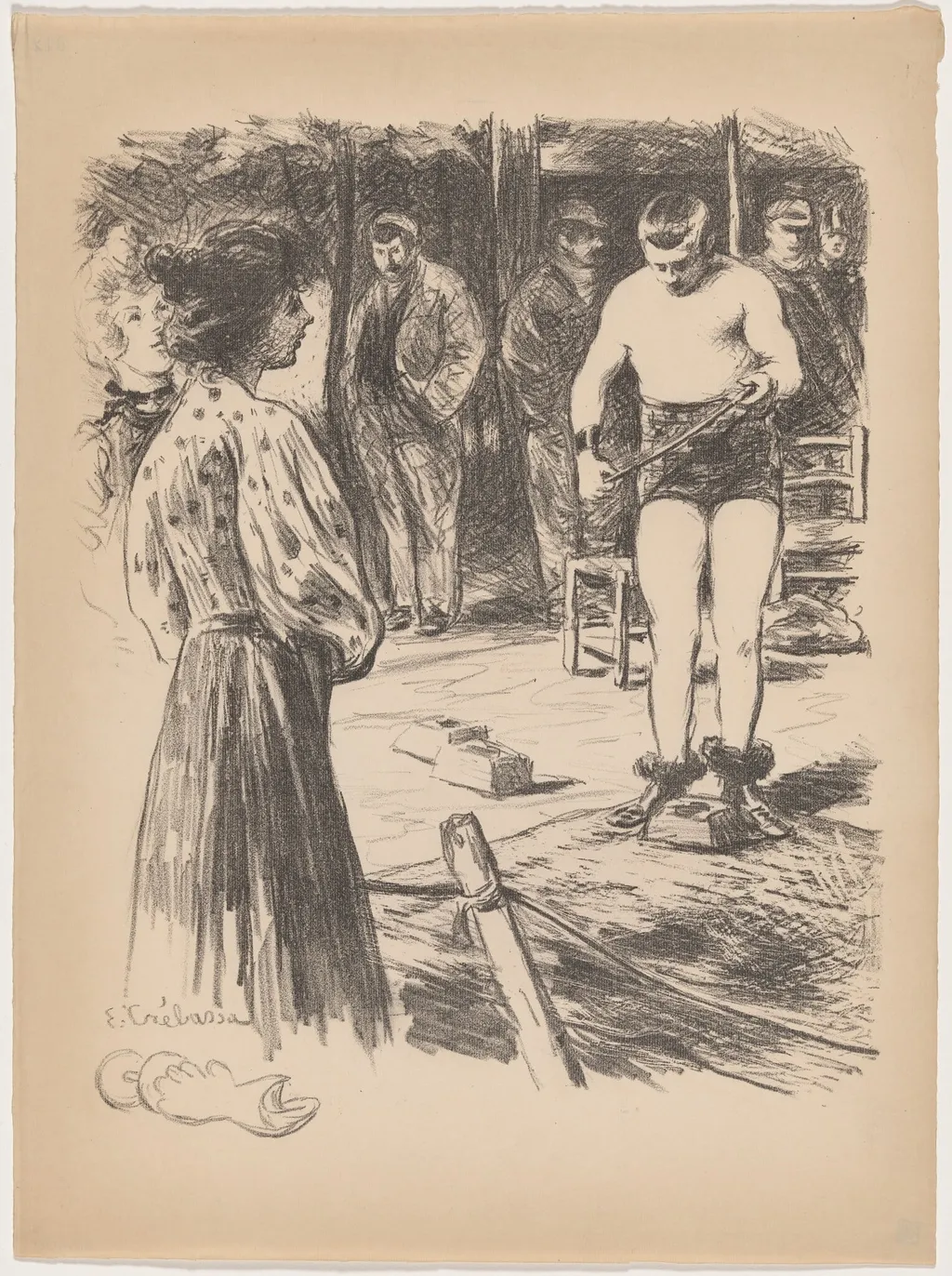
Lutteurs is an ink print by the Impressionist artist Paul Edouard Crébassa. It dates from 1895 and is held in the collection of the National Gallery of Art.
About this work
Overview
The work captures a quiet moment of physical contest among wrestlers in an unadorned interior.
Lutteurs is a black lithograph on Japan paper, executed by Paul Édouard Crébassa in 1895. It is part of the collection at the National Gallery of Art in Washington, D.C. The work captures a quiet moment of physical contest among wrestlers in an unadorned interior. Rendered with minimal detail and strong tonal contrasts, the image emphasizes movement and stillness within a confined space, reflecting the artist’s interest in human form and gesture.
Subject & Meaning
The scene portrays wrestlers in varied postures—some standing, others reclining or seated—suggesting a pause between bouts rather than active combat. Their simple clothing, ranging from loincloths to modest shirts and trousers, underscores a sense of everyday labor or training. The atmosphere is introspective, focusing on physical exertion and endurance rather than spectacle. The absence of spectators or decorative elements directs attention to the wrestlers’ bodies and their silent, concentrated presence.
Technique & Style
Crébassa employed lithography to achieve a range of gray tones through careful ink application on stone. The use of Japan paper, thin and absorbent, enhanced the ink’s depth and allowed subtle gradations of shadow. Lines are economical, with forms suggested rather than outlined, and the high contrast between black and white areas heightens the sense of volume and spatial recession. The technique favors atmosphere over detail, aligning with late 19th-century interest in expressive monochrome printmaking.
History & Provenance
Created in 1895, Lutteurs entered the National Gallery of Art’s collection through the A.W. Mellon Educational and Charitable Trust, a major benefactor of the museum’s early print holdings. Its acquisition reflects the institution’s commitment to documenting European graphic arts of the late 1800s. While Crébassa was not widely known, this work survives as a representative example of French lithographic practice focused on genre scenes during the period.
Context
In the 1890s, French artists increasingly turned to everyday life as subject matter, often depicting laborers, athletes, and rural pastimes. Lutteurs aligns with this trend, echoing the interest in physicality seen in works by Degas and Toulouse-Lautrec. Unlike theatrical depictions of sport, Crébassa’s approach is restrained, avoiding drama in favor of quiet observation. The lithograph reflects broader cultural fascination with the human body as both instrument and subject of discipline.
Legacy
Lutteurs remains a modest but significant example of French lithographic printmaking from the fin de siècle. Though Crébassa’s career was not widely documented, this work contributes to the understanding of how lesser-known artists engaged with contemporary themes of physicality and realism. Its preservation in a major public collection ensures continued access for study, offering insight into the quiet, observational side of 19th-century graphic art.
Own this work as a print
Artist & collection

 En soirée (At an Evening Party)
 Une saisie (A Seizure)
 Wedding at the Louvre
 Untitled
 Laboratoire
 Portrait of the Artist and His Model
 Di Ti Fellow - Englishmen at the Cafe-Concert (Di Ti Fellow - Anglaise au Café-Concert)
 Counted Out, second stone
 Rejane and Galipaux in "Madame Sans-Gêne" (Réjane et Galipaux dans "Madame Sans-Gêne")
 Scènes de moeurs: Voyez vous, c'te queuse de Pamela qui me cajole pendant toute la semaine pour que je la mene au bal...