Artwork
Bertoldino Whipping Himself to Kill Flies
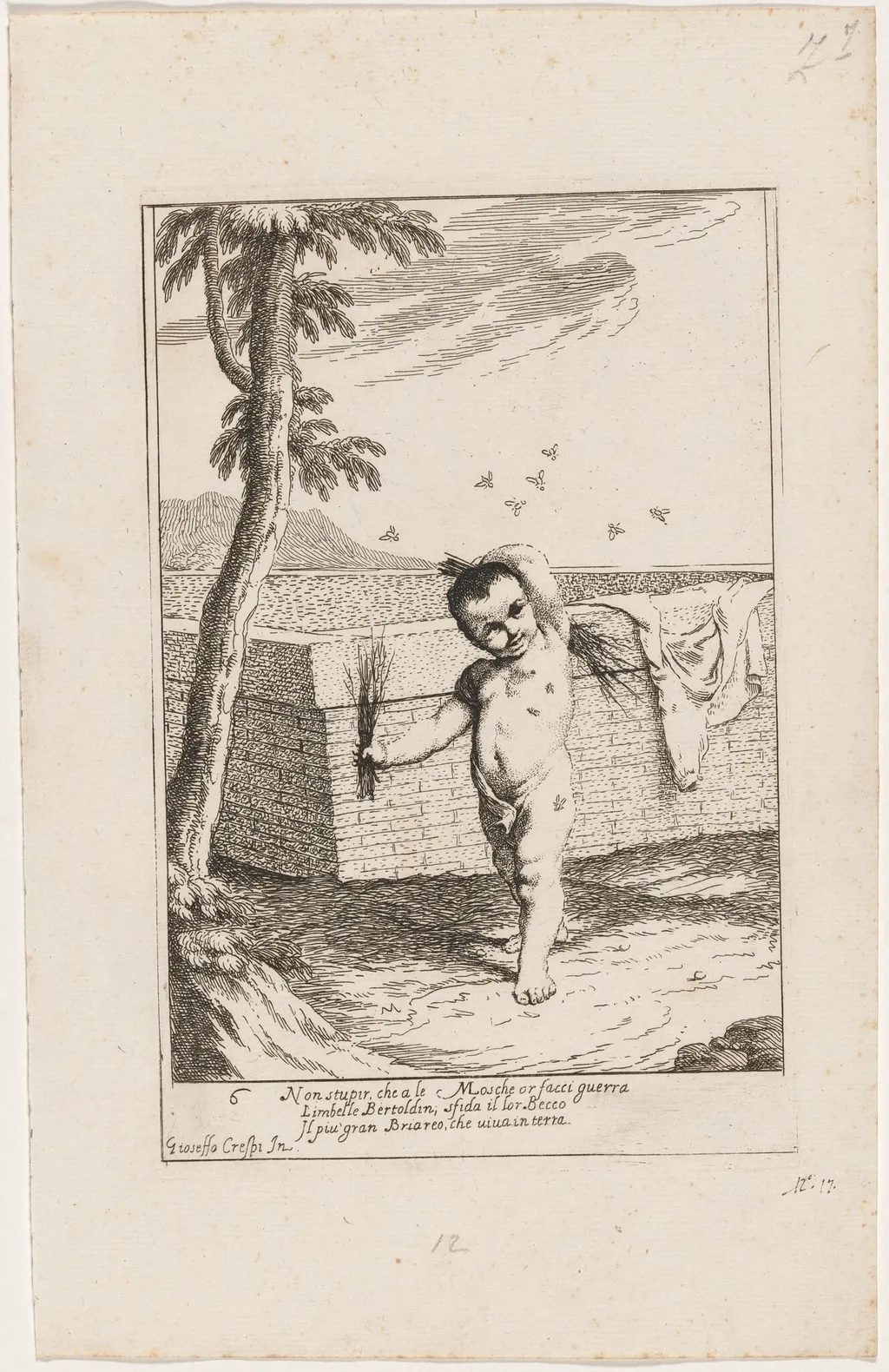
Bertoldino Whipping Himself to Kill Flies is an ink print by the Baroque artist Giuseppe Maria Crespi. It dates from 1712 and is held in the collection of the National Gallery of Art.
About this work
Overview
Giuseppe Maria Crespi, active in early 18th-century Bologna, produced this etching around 1712 as part of his exploration of secular, everyday moments.
Giuseppe Maria Crespi, active in early 18th-century Bologna, produced this etching around 1712 as part of his exploration of secular, everyday moments. Unlike his religious commissions, this work captures an eccentric, almost surreal scene involving a putto engaged in a peculiar self-directed act. Executed in etching and drypoint on laid paper, it reflects Crespi’s shift toward intimate, unconventional subjects in his later years.
Subject & Meaning
The image portrays a winged child, or putto, standing on a rocky ledge beside a palm tree, vigorously striking itself with a bundle of sticks. The action, ostensibly to kill flies, defies logical expectation, suggesting allegory or satire. The child’s strained expression and isolated setting imply a meditation on futility, obsession, or the absurdity of human-like rituals, rendered with a tone of quiet irony rather than humor.
Technique & Style
Crespi employed etching and drypoint to achieve fine, expressive lines that model the putto’s tense form and the textured rock surface. The delicate cross-hatching and varied line weight create subtle tonal gradations, enhancing the realism of the scene. The background, rendered with sparse, atmospheric strokes, suggests distance without detail, focusing attention on the figure’s peculiar motion and emotional intensity.
History & Provenance
The print entered the collection of the National Gallery of Art in Washington, D.C., where it remains today. While its early ownership is undocumented, its survival in good condition suggests it was valued by collectors interested in Crespi’s genre work. As a relatively small-scale print, it likely circulated among connoisseurs rather than the general public, reflecting its niche appeal.
Context
In early 18th-century Italy, religious and mythological themes dominated printmaking. Crespi’s choice to depict a whimsical, self-absorbed putto in a mundane, almost absurd act diverged from convention. His interest in ordinary life, influenced by Dutch genre painting and Bolognese realism, positioned him as an outlier among his contemporaries, prioritizing psychological nuance over idealized form.
Legacy
Though not widely reproduced or celebrated in its time, the etching has endured as a testament to Crespi’s willingness to explore the bizarre within the familiar. It contributes to modern understandings of Baroque art’s capacity for psychological depth and satirical observation, influencing later artists who sought to elevate the eccentricities of daily life through print.
Artist & collection

Artist
Giuseppe Maria Crespi (14 March 1665 – 16 July 1747), nicknamed Lo Spagnuolo ('The Spaniard'), was an Italian late Baroque painter of the Bolognese School.

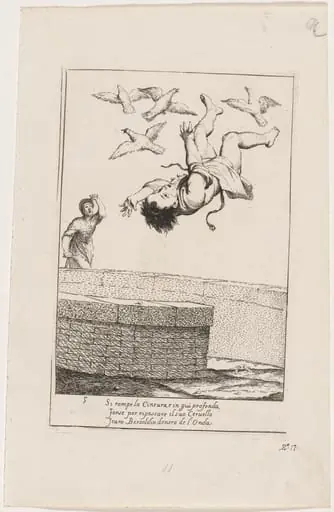 Bertoldino Falling into a Fish Pond
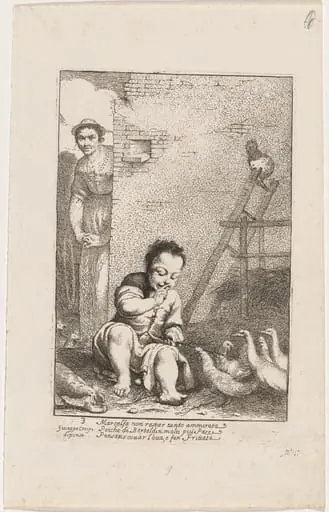 Marcolfa Sees Bertoldino Hatching Eggs
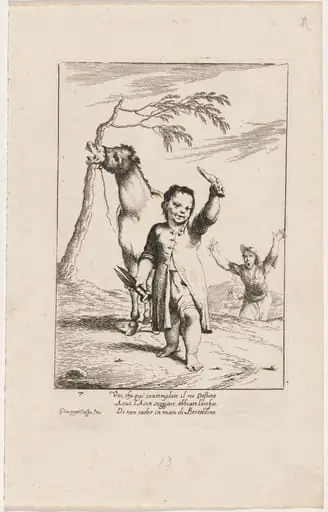 Bertoldino Cutting Off the Donkey's Ears
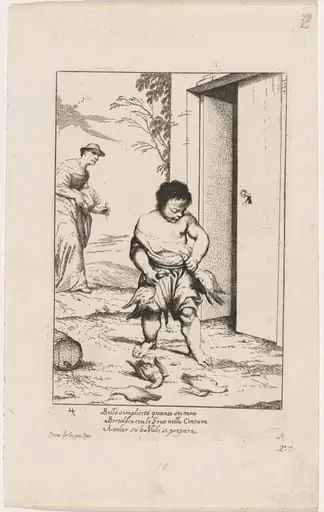 Bertoldino Fastening Geese to His Belt
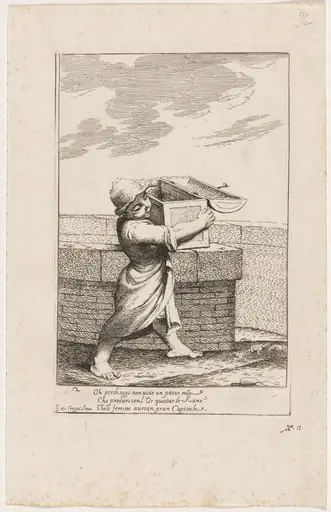 Bertoldino Enraged by the Croaking Frogs
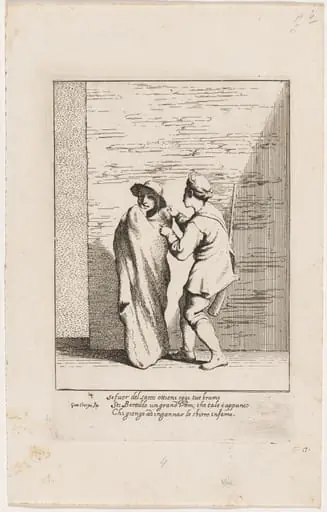 Bertoldo Stuffed in a Sack
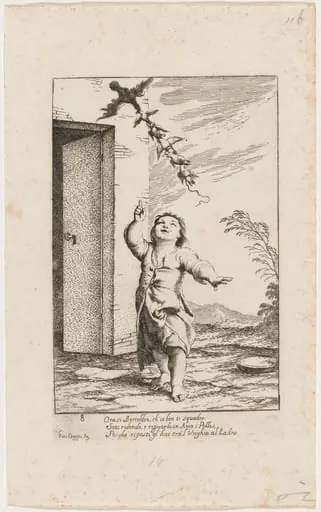 Bertoldino with the Birds Carried Away By the Kite
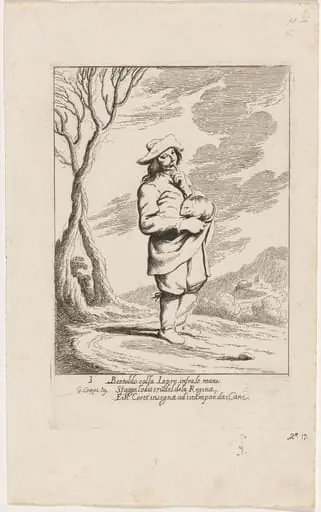 Bertoldo Holding a Hare
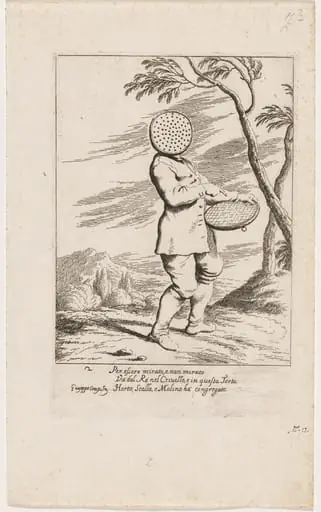 Bertoldo with a Sieve on His Head
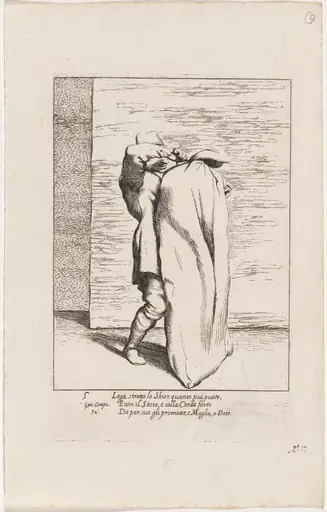 Bertoldo Placing the Jailer in the Sack
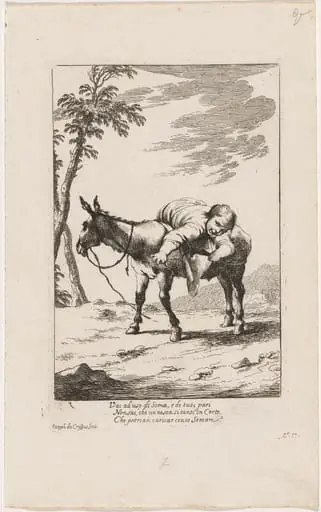 Bertoldino Lying on a Donkey