Artwork
Bertoldo Hiding in a Furnace
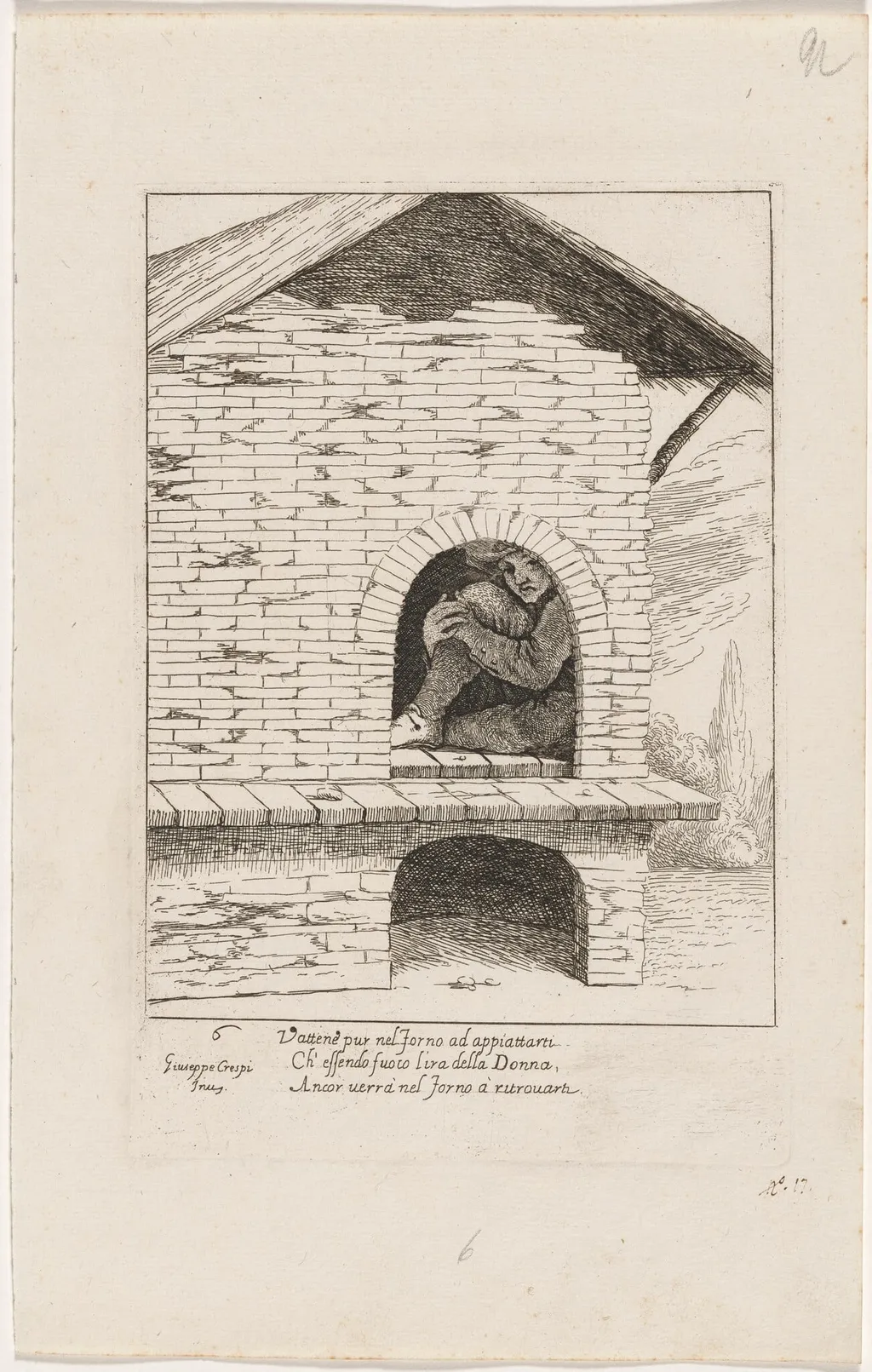
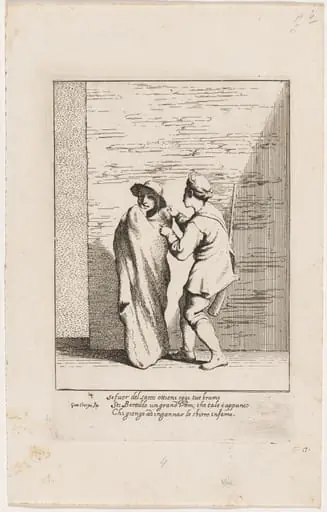
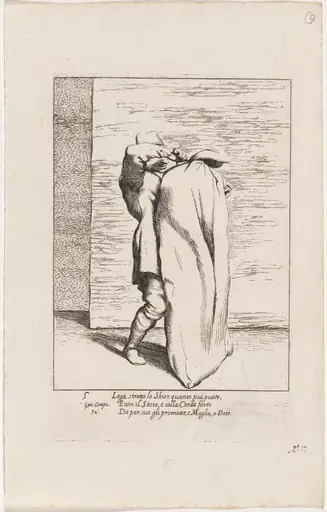
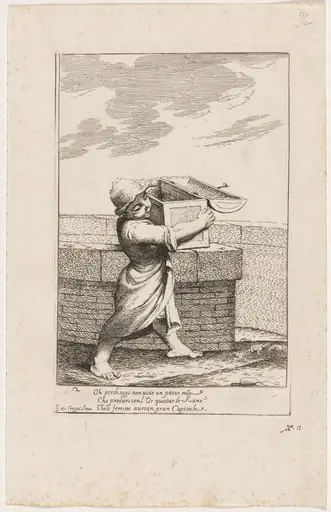
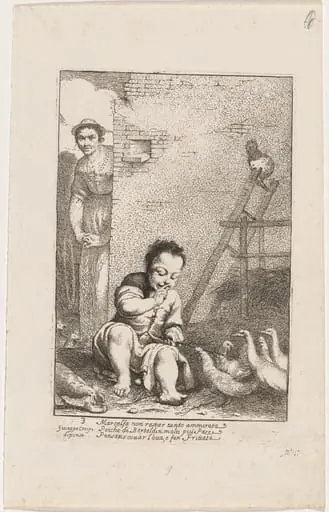
Bertoldo Hiding in a Furnace is an ink print by the Baroque artist Giuseppe Maria Crespi. It dates from 1712 and is held in the collection of the National Gallery of Art.
About this work
Overview
Giuseppe Maria Crespi, known as Lo Spagnuolo, produced this etching around 1712 in Bologna. Executed on laid paper, the work belongs to his extensive output of prints that explore everyday and narrative subjects. Unlike his painted genre scenes, this piece relies on the precision of line and tonal contrast inherent to etching, capturing a moment of quiet tension with minimal detail.
Subject & Meaning
The scene evokes vulnerability and secrecy, inviting interpretation as a moment of escape or punishment, though the exact narrative remains unconfirmed.
The image portrays a concealed figure nestled within a narrow opening in a weathered brick wall, suggesting concealment from an unseen threat. The title references Bertoldo, a figure from medieval Italian legend often depicted as a trickster or fugitive. The scene evokes vulnerability and secrecy, inviting interpretation as a moment of escape or punishment, though the exact narrative remains unconfirmed.
Technique & Style
Crespi employed etching to render texture with subtle gradations—rough bricks, fractured mortar, and sparse ground are suggested through fine, irregular lines. The hunched figure is rendered with compact, angular strokes that emphasize tension. The composition is tightly framed, focusing attention on the figure’s isolation. The absence of shading or tone beyond line work heightens the sense of austerity and immediacy.
History & Provenance
The print was made during Crespi’s mature period in Bologna, when he increasingly turned to printmaking alongside his painting. While no early ownership records are widely documented, the work aligns with his known interest in secular narratives and domestic intimacy. It likely circulated among collectors of Bolognese graphic art, valued for its narrative ambiguity and technical finesse.
Context
In early 18th-century Bologna, printmaking served as a medium for exploring informal and民间 themes, distinct from the grand religious or mythological subjects favored elsewhere. Crespi’s focus on marginalized figures and hidden moments reflected a broader shift toward realism. This etching fits within a tradition of Italian graphic art that privileged psychological nuance over theatricality.
Legacy
Though not widely reproduced, the etching exemplifies Crespi’s contribution to the evolution of narrative printmaking in Italy. Its understated emotion and attention to architectural decay influenced later artists interested in quiet, human-centered scenes. Today, it remains a quiet testament to his ability to convey complex stories through minimal means.
Artist & collection

Artist
Giuseppe Maria Crespi (14 March 1665 – 16 July 1747), nicknamed Lo Spagnuolo ('The Spaniard'), was an Italian late Baroque painter of the Bolognese School.