Artwork
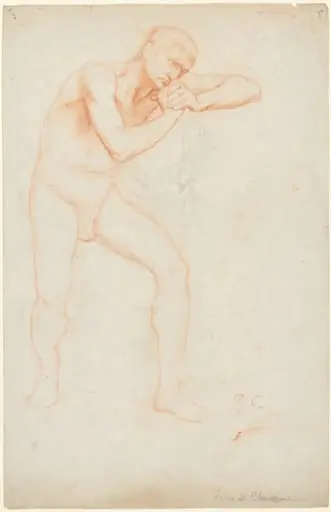
Male Nude Holding a Mirror [recto]
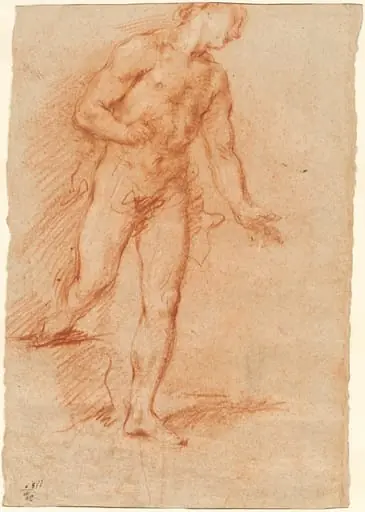
![Male Nude Holding a Mirror [recto], by Albrecht Dürer, ink, 1500](https://artifactworldgallery.com/img/albrecht-durer--male-nude-holding-a-mirror-recto--6c2ca7c869cbcffa-w1024.webp)
Male Nude Holding a Mirror [recto] is an ink drawing by the Northern Renaissance artist Albrecht Dürer. It dates from 1500 and is held in the collection of the National Gallery of Art.
About this work
Overview
This ink drawing by Albrecht Dürer, dated around 1500, depicts a standing male nude holding a mirror. Executed in pen and brown ink on laid paper, the sheet bears faint pricks and indentations, suggesting it may have served as a preparatory study. The figure is rendered with careful linear modulation, and the paper’s surface retains subtle traces of the artist’s working process.
Subject & Meaning
The pose and object suggest an introspective or self-reflective act, possibly tied to Renaissance ideals of human proportion and self-knowledge.
The figure stands in a relaxed contrapposto, gazing downward at the mirror he holds. The pose and object suggest an introspective or self-reflective act, possibly tied to Renaissance ideals of human proportion and self-knowledge. The mirror may reference classical themes of vanity or the pursuit of ideal form, though no explicit narrative is given—focus remains on anatomical study and visual inquiry.
Technique & Style
Dürer employed fine pen strokes and cross-hatching to model the body’s volume and surface texture. The lines vary in density to suggest light, shadow, and musculature, with minimal use of wash. The paper’s faint compass pricks and stylus indentations indicate the artist may have transferred or scaled the figure for further use, revealing his methodical approach to anatomical precision.
History & Provenance
The drawing has remained within institutional collections since at least the 19th century, with no documented private ownership prior. Its condition suggests careful preservation, and the physical marks on the paper align with known studio practices of Dürer’s Nuremberg workshop. Its function as a study, rather than a finished work, is supported by its modest scale and technical underpinnings.
Context
Created during Dürer’s second journey to Italy, this drawing reflects his deepening engagement with classical anatomy and Italian artistic principles. While not a direct copy of ancient sculpture, it demonstrates his effort to reconcile Northern European draftsmanship with the humanist ideals of proportion and balance emerging in Renaissance Italy.
Legacy
This drawing contributes to a broader corpus of Dürer’s anatomical studies, which influenced later Northern European artists in their pursuit of naturalistic representation. Though less known than his prints, such works reveal his systematic approach to the human form and his role in bridging artistic traditions across Europe during the early 16th century.
Artist & collection
Artist
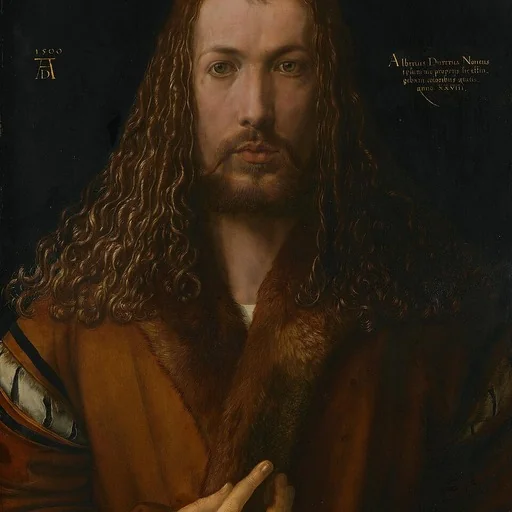
Albrecht Dürer spent his life in Nuremberg, a busy German city where artists traded prints like currency.

![Madonna and Child [obverse], by Albrecht Dürer](https://artifactworldgallery.com/img/albrecht-durer--madonna-and-child-obverse--d7b8ebf05d22ebe5-w320.webp)
![Lot and His Daughters [reverse], by Albrecht Dürer](https://artifactworldgallery.com/img/albrecht-durer--lot-and-his-daughters-reverse--b4ebf9b282faa17a-w320.webp)
![Male Nude [recto], by Michelangelo](https://artifactworldgallery.com/img/michelangelo--male-nude-recto--8c3354d89884753a-w320.webp)
![Male Nude [verso], by Michelangelo](https://artifactworldgallery.com/img/michelangelo--male-nude-verso--d48a81b2ad2bdbb8-w320.webp)