Artwork
Je ne puis en croire ma lorgnette ...
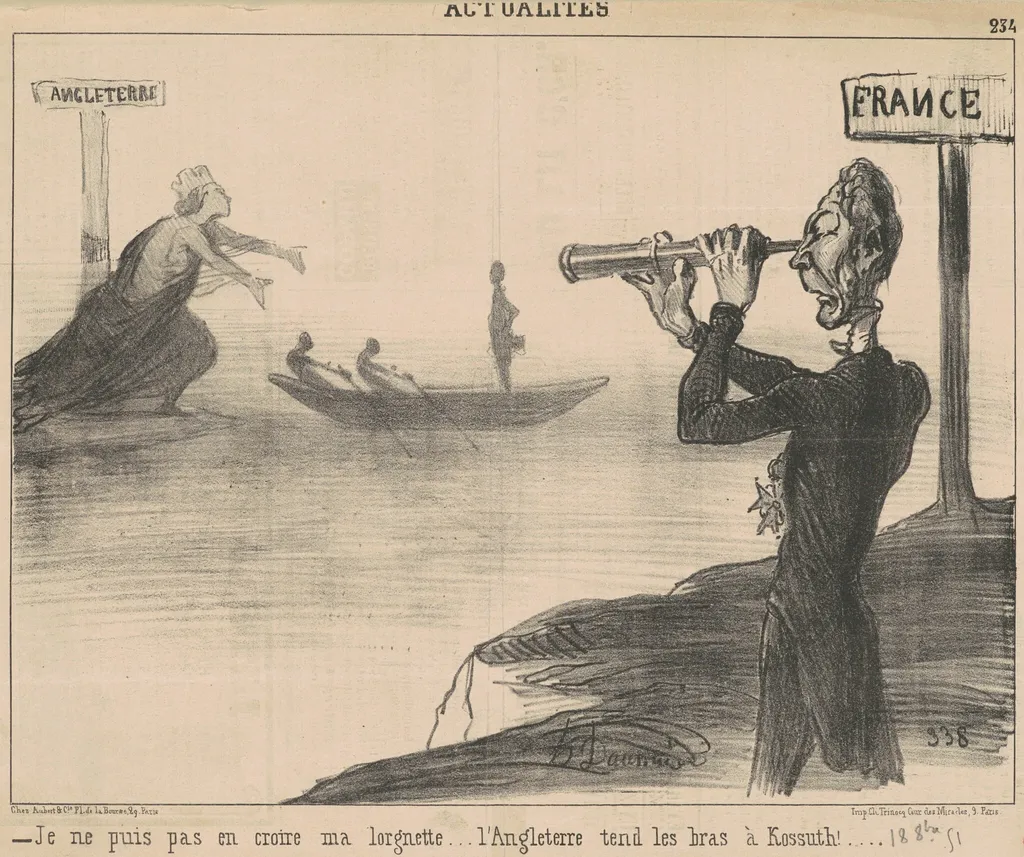
Je ne puis en croire ma lorgnette ... is an ink print by the Impressionist artist Honoré Daumier. It dates from 1851 and is held in the collection of the National Gallery of Art.
About this work
Overview
Honoré Daumier’s lithograph captures a moment of political spectacle, depicting Hungarian leader Louis Kossuth aboard a vessel while a French onlooker watches from the shore through a telescope. The composition is rendered in Daumier’s characteristic caricatural manner, emphasizing the contrast between the two figures and the water that separates them.
Subject & Meaning
The print juxtaposes Kossuth, a symbol of revolutionary fervor, with a French spectator whose astonished expression underscores the foreignness of the Hungarian cause to a French audience. The English Channel functions as a visual metaphor for the cultural and political distance between the two nations.
Technique & Style
Executed as a lithograph, the work employs the medium’s capacity for bold lines and tonal variation. Daumier’s use of exaggerated facial features and distorted proportions aligns with his broader caricature practice, employing visual distortion to convey satire and commentary.
History & Provenance
Created during the mid‑19th century, the image reflects contemporary French interest in Kossuth’s 1849 exile after the Hungarian Revolution. The lithograph was likely produced for circulation among the French public, capitalising on the topicality of Kossuth’s presence in Western Europe.
Context
At the time, the English Channel represented both a literal and figurative boundary between Britain, France, and the continent. Daumier’s choice to place Kossuth on a boat underscores the transnational movement of political refugees and the French public’s voyeuristic fascination with such events.
Artist & collection

Artist
Honoré-Victorin Daumier was a French painter, sculptor, and printmaker, whose many works offer commentary on the social and political life in France, from the Revolution of 1830 to the fall of the Second French Empire in 1870.