Artwork
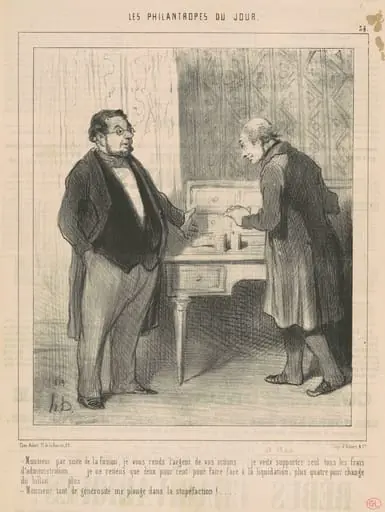
Monsieur, je souscris pour le temblement de terre ...
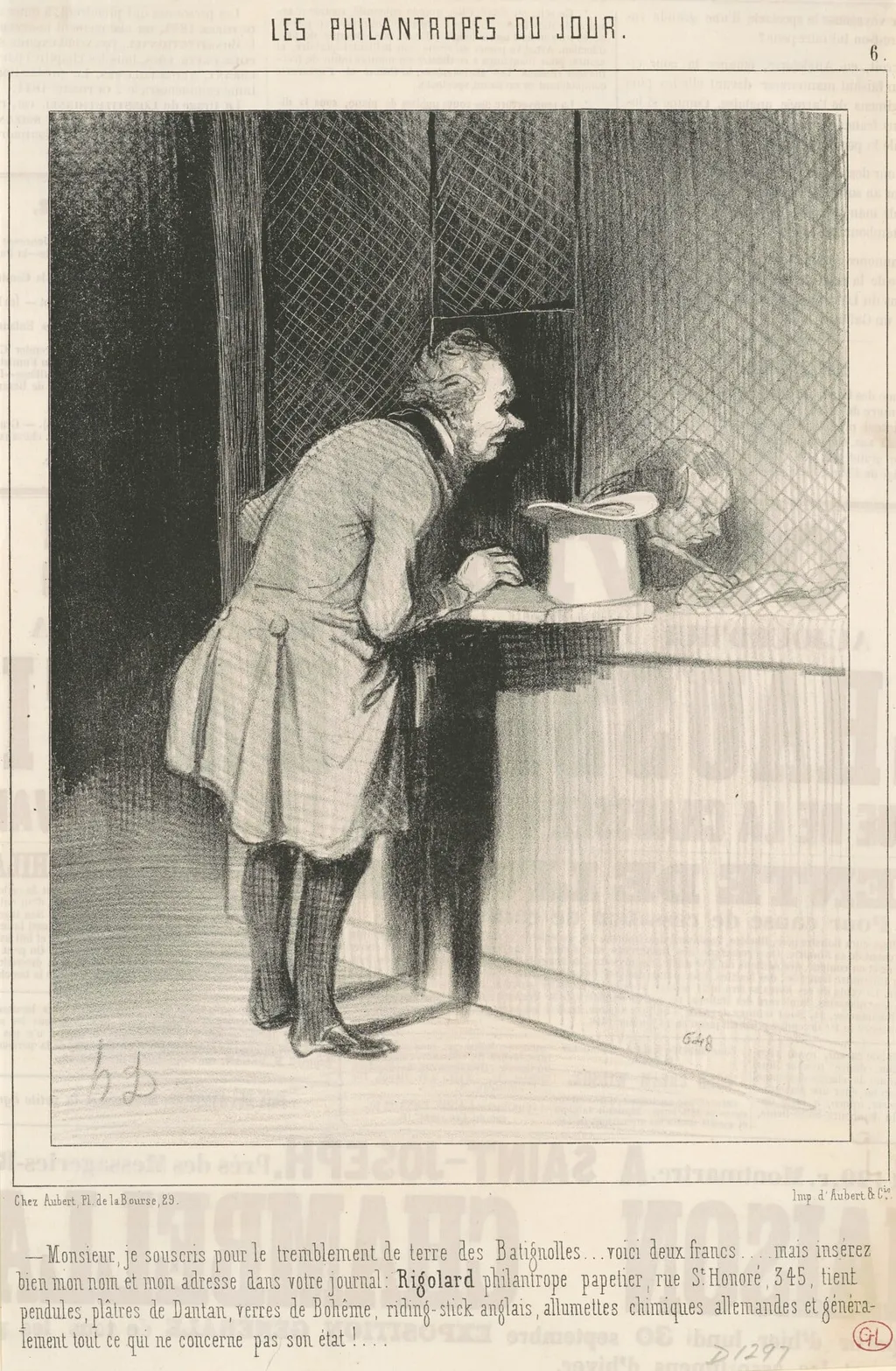
Monsieur, je souscris pour le temblement de terre ... is an ink print by the Romanticist artist Honoré Daumier. It dates from 1844 and is held in the collection of the National Gallery of Art.
About this work
Overview
The scene captures a routine moment of administrative formality, rendered with Daumier’s characteristic economy of line and subtle irony.
This 1844 lithograph by Honoré Daumier portrays a quiet, bureaucratic exchange between two men in an office. One signs a document while the other observes, separated by a grid-like barrier. The scene captures a routine moment of administrative formality, rendered with Daumier’s characteristic economy of line and subtle irony. It belongs to a series of works critiquing the French legal and financial systems of the July Monarchy.
Subject & Meaning
The image depicts a transaction of consent—likely a financial pledge or subscription—between a client and an official. The man signing appears passive, while the observer, possibly an agent or clerk, holds silent authority. Daumier highlights the asymmetry of power in civil transactions, suggesting how individuals are drawn into systems they do not fully control, masked by the veneer of procedure.
Technique & Style
Daumier employed lithography for its capacity to reproduce sharp, expressive lines quickly, suited to his journalistic output. Here, he uses minimal shading and stark contrasts to define figures and space. The partition’s grid becomes both a physical and symbolic barrier, reinforcing social division. His figures are simplified yet psychologically acute, conveying character through posture and gesture rather than detail.
History & Provenance
Created during Daumier’s prolific period contributing to the satirical journal Le Charivari, this print was part of a broader campaign targeting corruption and public gullibility in financial schemes. It was widely distributed as a broadsheet, reaching middle-class audiences. The work remained in private collections after Daumier’s death, later entering institutional holdings through acquisitions of his graphic oeuvre.
Context
In 1840s France, speculative investments and public subscriptions for dubious projects were common, often exploiting the poor and middle class. Daumier’s prints responded to this climate, exposing the rituals of consent that masked exploitation. His work intersected with rising public skepticism toward institutions, paralleling broader political unrest leading to the 1848 revolution.
Legacy
Daumier’s lithographs, including this one, helped redefine printmaking as a vehicle for social critique. His unembellished style influenced later realist and modernist artists, particularly those interested in the everyday mechanics of power. Though not widely exhibited in his lifetime, his graphic work gained recognition in the 20th century as foundational to political illustration and critical visual culture.
Artist & collection

Artist
Honoré-Victorin Daumier was a French painter, sculptor, and printmaker, whose many works offer commentary on the social and political life in France, from the Revolution of 1830 to the fall of the Second French Empire in 1870.