Artwork
Une séance du conseil des cinq
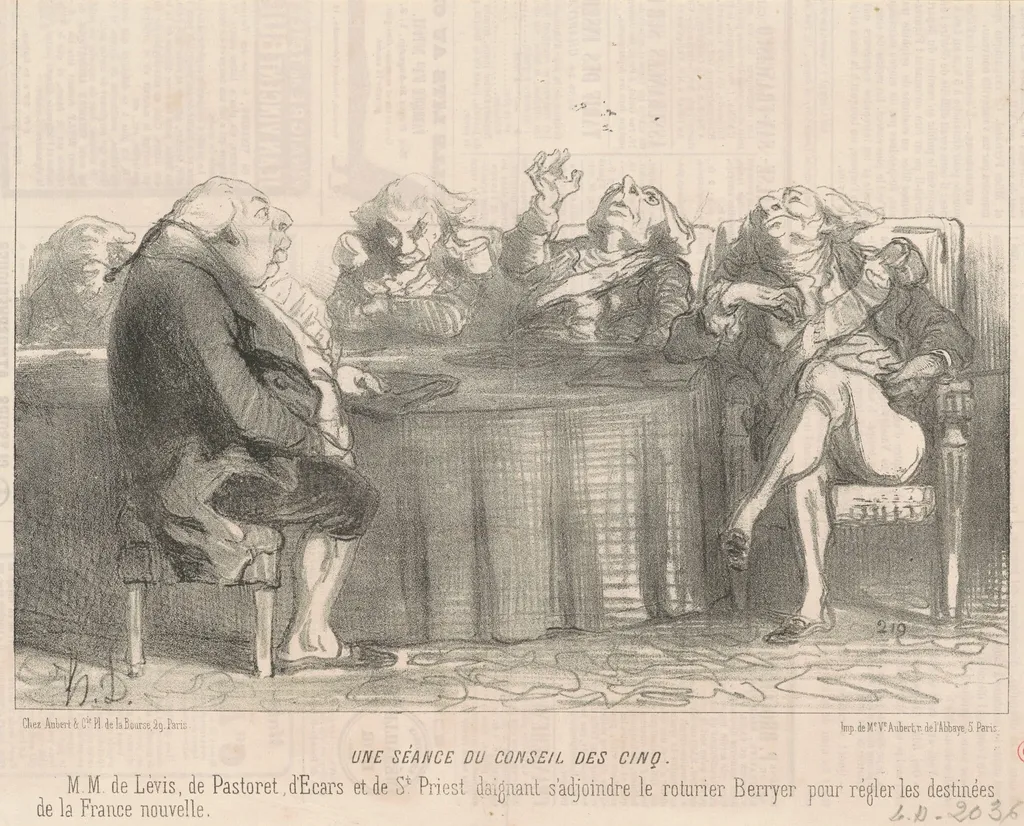
Une séance du conseil des cinq is an ink print by the Impressionist artist Honoré Daumier. It dates from 1850 and is held in the collection of the National Gallery of Art.
About this work
Overview
Honoré Daumier’s 1850 lithograph titled *Une séance du conseil des cinq* depicts a small gathering of five men seated around a table.
Honoré Daumier’s 1850 lithograph titled *Une séance du conseil des cinq* depicts a small gathering of five men seated around a table. The figures are rendered in formal dress that recalls late‑eighteenth‑century or early‑nineteenth‑century attire. The composition is uncluttered, with a plain backdrop that directs attention to the participants’ faces and gestures, emphasizing the seriousness of their exchange.
Subject & Meaning
The work presents a moment of political deliberation, the men appearing absorbed in a weighty discussion. Their posture and mutual gazes suggest a council or committee engaged in decision‑making, reflecting the broader importance of dialogue in governance. By isolating the group from any specific setting, Daumier underscores the universal character of civic debate.
Technique & Style
Executed as a lithograph, the image relies on bold line work and subtle tonal variations to model the figures. Daumier’s handling of light and shadow creates depth despite the flat background, while the careful rendering of clothing folds and facial expressions conveys individual character within the collective scene. The print’s crisp lines are typical of his socially observant oeuvre.
History & Provenance
Created in the middle of the nineteenth century, the lithograph was produced during a period when Daumier frequently addressed political subjects. While specific ownership records are limited, the print has been catalogued among his series of social commentary works and is held in several public collections that specialize in 19th‑century French graphic art.
Artist & collection

Artist
Honoré-Victorin Daumier was a French painter, sculptor, and printmaker, whose many works offer commentary on the social and political life in France, from the Revolution of 1830 to the fall of the Second French Empire in 1870.